
'Wuthering Heights' Review: Margot Robbie and Jacob Elordi Burn Bright in Emerald Fennell’s Worn Out Adaptation
Wuthering Heights is one of those antique pieces in the worn pages of a book from the Victorian age that ebb and flow in the likeness of today’s readers — be it a confused adaptation that Hollywood coughs up every few years, a drama on Broadway, or a release of a cheap copy as a loose, twisted adaptation. In today’s episode of top 10 Hollywood oopsies moments, Emerald Fennell’s newcomer undoubtedly checks off all the boxes. A grotesque, Saltburn-esque, half-butchered, overstimulating, deranged adaptation of classic literature’s finest work to exist begs some glaring dissection that follows here.
Yes, the movie does breeze through some solid A-game cinematography, editing, and original sound, but does it remotely satisfy the expectations of readers and even movie fans alike?
Wuthering Heights does decent as a standalone movie
ADVERTISEMENT
Article continues below this ad
Zooming out the filmography, even as a standalone movie, it starts out odd. In the very beginning, one starts to wonder about the necessity of many scenes. What did the hanging till death punishment, and the joy in it, stand for? No one knows. Given the interpretation that follows, one might see it as a visual trailer of the storm that's about to blow past the heights. Sufferance till death, monstrous joy in brutal pain, and everything that follows.
Needless to say, the visual representation of Wuthering Heights, the dark Yorkshire Moors, was definitely moving. On spot cinematography with the ensemble aceing their characters, the murky setting does serve the likeness of the audience. Mr. Earnshaw, played by Martin Clunes, the crude patriarch who is directly responsible for the atrocities at the Heights, successfully disgusts you with everything he does. There was consistency in that character. And probably the one thing he did for his daughter right by was getting a young, meek yet outrageous little Heathcliff home. Owen Cooper assures the future of acting is in safe hands.
The housemaid, Nelly, partly, though unintentionally, responsible for the misery of our protagonists, does play a pretty involved role too. Envious of young Catherine, who gets all busy naming, dressing, and playing with her new friend, Nelly still cares for her, but seems to misjudge the intensity and the depth of the bond that Catherine and Heathcliff share. The care is overwhelmingly overshadowed by the miseries it inflicts upon the pair in the near future.
Catherine and Heathcliff, on the other hand, partly unaware of their own feelings, keep driving through the Moors unless the Earnshaws have neighbours, laden with wealth, exactly at a time when the age-old inhabitants face their financial downfall. An eager, gorgeous and all grown up, Catherine, tired of battling poverty, fails to resist the temptation that comes with the Lintons. Margot Robbie’s naïve character throws herself to the bachelor owner of all this fresh wealth, Edgar Linton, with the sole purpose of the richness, She does accept his offer to marry, only to realise a night later that she has wronged herself.
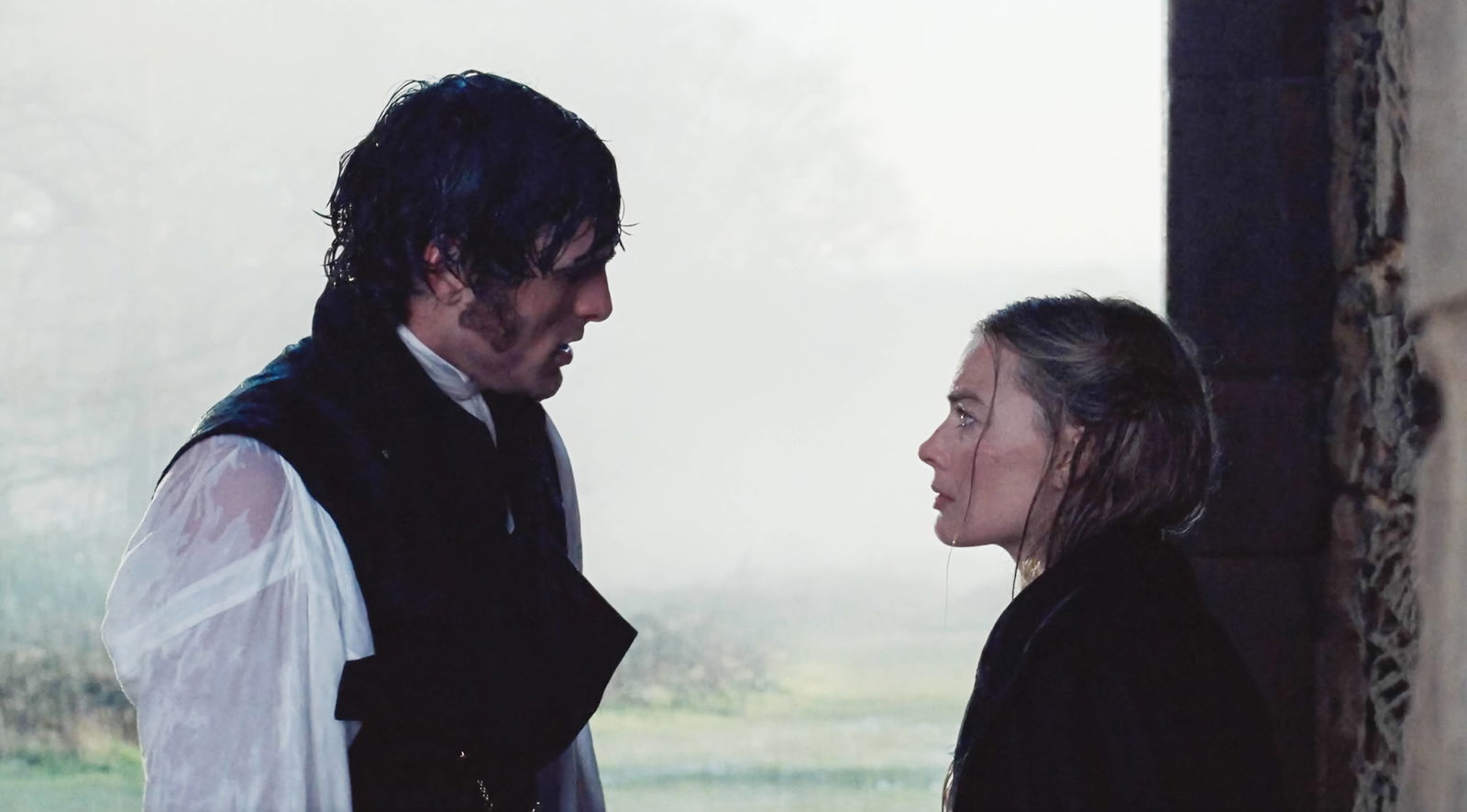
Alas, that was too late. Nelly’s deliberate attempt to part their ways, Jacob Elordi’s brooding Heathcliff's send off, and Catherine’s hopeless attempt to wait for her love to be back post a heartfelt confession, all build up to a point when her and Heathcliff are stretched the farthest apart. Years later, post an endless emptiness that engulfs Catherine, when she finally settles in, comes back the deranged hero, all transformed in ways and in looks, wealthy enough to buy the dilapidated Heights from a deteriorating owner, Mr Earnshaw.
The movie holds pretty well till this point. Proper storytelling, a flowy sequence with on spot acts. However, what follows dulls the masterpiece at once. Endless scenes of Catherine and Heathcliff consummating their love, devouring each other in extreme passion, do feel good for the few initial times, which stands for a respite after all these years of separation. But post a point, Emerald Fennell’s deliberate act to spice it up ultimately does wear it down.
Catherine’s secret is out there on the wild (she is pregnant) and Heathcliff wants to have peace once and for all. But to counter Mrs. Linton’s rigidity, he does the unthinkable for the same purpose of pursuing his one love. Marrying Isabella Linton into his madness, he unleashes his animalistic rage out, just to convince Cathy to end it. However, Nelly does play traitor again. Holding off all letters from Isabella and waiting on a terribly ill Catherine to pull herself up, she fails to understand she was actually killing them both.
Days pass, Heathcliff grows gruesome and Catherine turns pale, unless one day she loses her child in a painful miscarriage, in agony and sickness. Shortly after, Catherine Linton slips away. Edgar fails to save her, and upon Heathcliff’s arrival, gives up to their boundless love. Conflicted, hurt, and whimpering like a wounded dog, Heathcliff takes shelter in the dead body of his life’s purpose and passes out as the madness within Thrushcross Grange comes to a devastating end.

It’s gut-wrenching at the point where the movie leaves you to just deal with the heartbreak. However, as fresh viewers must have ended up in tears, the bookworms with previous knowledge might have too, but for other reasons. The movie betrays the source material from the very beginning to the end. No Mr. Lockwood appears to spend some time over to listen to the stories of Wuthering Heights; there is no Gothic element present, which was a true catalyst in the intensity that the 1847 masterpiece carried.
All the ways the movie butchered the book
The few heartfelt dialogues that are the heart and soul of the movie do stay intact, but a lot falls out. Especially in the second half of the movie, which is not even there, and the main treacherous ending that the book boasted, is nowhere to be found. The miscarriage that Catherine suffers through is in complete misalignment with the book. She does deliver a young Cathy, who later becomes the subject of Heathcliff’s wrath after Catherine passes away.
A young Heathcliff, Linton, Heathcliff’s meek son, also comes up later in the story, where they are both married by the violent force that Heathcliff becomes. He also slips away in sickness, and what is left is Catherine’s sole remnant as her daughter, who is now winding up with the dying protagonist of the novel. A lot of these go down the lane.
One of the most crucial, horrifying moments in Wuthering Heights, the kind of scene that makes the novel as treacherous and unsettling as it is.
In one of the later chapters, Heathcliff tells Nelly that he had Catherine’s grave opened. Not once in a fit of madness, but years after her death, when Edgar Linton is being buried. He bribes the sexton to lift the lid of Catherine’s coffin so he can see her face again. What makes it worse is not that he finds bones. He describes her face as if time had barely touched her. He does not literally embrace a skeleton, but the emotional equivalent is there. This is not mourning, it is possession beyond death.
He even instructs that when he dies, the sides of his coffin and Catherine’s be removed so that their dust can mingle. Even in death, he does not want separation. This is also the exact moment that strips away any romantic illusion about Heathcliff. It shows the extremity of his attachment, turning love into something gothic, morbid, almost violent against nature itself.
ADVERTISEMENT
Article continues below this ad
It is scenes like this that make the book so treacherous; that love is not always tender. It is consuming. It refuses boundaries, even the boundary of the grave.
The movie at 64% IMDb, with a solid 71% Rotten Tomatoes rating, tried to replicate the same in the last moments where Heathcliff goes on to kiss the body of Catherine after she is gone. Not once, twice, but goes on to kiss several times before he rests next to her after the whirlwind settles. As moving as it was, it fails to come at par with the intensity that the book holds. Leave alone coming at par, it doesn’t even come close.
ADVERTISEMENT
Article continues below this ad
What is your opinion of the 2026 reimagining of Wuthering Heights? Let us know in the comments below.
ADVERTISEMENT

Edited By: Itti Mahajan
More from Netflix Junkie on Hollywood News


ADVERTISEMENT