
EXCLUSIVE: Oscar-Nominated ‘Two People Exchanging Saliva’ Directors Explain How Absurd Humor and Authoritarian Politics Collide in Their Provocative Film
Alexandra de Saint Blanquat
Alexandra de Saint Blanquat
Short films often prove that storytelling does not depend on duration, but on the way a story is told. In a limited runtime, they challenge ideas, provoke emotions, and leave audiences thinking long after the credits roll. That is exactly what makes Two People Exchanging Saliva such a striking cinematic experience.
Mixing absurd humor with unsettling political commentary, the 36-minute film imagines a world where intimacy is forbidden. Sounds bizarre, right? But that is the primary reason why this film manages to form a deep connection with viewers, and ultimately earned an Academy Award nomination for Best Live-Action Short Film.
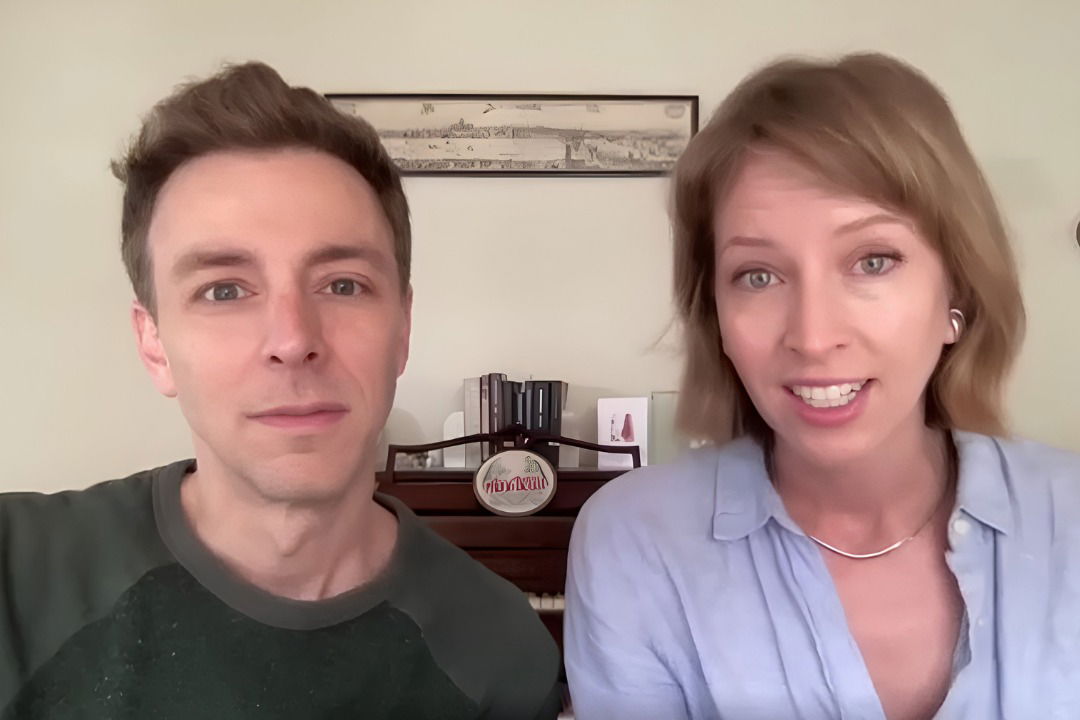
Netflix Junkie sat with directors Natalie Mustaeta and Alexandre Singh to discuss the film's surreal political logic, crafting its voyeuristic style, and balancing satire with emotional truth. While opening about their film, the duo gives rare insight into one of this year's most daring and thought-provoking films.
ADVERTISEMENT
Article continues below this ad
Aayush Sharma: Your world treats intimacy as criminal and violence as currency. At what point did you realize this wasn’t just satire but a fully functioning political system, and how did you map its internal logic so audiences subconsciously believe it?
Alexandre Singh: That is such an interesting and good question.
Natalie Musteata: I think it was really early, because we were always inspired by what was happening in the real world. The absurdity came from the fact that we are living in very absurd times. It became a playful way for us to mirror and reflect what’s happening right now in the world and the autocracies around the world. So we were always thinking about it in quite serious terms. At the same time, it’s also in our nature to subvert. When you work on something for a very long time, it’s hard not to bring in a bit of humour, because it’s difficult to stay in a sad place all the time. I also think we’re living in a moment where the ridiculous and the horrific exist side by side. It almost feels hard to satirise the contemporary moment, because everything already feels so heightened, absurd, and ridiculous.
Credits: Netflix Junkie
Credits: Netflix Junkie
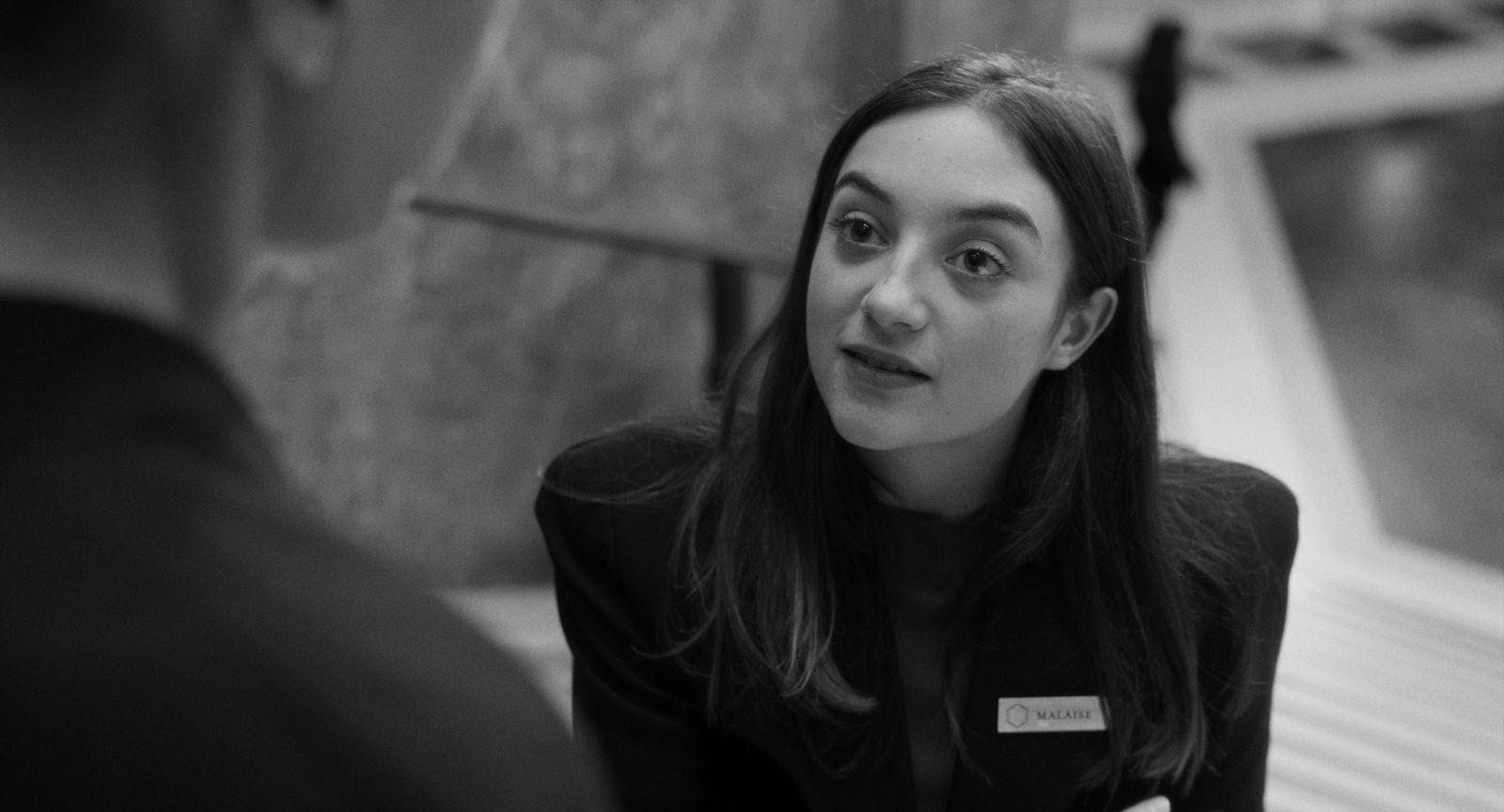
Alexandre: And irrational. I think that’s one of the defining aspects of ideological and religious systems when they become fervent — and often extreme — they can become filled with hate, because hate is not really rational. If you really break it down, it’s like a drunk person coming out of a bar looking for a fight, saying, “I don’t like your face.” Essentially, that is what much of animosity becomes: I don’t like your face because of the colour of your skin, your religion, your political system, or simply because I have decided I do not like you. It is not rational. Not that love is rational either, but it belongs to a different space. That’s why we speak of faith and love as acts of giving. It is funny that they are flip sides of irrationality. So it is interesting in a film that treats hate as an absurdity, to also counterpoint it with the irrational love of the characters, the character of Malaise, who's young and playful, and encounters Angine at the very beginning of the film, and pretends that they're already friends. Everything that she's doing is very dangerous in her society.
Aayush Sharma: The camera often observes characters as if they are already being watched. Were you intentionally designing framing to mimic surveillance optics rather than classical cinematic coverage?
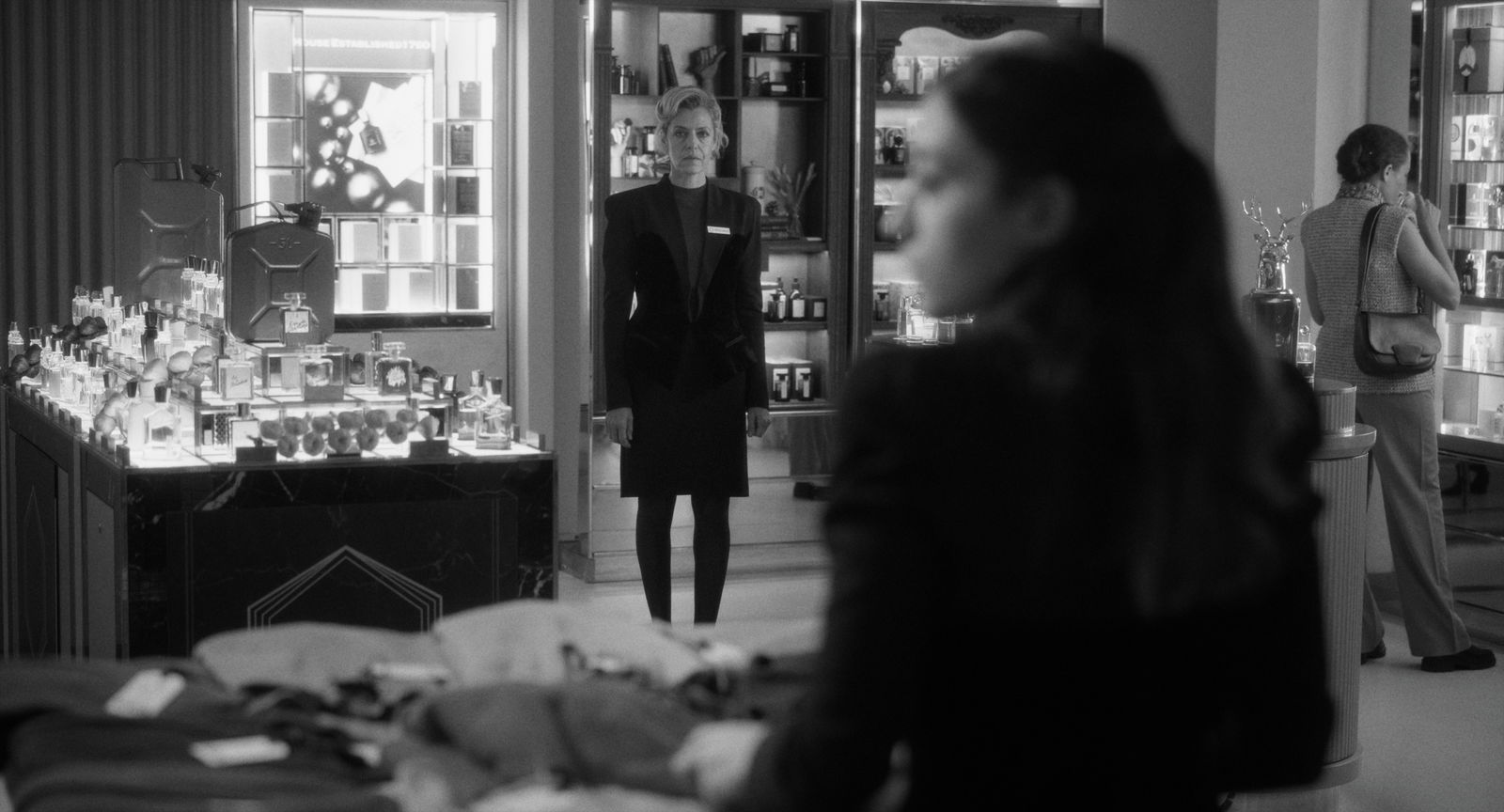
Alexandre: Well, I think when we were in the store, we were both thinking about how there are so many mirrors in department stores, because everyone is constantly looking at themselves. When you shoot into a mirror, it immediately doubles the distance. You get a sense of a foreground — what you are directly seeing — and then a deep focus made up of what’s being reflected. So you immediately start thinking about the feeling of being looked at.
Natalie: I mean, it's already a place of voyeurism. But this way, by shooting through mirrors, we thought about it like surveillance. And so that was always something that we were sort of trying to infuse each image with.
Alexandre: Yeah, I would also say that when you watch a character looking at themselves in a mirror, they’re often unaware of what’s happening around them. They’re absorbed in their own image. That makes them feel vulnerable, as if they’re not fully present in the moment. I think that adds to the unease. We approached it in two ways — sometimes we shoot through a mirror, which creates a voyeuristic feeling, and other times we simply observe.
Natalie: You know, the story follows three women from three different generations, each responding to the absurd rules of their world in very different ways. Part of what we were thinking about was not only contemporary society but also how history tends to repeat itself. My family comes from communist Romania, and they fled to France in exile. During the years of Ceaușescu, one in three people was an informant. So when you’re telling a story about three characters, it almost feels inevitable that one of them might betray another — or even both. That idea comes from a world where you don’t know whether you can trust your neighbor. There is a scene in the film set in a corridor where Miles is coming home and discovers that two of her neighbors have been taken away. She’s then confronted, in a very uncomfortable way, by one of her neighbors, who is quite unpleasant.
Aayush Sharma: You have used digital scanning and extensive pre-visualization tools before production, which suggests a highly controlled visual blueprint. I’m curious how that level of technological precision translated once you arrived on set.
Did it actually create a sense of freedom for the actors and camera to discover unexpected moments within a secure framework, or was there ever a concern that such meticulous planning might pre-determine performance rhythms and limit organic spontaneity?
Natalie: For us, it was hugely helpful. We didn’t go to film school and had very little experience on set. We were also shooting in the middle of the night — between midnight and 6 a.m. — so we were tired and didn’t have any margins or time to lose. Because of that, we came very prepared, while always knowing that the preparation could be left at the door if necessary. It was there as a backup plan. More than 60% of the film ended up being a one-to-one replica of what we had planned. We even created a 3D animation of the film beforehand, though we still deviated from it at times. A lot of the film is handheld, and you can’t really plan handheld shooting precisely. You might know where you begin and which character you’re following, but the real energy comes from discovering it on set. So we allowed ourselves the freedom to move away from the plan when needed, but having that safety net was incredibly important — especially because there were two of us, and we needed to agree on arriving on set.
With the actors, we didn’t show them the previs. Instead, we had broad conversations about where their characters were in the story, what they were feeling, and what each scene was about. They’re professionals, so they understood where the camera was, but much of their movement came from what felt organic in the moment.
Alexandra de Saint Blanquat
Alexandra de Saint Blanquat
Aayush Sharma: Slapping becomes strangely sensual and economic at the same time. How did you direct actors to perform violence without playing it as aggression, almost as a social ritual instead of conflict? And because intimacy is forbidden, every glance carries narrative weight. Did you rehearse micro-gestures more rigorously than dialogue?
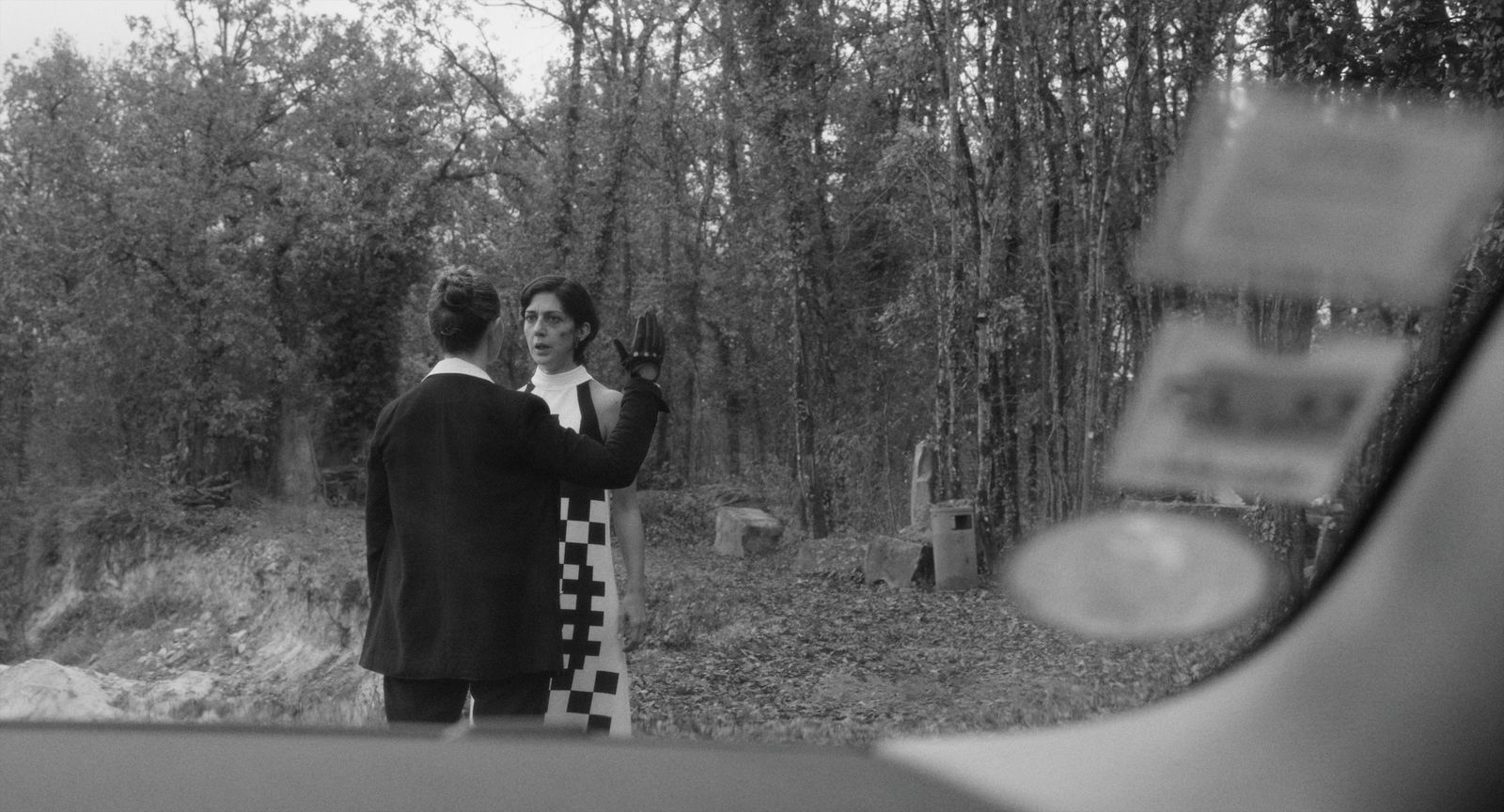
Natalie: We did not. The slapping itself is very technical; there are no real slaps. We had a stunt coordinator guiding us, because from certain angles, a fake slap simply does not work.
Alexandre: But you are still directing the actors in terms of what the character is feeling. So you’re right — at the very beginning of the film, we talked about slapping as something boring. It’s just how you pay for things. It takes time; you have to stand there, be solemn, and accept it. And that’s what it is for the characters at the start. But once yearning and romance begin to emerge, it becomes an excuse to touch, to feel, and to genuinely connect. There is definitely, I think, for Angine, a masochistic and erotic pleasure in being slapped; it’s something that awakens her.
Natalie: That was something we talked about a lot, but it was not something we rehearsed. We were working with such talented actresses that, after several discussions, they really understood what the story was. So we discovered it together on set.
Alexandre: That’s funny. Once you move into shots where you are framing the actor from the forehead to the chin, and the scene is really unfolding in that space, it is not something you should even try to rehearse. It needs to come from the spontaneity and energy of the actual take. You have to be very present in that moment. Rehearsal is more useful for figuring out practical things, where someone stands, where to put the bag down, and whether there’s enough time to get back for a line. That way, you’re not working out mechanical details while you’re on set.
Natalie: In terms of the slapping itself, I mean, we really love the idea of taking something that is a negative in this world and making it a positive, that the idea that they're sort of co-opting and subverting this violent act into something beautiful, and the way throughout history we have done that, you know. So, yeah.
Aayush Sharma: Your film’s rigid social rules immediately evoke the behavioral systems seen in the cinema of Yorgos Lanthimos, where characters obey irrational structures with total sincerity. Were you interested in exploring how ideology becomes invisible precisely when it feels normalized within performance?
Natalie: Absolutely. I mean, we are thinking a lot about the way that, as a mode of survival, we become accustomed to quite absurd things very quickly. And we don't even see the absurdity of them, of our social structures, for instance.
Alexandre: For example, there is an Iranian filmmaker, Maryam Tafakory, who made a film called Irani Bag, which uses archival footage from Iranian films spanning the 1960s to the present day. It explores how, in Iranian cinema, men and women cannot physically touch on screen. Because of that, there always has to be something placed between them. The handbag often becomes that object. You might see a scene where a couple is arguing while both hold onto the same handbag, pulling it back and forth, touching it at the center, as if that shared contact replaces physical touch. It is all very coded, and over time, it has become part of the language of Iranian cinema, much like how social habits and rituals can shape and even distort human behavior in any society, including our own.
When you mentioned Yorgos Lanthimos, he’s certainly a filmmaker we really admire. But we were also thinking about Buñuel’s films, especially The Phantom of Liberty. There’s a very funny scene in which people attend a dinner party but sit on toilets, because in that society, excretion is public, while eating is treated as something shameful and done privately. Buñuel was brilliant at flipping what we consider normal behavior and exposing its irrationality.
Alexandra de Saint Blanquat
Alexandra de Saint Blanquat
Aayush Sharma: The film compresses an entire political system into a short runtime. What narrative information did you deliberately withhold, trusting audiences to construct meaning themselves?
Natalie: We withheld a lot, partly because we didn’t want heavy exposition. We trust that audiences are very intelligent. Of all art forms, filmmaking is something people begin learning very early in life, because even as children, we grow up watching films. So the audience is already very perceptive.
Alexandre: And they know when something is a flashback, a dream sequence, or a flash-forward. They understand what a narrator is, and they can tell when a narrator is part of the story and when they are not.
Natalie: We really adhered to the principle of “show, don’t tell.” Especially in the first 10–15 minutes of the film, we’re leaving breadcrumbs and slowly revealing what it means to live in this absurd world. Hopefully, the audience is following along, but I’ve never come across anyone who reached a point where they didn’t understand what was happening. And just in case, we do spell certain things out in the dinner scene.
Aayush Sharma: The humor feels unsettling because it never signals when to laugh, closer to absurdist cinema than satire. Do you see comedy here as destabilization rather than relief, similar to how surrealism disrupts logical spectatorship?
Alexandre: Wow, that is a very deep question.
Natalie: It is nervous laughter because I think a lot of it comes from the sort of realization of what it is saying about our world.
Alexandre: There is also a tension — something we have never really talked about — between the form of the film and its humor. The fact that it’s French, shot in black and white, and uses the austere vocabulary of a certain kind of auteur filmmaking makes the humor feel more like a counterpoint. It would feel very different if it were shot in color and had a more openly joyous tone. Does that make sense? Your point about surrealism is also quite interesting. I’ve never really considered the difference in humor within surrealist work. It does feel more provocative and destabilizing, doesn’t it?
Natalie: Yeah. I think it also goes back to what we were saying earlier. And also something true about life in general. We often try to pigeonhole films into a particular genre and say, like, this film is a comedy, and this film is a drama, and this film is a thriller. Really, that's not true to our lived experience.
Alexandre: Except in Korea. (laughs) This is a romantic comedy, and it is a horror film, and it is funny and moving.
Natalie: There was a moment during the film when we realized we were almost making a Korean film, and we thought, this is actually the closest tonal comparison. But in life, even when we experience something horrific, everything else doesn’t disappear. There is still beauty, comedy, and many other emotions woven into daily experience. To look at the world through only one lens feels untrue.
Aayush Sharma: The film’s tone oscillates between deadpan comedy and existential dread, recalling European absurdism. Were literary influences — Kafka or Ionesco — part of the conceptual conversation during writing?
Natalie: I think many of those literary references live inside us. We were not consciously thinking about them that much, because much of the idea was inspired by news stories — stories filtered through our own imaginations. But Ionesco, of course, is foundational to the Theatre of the Absurd. He’s a Romanian playwright I read when I was very young, and I still think about his play Rhinoceros all the time.
Alexandre: Mikhail Bulgakov is someone we think about a lot. His work blends imagination, joy, humor, and surrealism with deeply profound meditations on authoritarianism and the crushing of the human spirit.
Aayush Sharma: Since you mentioned that you’re now developing a feature-length film built around this theme and premise, what stage is the project currently in? Are you already in production, or are you still in the development phase and working toward a filming start date?
Natalie: Well, we started writing exactly a year ago, in February 2025, and we got pretty far along in the script until all of this [Oscar nomination] started happening.
ADVERTISEMENT
Article continues below this ad
Alexandre: We initially thought we would campaign for a couple of months, and once we didn’t make the shortlist, we’d start writing. Then we made the shortlist. So we said, we’ll continue until the nominations, and then we’ll begin writing. But once we reached the nominations, the timeline shifted again, and the process has been pushed forward a little.
Natalie: So it has been delayed just a little. But we’re really looking forward to the week after March 15th — once we’ve caught up on sleep and cleaned the house — and getting back to writing. The plan now is to shoot in 2027. We’re moving steadily toward that date. At the moment, it’s a very unusual and privileged position to be in, with many open doors and possibilities. It’s really about deciding what the right version of the future looks like for us. But we can’t wait — we’re excited to be back in the writer’s room and to start being creative again.
ADVERTISEMENT
Article continues below this ad
Did you watch Two People Exchanging Saliva yet? Let us know your thoughts.
ADVERTISEMENT

Edited By: Adiba Nizami
ADVERTISEMENT
ADVERTISEMENT
