
‘Vladimir’ Review: Seduction, Scandal, and the Perils of Being the Narrator of Your Own Life
Credit: Shane Mahood/Netflix
Credit: Shane Mahood/Netflix
It will not be incorrect to say that desire in us rarely disappears. Just like water, it changes shapes, quietly retreating into the background, until something or someone stirs it awake again. For some, it resurfaces as nostalgia; for others, as regret. And sometimes, it returns as obsession, arriving with the unsettling realization that the life one has carefully built might not be enough anymore.
Academic spaces have long thrived on a particular illusion: that intellect can discipline impulse, that reason can tame longing. But beneath the polite rituals of seminars, faculty meetings, and literary debates, the same messy human instincts persist—ambition, jealousy, vanity, and desire. When those forces collide, the result is rarely tidy.
It is precisely this uneasy terrain that Julia May Jonas explored in her 2022 novel Vladimir, a sharp, provocative story about a literature professor whose carefully constructed life begins to fracture when scandal, obsession, and self-delusion collide. And now, Netflix’s adaptation leans into that same tension, turning a seemingly contained academic drama into something far more unsettling: a darkly funny, psychologically probing look at desire, power, and the stories people tell themselves to remain the protagonists of their own lives.
Vladimir: A Seductive Study of Desire, Power, and Academia
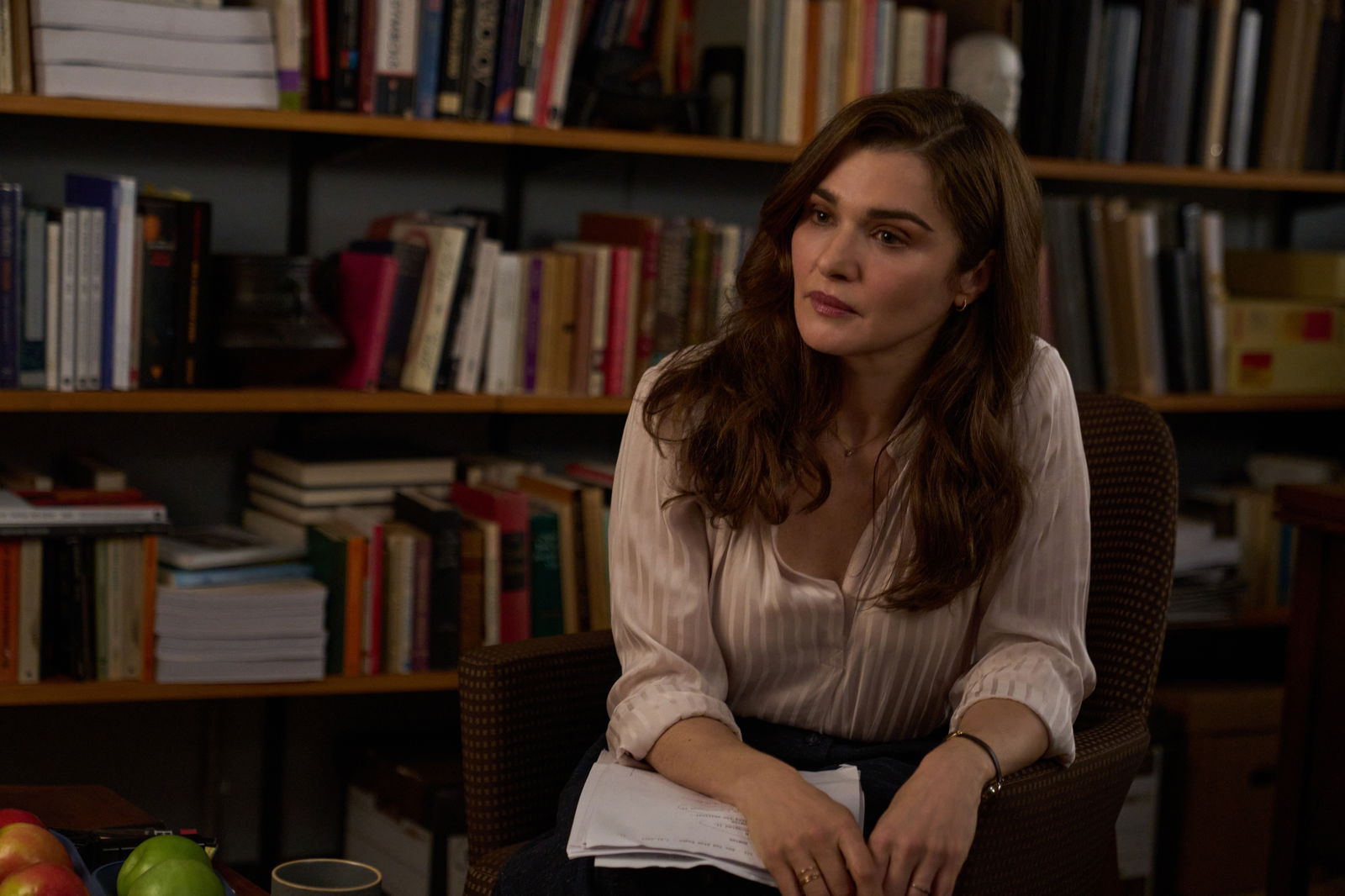
At its core, Vladimir unfolds within a familiar yet volatile setting: the modern university, a space that prides itself on intellectual clarity but is often riddled with personal contradictions. At the center is Rachel Weisz, the unnamed narrator, interacting with us. Weisz’s character is a veteran professor who has spent three decades teaching literature at the same university, reflecting on the strange erosion of authority that comes with age: how students who once admired her now find her ideas outdated, how the power she once held in classrooms seems to be slipping away. This sense of fading relevance becomes the emotional backdrop against which the show’s central controversy unfolds.
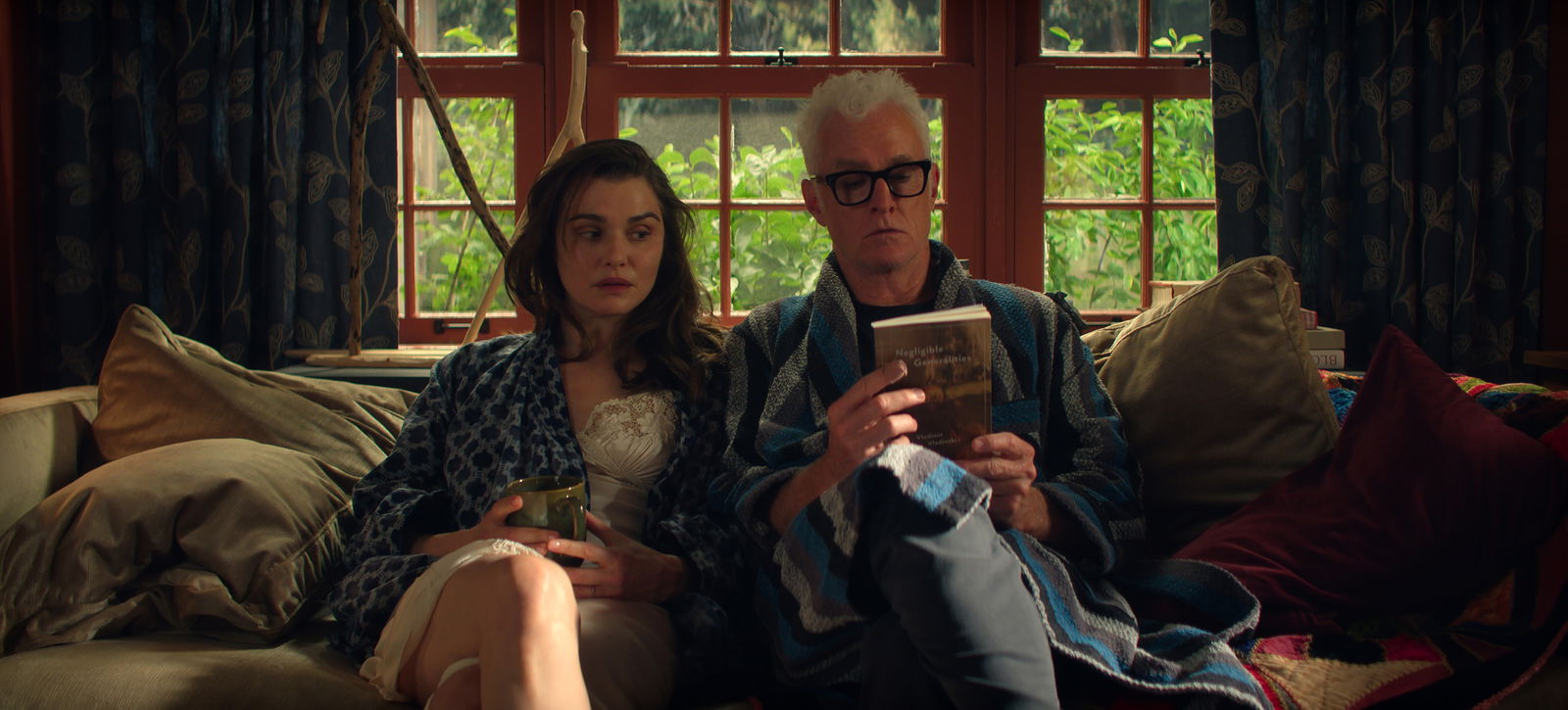
Funnily, the controversy itself centers on her husband, John (John Slattery), a celebrated poetry scholar and department chair whose reputation is suddenly threatened when multiple former students accuse him of having sexual relationships with them. What begins as a rumor soon escalates into formal hearings and internal investigations, with faculty members debating whether he should be removed from his position. The scandal quickly becomes the talk of the campus, turning departmental meetings and faculty retreats into tense arenas where colleagues dissect the situation in hushed yet pointed conversations.
Yet the most surprising element of this conflict is the narrator’s reaction to it. While the rest of the university frames the allegations through the language of power imbalance and exploitation, she refuses to adopt the same moral framework. Their marriage, she reveals, has always been open, and she has long been aware of John’s relationships outside it. In her mind, these encounters were consensual and complicated rather than predatory. This perspective places her at odds with the cultural climate surrounding her, where students and administrators increasingly demand clear moral accountability from faculty members.
The tension intensifies as the institutional machinery begins to close in. Against this backdrop of scandal and institutional anxiety, the arrival of Vladimir Vladinski (Leo Woodall) quietly alters the emotional landscape. A younger novelist newly hired by the department, Vladimir initially appears as a refreshing intellectual presence within the tense academic environment. His early interactions with the protagonist are casual and seemingly innocent: discussions about literature, polite compliments about her work, and the small gestures of collegiality that define faculty life. Yet these encounters slowly awaken something in her that the scandal surrounding John had only begun to stir: a renewed awareness of desire, attention, and creative possibility.

Credits: Netflix
Credits: Netflix
The situation becomes even more complicated when the story expands beyond the university. Weisz’s daughter, Sidney aka Sid (Ellen Robertson), struggles to process the revelations about her parents’ unconventional marriage, particularly when the scandal forces these private arrangements into public view. Conversations at the family dinner table become tense, exposing generational divides about relationships, accountability, and personal responsibility. What began as an institutional controversy gradually transforms into a deeply personal crisis that touches every part of M’s life.

Is Netflix’s 'Vladimir' Based on a Book? Check All About Streamer’s New Sensual Drama From Its Roots
With Weisz’s fourth wall interactions, Vladimir uses the academic setting not merely as a backdrop but as a thematic engine. Universities in the series are portrayed as places where intellectual authority and human vulnerability coexist uneasily, spaces where professors debate ethics in classrooms while navigating their own tangled desires outside them. The scandal surrounding John becomes the spark that reveals these contradictions, setting the stage for a story that is less about a single accusation and more about the fragile structures of power, reputation, and longing that shape life within academia.
Rachel Weisz’s unnamed narrator and the thrill of obsession
The scandal belongs to John, but the series truly belongs to Rachel Weisz’s sharp, unsettling, and endlessly fascinating narrator, whose perspective shapes every moment of the story. From the very beginning, she breaks the fourth wall, speaking directly to the audience with a mixture of confession, irony, and quiet defiance. Sitting on her couch and addressing us almost conspiratorially, she reflects on how age has slowly eroded the authority she once wielded as a professor and a woman. Students who once admired her now question her ideas, and the power to captivate a room, intellectually or sexually, seems to have faded. It is a striking opening that immediately places the audience inside her restless, self-aware mind.
This narrative device becomes one of the series’ most compelling tools. Rather than presenting events objectively, the show allows us to experience them through her constantly shifting perspective. She is witty, intellectually sharp, and often brutally honest in her observations, yet there is also a clear distance between what she believes about herself and what the audience can see unfolding. So at places where you will want her to be mad, like her talking to us about how it is her husband John who is at the center of the scandal, she appears to be eerily calm to an extent that you will find it your duty to feel mad on her behalf. Her commentary frequently reframes uncomfortable situations with humor or rationalization, revealing the extent to which she is both self-aware and deeply in denial.
Nowhere is this contradiction clearer than in her growing fascination with Vladimir Vladinski. Their first encounter is almost mundane, a brief moment in a grocery store, followed by an awkward interaction at a faculty retreat where he offers her his seat. Yet the effect on her is immediate and electric. She begins to notice him everywhere, replaying small gestures and casual remarks in her mind with disproportionate intensity. What might appear to others as simple collegial interactions slowly become, in her imagination, moments charged with meaning.
Credits: Netflix
Credits: Netflix
The series frequently blurs the line between reality and fantasy to illustrate the depth of this obsession. As Vladimir speaks about writing or literature, M’s mind drifts into imagined scenes of intimacy with him—moments that interrupt ordinary conversations with sudden flashes of desire. These fantasies are not presented as romantic escapism but as intrusive thoughts that reveal how completely Vladimir has begun to occupy her imagination. Even small details—such as him placing her bag on the table instead of the floor, or complimenting her writing—become charged symbols of attention and admiration in her mind.
Yet what makes Weisz such a compelling narrator is that she remains aware, at least partially, of her own absurdity. She frequently comments on her actions with a mixture of humor and embarrassment, acknowledging the irrational nature of her fixation while continuing to indulge it. This self-commentary gives the show a darkly comedic tone, allowing the audience to both sympathize with and recoil from her behavior.
Rachel Weisz navigates this delicate balance with remarkable precision. Her performance captures the intellectual arrogance, vulnerability, and longing without ever reducing her to a caricature. In quieter moments, whether reading Vladimir’s novel late into the night or staring out a window after a faculty gathering, Weisz reveals the character’s deep insecurity about aging and relevance. The obsession with Vladimir is not simply about attraction; it is about the intoxicating possibility of feeling visible again.
In many ways, M’s fixation becomes the emotional engine of the series. Through her eyes, Vladimir transforms from a colleague into a symbol of everything she fears losing: youth, creative vitality, and the power to inspire desire. Whether these feelings are reciprocated or entirely imagined remains deliberately ambiguous. What matters is the intensity with which she experiences them—and the increasingly reckless choices that follow.
The collision of fantasy with reality
For much of Vladimir, the narrator’s obsession exists in a strange, suspended space between imagination and possibility. Small interactions feel charged with meaning, fantasies interrupt ordinary conversations, and every gesture from Vladimir seems to hint at something more. But as the series progresses, the delicate balance between fantasy and reality begins to collapse, pushing her toward choices that are far more dangerous than she initially realizes.
The turning point arrives when the emotional chaos surrounding her life intensifies. John’s hearing looms closer, her position at the university becomes increasingly unstable, and the carefully maintained boundaries between her professional and personal lives begin to blur. It is in this volatile state that her fixation on Vladimir escalates into something far more impulsive. What had once existed largely in her imagination finally spills into action, culminating in a moment where she drugs his drink and ties him to a chair in her cabin, an act she later tries to dismiss as a drunken misunderstanding.
This sequence marks a dramatic tonal shift for the series. Until this point, the narrator’s obsession has often been played with a dark comedic edge, framed through witty narration and exaggerated fantasies. Here, however, the show allows the situation to become deeply uncomfortable. Vladimir’s confusion and anger collide with frantic attempts to control the narrative, exposing just how far her rationalizations have carried her away from reality.
The aftermath is equally chaotic. Confrontations between John, Vladimir, and the narrator unravel the fragile web of assumptions that had been holding the story together. Accusations of affairs, misunderstandings, and emotional grievances spill out in rapid succession, leaving none of the characters entirely innocent or entirely honest. What once appeared to her as a carefully unfolding romance now reveals itself as a far messier and more ambiguous connection.
Credits: Netflix
Credits: Netflix
Yet the series ultimately steers the story toward an unexpected conclusion. In its final moments, the focus shifts away from the men entirely and towards her writing. After a fire breaks out in the cabin, she is forced to choose between saving the manuscript she has been working on or helping the men escape. Her instinct is immediate: she grabs her work and runs.
The moment reframes everything that came before it. The obsession with Vladimir, the scandal surrounding John, and the emotional chaos of the past weeks become, in her mind, raw material for the story she is writing. Desire, it turns out, was never the final destination. It was simply the spark that allowed her to reclaim something she had feared losing, her creative voice and the power to shape her own narrative.
In the end, Vladimir is less interested in resolving its scandals than in exposing the contradictions that fuel them. What begins as a campus controversy slowly evolves into a psychological portrait of a woman grappling with aging, relevance, and the intoxicating pull of desire. Rachel Weisz anchors the series with a performance that is sharp, vulnerable, and unapologetically complicated, allowing the narrator to remain both fascinating and deeply flawed while the rest of the cast plays its part. By the time the story reaches its unsettling finale, the show makes one thing clear: the real conflict was never simply about infidelity or institutional ethics. It was about authorship—about who gets to control the story of one’s life. In that sense, Vladimir leaves behind not neat answers, but a provocative question about agency, obsession, and reinvention.

What do you think about Vladimir? Let us know in the comments.

Edited By: Aliza Siddiqui
