
Unmasking the Heart: 'Bridgerton' Season 4 Finds Its Way Back to Romance —Recap
Dearest gentle reader,
After a rather disappointing Season 3, with rushed arcs, wavering tensions, and the controversial shift from Michael to Michaela, the Ton can finally exhale. Season 4 arrives with immaculate Cinderella-esque charm, revived family warmth, and a forbidden spark surrounding Benedict Bridgerton and Sophie Baek.
Their tale, rooted in An Offer from a Gentleman, promises forbidden romance, class-bound identity, and fairytale allure. The first four episodes prove one thing: Bridgerton is finally returning to its legacy.
ADVERTISEMENT
Article continues below this ad
Episode 1- The Waltz
“When one chooses heart over the head, all reason goes out of the window.” This one infamous line from Season 3 tried to define the crux of the previous season, but to me, it fits the narrative of Bridgerton Season 4 more than ever.
Living up to the episode’s name, the season actually sounds like a waltz in Bridgerton House: a busy kitchen, a fuller home, Eloise and Francesca’s return from Scotland, and tensions between Eloise and Penelope fizzling out. We see the chubby young Lord Featherington, Penelope and Colin’s son, and Hyacinth eager for her debut with low hems. Right at its opening, Season 4 reclaims what Season 3 lacked, family texture full of warm, lived-in comic timing.
While all Bridgertons are present except Anthony and Kate in India, Benedict is nowhere to be found. Missing from the bustle, he is in his usual rakish abandon, prompting Violet to push him toward responsibility. Their conversation becomes the emotional anchor. She insists he must “live up to the family name,” but Benedict’s retort slices through his long-standing conflict:
“His [Anthony] reputation secures the Bridgerton name. I am merely a second son.” This turmoil traces back to previous seasons—his Season 2 confidence shattering when Anthony paid for his acceptance, and his Season 3 struggle to find purpose.
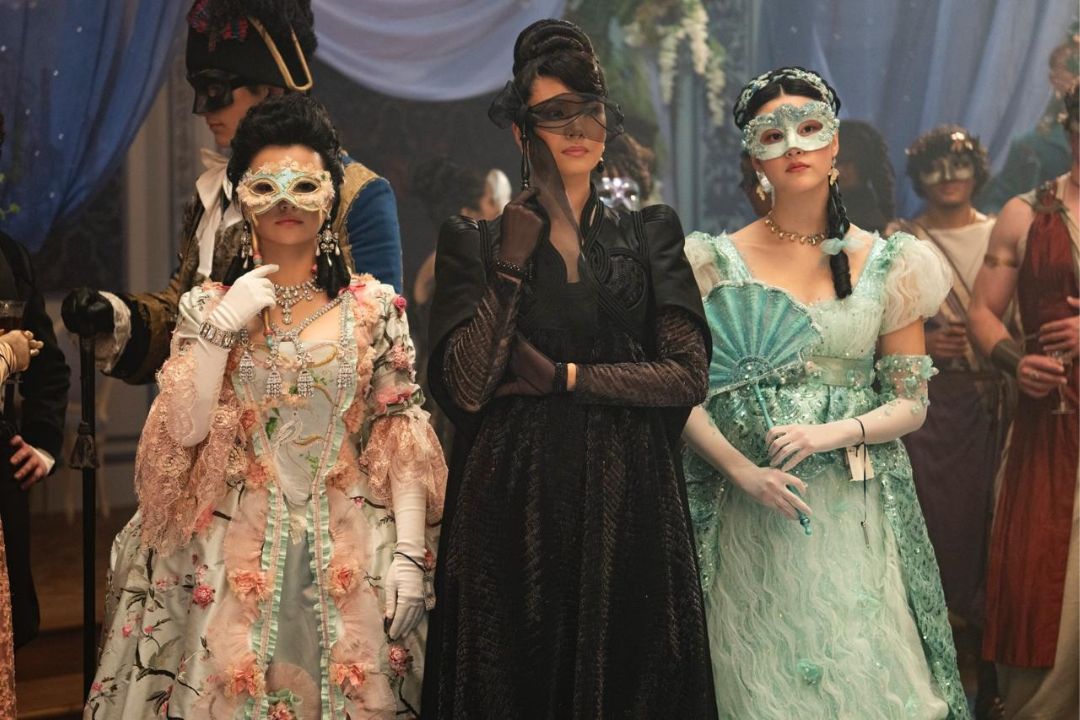
What episode 1 also took me into was the most anticipated confrontation between Lady Whistledown and the Queen, which is full of humor (it excited me as much as it excited the Queen) while Lady Danbury’s pursuit of the Queen to attend Violet’s masquerade sets up the season’s central gimmick: the Unmasking at Midnight ball, with stronger Cinderella coding than ever.
When masks appear, Sophie Baek enters, soft, radiant, terrified, the perfect Cinderella parallel. Her chaperone, Alfie, warns her to hide and leave before midnight, as she’s already hiding from her stepmother, Lady Penwood.
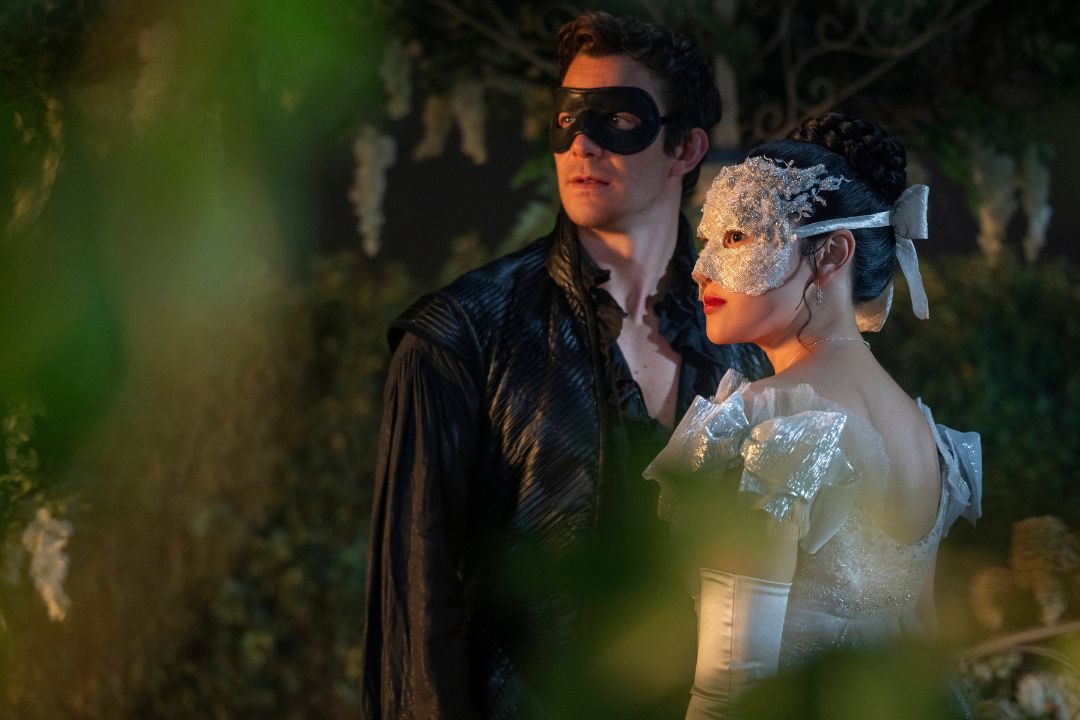
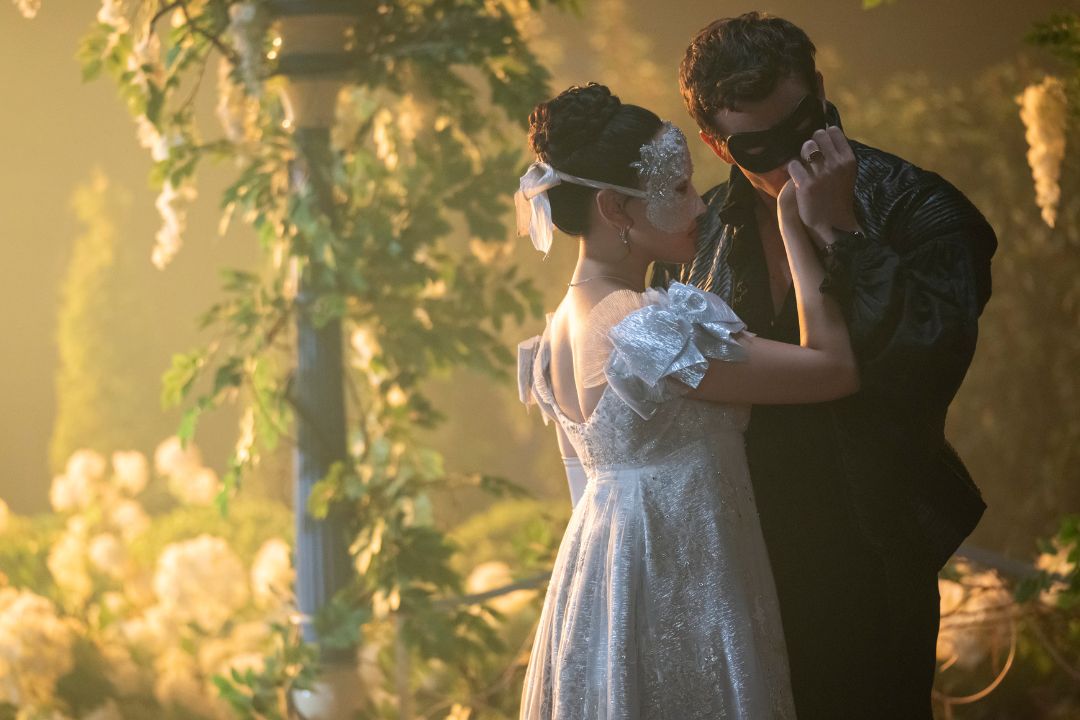
Despite promising to be on time, Benedict is late. Minutes in, he spots Sophie admiring the chandelier, their yearning quietly romantic. Avoiding Violet and Lady Penwood, they escape to the terrace. The dance lesson, tender, awkward, intimate, is a beautifully executed moment. Sophie steps on his foot, apologizes, and is stopped by him. They dance again. She closes her eyes to “escape.” He calls her “intriguing.” Their chemistry reverberates through the scene. Just as masks must come off, Sophie flees. Benedict pleads for her name. She kisses him, a single charged moment, and disappears, leaving only her glove and not the shoe.
Sophie returns home, not as a guest of the ton, but as a maid in Lady Penwood’s house. A brilliant contrast. The fairy tale collapses instantly, grounding her arc in the book’s Cinderella structure.
Benedict and Sophie’s first meeting at the Unmasking at Midnight ball is quietly one of the most poetic setups Bridgerton has done. The title of the masquerade is not just for the sake of it; it mirrors both characters’ emotional arcs. Sophie arrives dressed in silver, wide-eyed and trembling with awe, slipping into a life she can only borrow for a night. For her, the mask is protection, a brief escape from servitude, a chance to exist as the version of herself she is never allowed to be. Benedict, meanwhile, wears a different kind of mask: charm, ease, and the façade of a carefree rake who feels “merely a second son.”
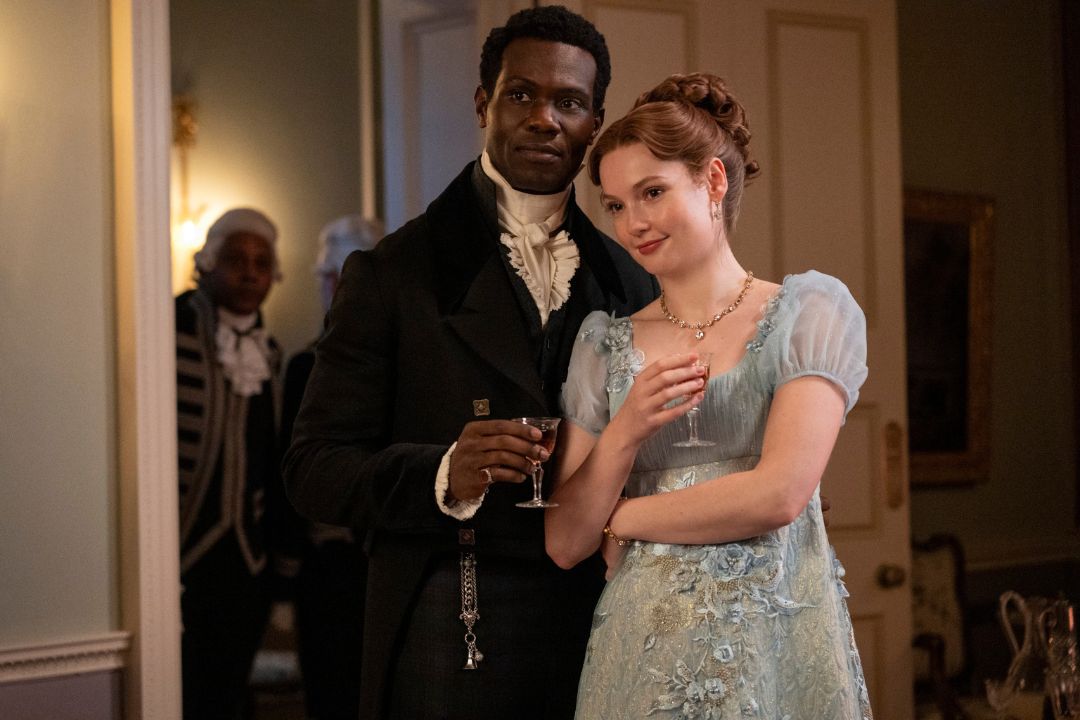
The episode closes with Eloise discussing spinsterhood with Violet, and Violet telling both her and Benedict that running from the season is not an option. Then Benedict, still reeling, tells Violet he has newfound respect for the work debutantes do, something which Sophie gave him, signaling how she already has a hang of him. Already.
Episode 2- Time Transfixed
While Episode 1 was a fairytale that made me giggle like a teenager again, Episode 2 revealed the cost of wearing borrowed magic. The second episode deepens Sophie and Benedict’s story by peeling back both their facades, showing how the masquerade was not just a romantic backdrop but a metaphor for identity, illusion, and longing across class boundaries, something the book did and the show is finally embracing.
It opens with Benedict sketching Sophie from memory before shifting to Sophie’s past, a crucial choice that grounds her in hardship rather than mystique. Through flashbacks, we see how she came to the ball: mocked by Lady Penwood and Rosamund, defended only by Posy. Irma calling the ball her “birthright” and Alfie dressing her in Penwood’s discarded gowns heighten the Cinderella parallels, reinforcing how Sophie lives a fractured identity she is never allowed to claim.
The episode then cuts back to Penelope’s post-Whistledown reality, with Eloise by her side as guests line up to share gossip, evoking their Season 1 dynamic. Benedict seeks Pen’s help finding the “lady with the glove,” but she and Eloise warn him that the truth could ruin Sophie. His risky request for Whistledown to mention his search becomes the first sign he is willing to defy propriety.
The plan works too well. Sophie hears someone is looking for her; Benedict grows frantic. His montage of attending balls and scanning smiles brilliantly ties back to his “second son” insecurity. Sophie is the first woman who made him feel seen, and the loss destabilizes him.
Meanwhile, Violet’s scenes add a welcome comedic bite as she interrogates Penelope, accidentally bullying her into spilling the truth about Benedict’s mysterious encounter. Once Violet learns the glove bears the Penwood crest, the fairytale collides with reality. Benedict’s romantic idealism is suddenly tethered to the politics of Mayfair.
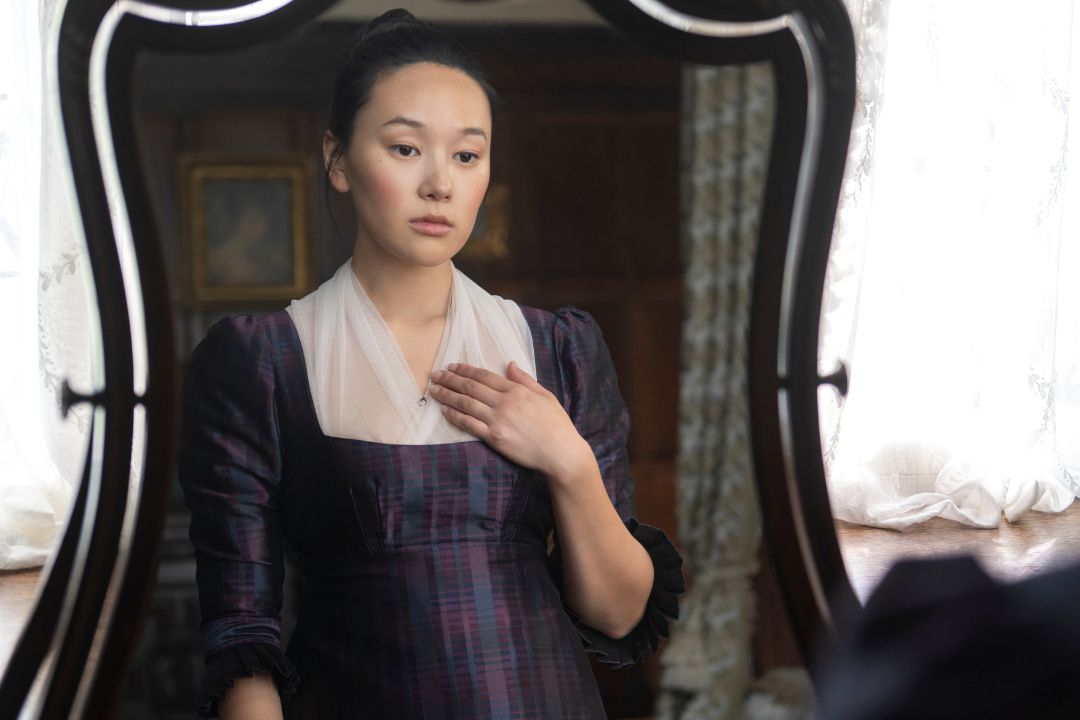
But the emotional core belongs to Sophie. Her life under Lady Penwood is crushing, and the flashback of her father’s death explains her inability to dance, her fear, and her belief she is unworthy. When Penwood discovers she wore the silver gown, the mask shatters. Sophie finally stands up for herself before being forced to flee into the night, Posy quietly supporting her.
The final act brings Benedict and Sophie into the same frame again, though neither recognizes the moment as fate. Sophie rescues a maid from Lord Cavender’s assault, and Benedict intervenes, injuring himself in the process. Her quick lie, that she merely remembers his name from whispers, is an act of self-preservation, yet Benedict senses something beneath it. The two parts, but the emotional tension lingers. Sophie, jobless and frightened, tries to reject any hope: “He does not want to find me. He wants to find the lady in the silver gown. And she is not real.”
The episode closes with Benedict offering her a new job, promising safety without understanding the depth of her fear. As she hesitantly takes his hand and enters the carriage, their dynamic shifts from fantasy to reality, a transition that sets the foundation for the morally complex, deeply intimate arc ahead.
Episode 3- The Field Next to the Other Road
Episode 3 of Bridgerton Season 4 slows the season down in the best possible way, giving Benedict and Sophie the space to breathe, unravel, and collide outside the rigid architecture of Mayfair. Their carriage ride to Benedict's remote countryside cottage sets the tone immediately: gentle intimacy, awkward honesty, and the creeping fear that the magic of the masquerade cannot survive daylight. Sophie reveals her name; Benedict stubbornly denies the coming rain, only to be proven wrong; and the two find themselves stranded together, the enforced proximity acting as a catalyst for both trust and tension.
The empty cottage with no Crabtrees, no servants, no structure becomes the perfect narrative container for their shifting dynamic, just like any other romance. Sophie slips instinctively into caretaking, lighting the fire, checking Benedict's wound, and even climbing through the window with practiced agility. Benedict, meanwhile, fights between viewing her as a guest, a mystery, and a woman who unsettles him simply by existing outside every category society prescribes. His fevered nighttime murmurs, calling her “my lady” and begging her not to leave him again, blur the line between fantasy and reality. Sophie stays, watches over him, and quietly internalizes that he is yearning for a version of her she can never safely claim.
Every Bridgerton season has always centered around the women, especially not being aware of intimacy at all. And this season, it is Francesa looking for her ‘pinnacle.’ Francesca and John’s intimacy is sweet but laced with uncertainty; her concern about not conceiving and her confusion about the “pinnacle” of passion underscore how quietly isolated she remains within her new marriage.
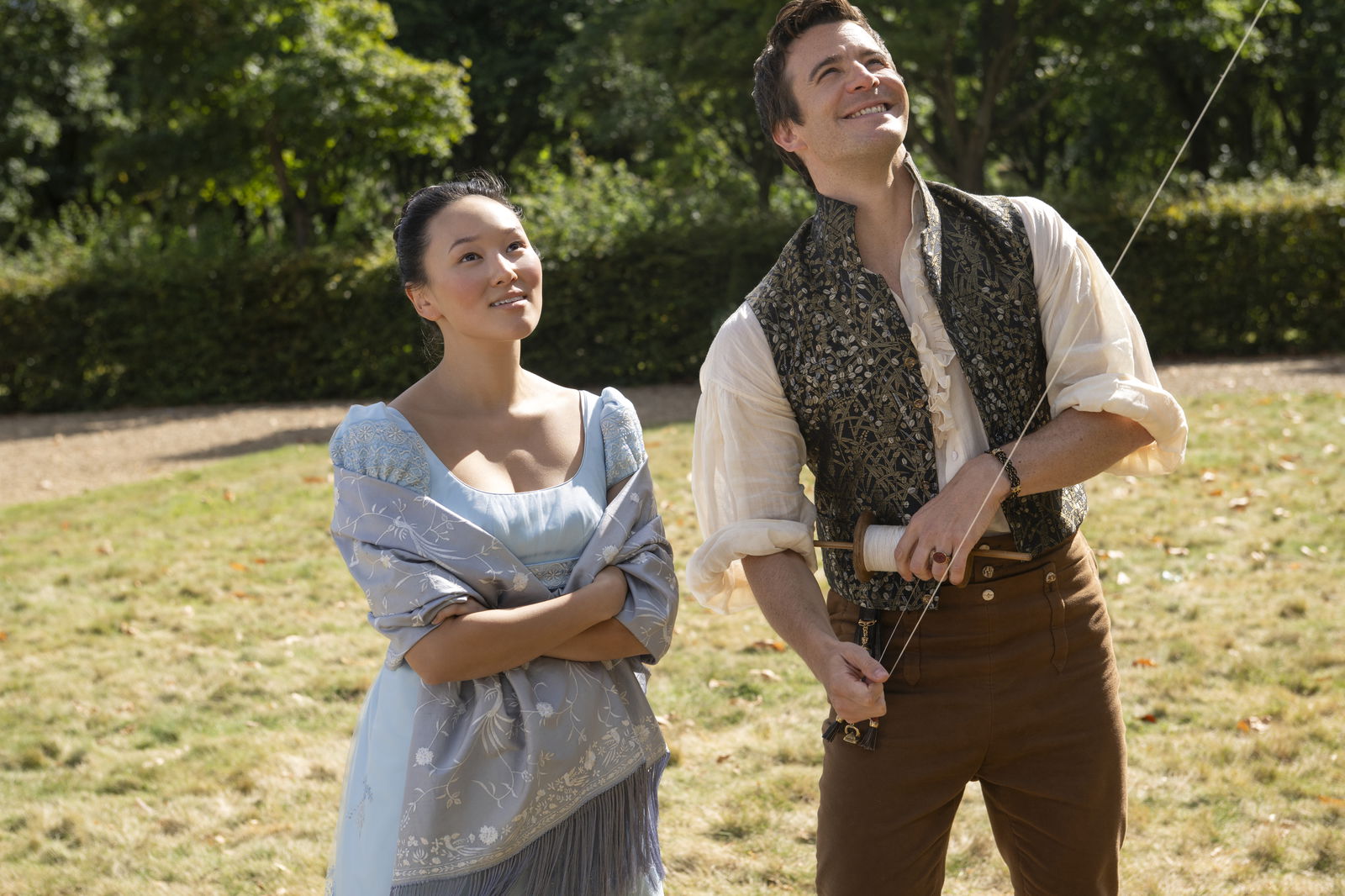
At My Cottage, Episode 3 uses domesticity to build romance: shared breakfasts, Sophie’s joyful overeating, kite flying, library conversations, and small moments of laughter. Ben is slowly disarmed not by mystery but by Sophie’s intelligence, her knowledge of Michelangelo, her French grammar, her insight into his art. The kiss by the lake, impulsive and quiet, shifts everything. Mrs Crabtree’s warning later that evening, that Ben must not treat Sophie like a “project,” gives voice to the class tension simmering beneath their growing connection.
The episode concludes with Sophie preparing to return to London, carrying both the hope and heartbreak of the brief world she and Benedict built together.
Episode 4: An Offer From a Gentleman
Episode 4 of Bridgerton Season 3 carries the title of Benedict’s original book arc, and the show uses it smartly, not by retelling the book verbatim, but by interrogating what it actually means to be a “gentleman.” Throughout the season, Benedict has been praised, teased, or boxed into that identity, yet this is the episode where the façade cracks.
The episode opens with Benedict bringing Sophie to Bridgerton House as a temporary maid, convinced he is doing the right, indeed, the gentlemanly thing. Sophie resists out of pride and fear, but his insistence and Violet’s eventual approval settle her into her new role. The juxtaposition is powerful: the Bridgerton home is warm, bustling, and egalitarian compared to Penwood Hall, and Sophie’s introduction to the staff is one of the season’s most human moments. Her admission that she once did the work of eight servants shocks the room, revealing how much she has endured without complaint.
Sophie’s integration into the Bridgeton women’s routines, Hyacinth’s dances, Eloise’s literature debates add layers to her character and form one of the episode’s softest subplots. Eloise immediately recognises Sophie’s intellect and curiosity, a bond that subtly echoes Eloise and Penelope’s original Season 1 closeness.
But the true center lies with Benedict and Sophie. Their growing tension, visible in every stolen glance and delicate button-fixing, finally erupts when Sophie advises him to pursue Miss Hollis. Their mutual frustration, Benedict’s longing, Sophie’s fear of hope, pushes them to their emotional limits. When they collide in Sophie’s doorway, the passion is immediate and unguarded. Benedict’s confession that he searches for her in every room is one of the most honest things he has ever said. And yet, this is where he stops being the gentleman the world keeps calling him.
ADVERTISEMENT
Article continues below this ad
His request that she become his mistress is not cruel but naïve; he is blinded by privilege, by longing, by the fantasy he still cannot separate from reality. Sophie’s pain at this moment defines the episode. She is no longer the woman in silver; she is the maid in plain clothes who knows that accepting would cost her dignity, safety, and self-respect.
Bridgerton Season 4 stands as a deliberate course correction, with an impeccable cast, an unmasking of everything the series drifted away from in Season 3. Across these four episodes, the show returns to what once made it irresistible: fully realised character arcs, emotional sincerity, and romances grounded not in spectacle but in longing, vulnerability, and choice. Benedict and Sophie’s story becomes the anchor of this shift, peeling back questions of privilege, identity, and self-worth with a tenderness the series has not embraced since Kate and Anthony in Season 2.

ADVERTISEMENT
Article continues below this ad
How did you like Bridgerton Season 4? Let us know in the comments below.
ADVERTISEMENT

Edited By: Aliza Siddiqui
ADVERTISEMENT
ADVERTISEMENT
