
‘Straight to Hell’ Ending Explained: Does Minori Publish the Book? What Happens to Kazuko?

Credits: Netflix
Credits: Netflix
Straight to Hell spends nine episodes building toward a confrontation that was inevitable from the beginning. A woman who has spent sixty years rewriting every story about herself — scamming fortune-teller clients, fleecing celebrities, fixing for the yakuza, manipulating the elderly, and buying the silence of the entire media industry — finally meets a pen of someone who will not be bought or threatened. Minori Uozumi was commissioned to write a biography, but what she ends up writing is something far more dangerous: the truth.
By the time the finale arrives, the question is not simply whether Kazuko Hosoki's carefully constructed public image will survive. It is whether either woman — the subject or the writer — will emerge from this confrontation as the person she believed herself to be. The ending of Straight to Hell does not offer a clean verdict on Kazuko. It offers something more uncomfortable: understanding without absolution, and a final scene that is quietly one of the most devastating things the show does.
Does Minori Publish the Book, and what Does Kazuko Do to Stop Her?
The final episode makes clear that Kazuko has known all along what Minori was finding out. She has survived journalists, rivals, debt collectors, the yakuza, and a public exposé before. She is not afraid of a writer. What she is afraid of, though she would never name it as fear, is losing control of her own story.
Throughout the series, Kazuko has granted Minori access to herself precisely because she intended to use the biography to further her own interests. There was a damaging article set to come out in the press, and Kazuko's calculation was simple: get a sympathetic book out first, shape the narrative, and neutralize the threat. Minori, she assumed, would be compliant, meek, and manageable. She had read her wrong.
By the finale, Minori has done her homework thoroughly. Interviews with Hisao — Kazuko's own brother, who was abandoned by her when his arrest became inconvenient for her — have exposed the lies Kazuko told about her role in rescuing singer Chiyoko Shimakura. The reality was that Kazuko and her yakuza lover Hotta had kept Shimakura as a cash cow, booking her performances and siphoning her earnings while she sank deeper into debt and dependency.
When Shimakura finally understood the arrangement and tried to leave, Kazuko gave her the ultimatum to leave and lose her support or stay and continue as things were, but in the end, Kazuko lost the one man she ever admitted to loving because of her own greed and she lied about every part of it to Minori's face.
Credits: Netflix
Credits: Netflix
Minori has also spoken to the daughter of Yasunaga, the elderly philosopher Kazuko married after exploiting his early dementia, encouraging his drinking, his smoking, isolating him from his family, and engineering his signature on the marriage contract before he was lucid enough to understand what he was signing. The daughter kept them apart as he deteriorated. Kazuko arrived at his funeral anyway, made a scene, and stayed in the newspapers. It was, like everything else, a performance.
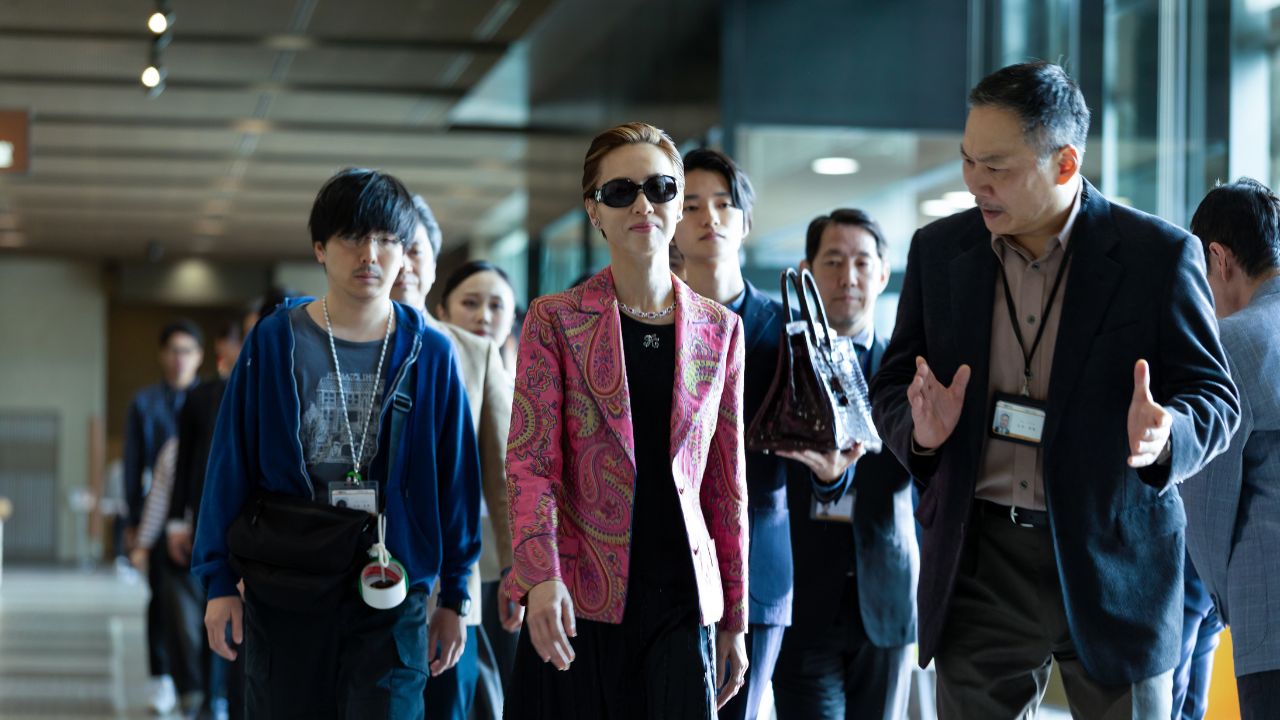
Even faced with all of this, Kazuko does not confess, nor does she retreat; she confronts Minori directly. In a scene that functions as the finale's centrepiece, she scatters the manuscript pages across the floor and walks over them. It is a power move, deliberate and cold. She tells Minori that she will not allow the book to be published, deploying the same tactic she has used her entire life: veiled threats wrapped in the language of conversation, intimidation dressed as intimacy.
But Minori does not back down. She speaks plainly about the lies, the manipulation, the gap between the self-portrait Kazuko wanted and the self-portrait the evidence demands. Kazuko is defeated in the face of integrity, and in a telling moment, after Minori leaves, she bends down and picks up the manuscript pages off the floor. It is the closest thing to a concession the show allows her.

The exposé article that Kazuko had been trying to suppress runs in the magazine, and then the magazine keeps running her story for fifteen consecutive weeks. Her television contracts are cancelled, and she withdraws from public life.
For a woman whose identity was entirely constructed around being seen, invisibility is the cruellest possible punishment.
What does the ending mean for Kazuko: is she really the villain?
In the final stretch of the finale, it refuses to let the exposure feel like justice; Kazuko is not destroyed. She retreats, regroups, launches a new fortune-telling app, and earns ten times her previous income. She eventually adopts her niece and lives out her final years with family around her. She died in 2021, having gotten, in the end, almost everything she ever wanted. The universe, it turns out, does not punish Kazuko Hosoki; it just occasionally inconveniences her.
This is the show's most honest and most unsettling choice. Because the alternative — a clean downfall, a final reckoning that costs Kazuko everything — would have been a lie. And Straight to Hell has been insisting from its first episode that comfortable lies are exactly what Kazuko trades in.
What the finale does is give Kazuko a moment of unguarded honesty, the only one in the series. In her final conversation with Minori, she admits that her one regret in life is never having a child of her own. It is a small crack in a very large wall, and the show does not make more of it than it is, but Minori recognizes it as real. And then Kazuko is herself again, composed, impenetrable, already moving on.

Credits: Netflix
Credits: Netflix
The final scene belongs entirely to Kazuko. Alone in her glass-walled house, she cannot find Tiara, her dog. The camera holds on her in that enormous, empty, immaculate space, and the image says everything the show has been building toward: this is what the castle looks like from the inside. This is what you win when you win like Kazuko.
She is confronted by a vision of her younger self — the girl from 1946, hungry, resourceful, unbroken by the world that had already broken Japan around her. The girl tells the older woman that she is going straight to hell. Kazuko looks back at her and says she has already been there too many times to be afraid of it.
It is a defiant exit. It is also a lonely one. The scene cuts to Minori going home to her mother and her daughter, back to her complicated but full life in a one-bedroom apartment. The contrast lands without needing to be underlined.
What the ending says about both women and the Japan that made them
The most layered thing Straight to Hell does in its finale is resist making Minori the straightforward moral victor and Kazuko the straightforward cautionary tale. The show is too intelligent for that, and it has spent too much time establishing the circumstances that produced Kazuko Hosoki to dismiss her as simply villainous at the end.
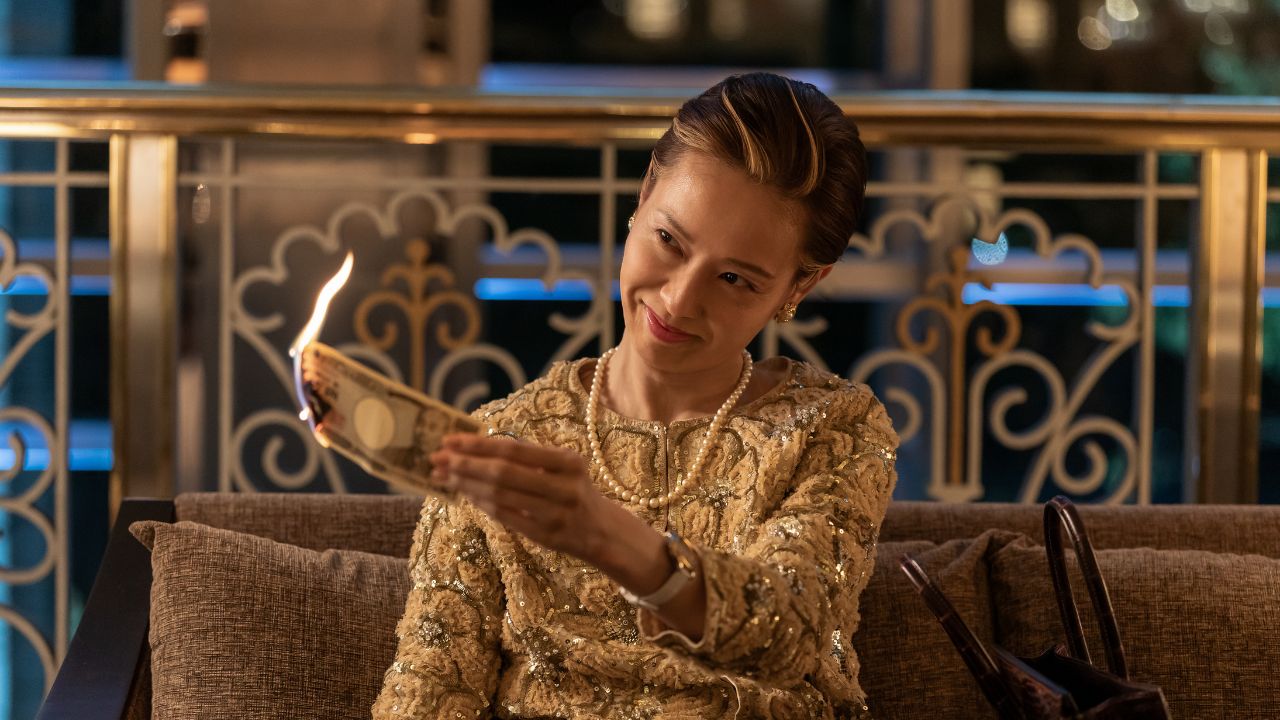
Kazuko is the product of a 40’s Japan that failed its marginalized children entirely. Born into the wreckage of 1946, she learned before she was a teenager that the world would take from her if she did not take first. Every man she trusted betrayed her, and every vulnerability she showed was exploited. The instinct to scam, manipulate, and control was taught to her, slowly and thoroughly, by circumstances that offered no better lesson.
Credits: Netflix
Credits: Netflix
Kazuko is seen in all her gory details in Minori’s manuscript. She cries reading the final manuscript because she can see the girl she started as, and the character arc is genuinely sad. A child who stole bread for her siblings grows into a woman who steals everything and calls it survival. Success built on other people's pain, the finale suggests, does not feel like success from the inside. Kazuko knows what she has done; her awareness is clear-eyed and total, but she simply decided long ago that awareness was a luxury she could not afford.
What separates Minori from Kazuko is not virtue; it is circumstance and choice, in that order. Minori was not born into a burnt-down country. She had the conditions to make different decisions, and she made them — staying true to her work, leaving a diminishing marriage, raising her daughter, writing the book even when it was dangerous to do so. Her life is not glamorous, but when the final scene cuts to her going home, there is something in it that Kazuko's glass castle does not have.
The title of Minori's book captures it precisely: Self Portrait of My Façade. Kazuko spent her whole life writing her own self-portrait, but what she produced was a façade, masterfully constructed and impossible to sustain. Minori saw the truth of her existence and confronted her with a mirror. In Straight to Hell, this truth turns out to be the only thing Kazuko Hosoki could not buy, fix, or frighten away.

Straight to Hell is streaming now on Netflix. What did you think of the finale? Let us know in the comments.
Edited By: Itti Mahajan
