
Netflix’s 'Sparks of Tomorrow' Season 1, Episode 1 Recap: Kyoto Animation Builds an Age of Electricity on Faith

Credits: Netflix
Credits: Netflix
Faith. A myth for many. And a reality for most of us. Long before man learned how to cook, use fire or go to war, everyone just had faith. It is a curious thing. Sometimes it lives in stories. And sometimes, a story itself becomes proof that faith was worth holding on to. Sparks of Tomorrow is one such story, an anime that rose from the ashes of Kyoto Animation, only to tell a tale about believing in a brighter tomorrow.
For nearly eight years, Sparks of Tomorrow remained just that, a promise. First announced in 2018, Kyoto Animation's adaptation was caught in the wake of the 2019 arson attack that forever changed the studio, delaying a project that many wondered if they would ever see completed. Then came in producers, feeling that the grand vision could not be met with the technology back then. Yet, much like the very world it depicts, where light waits patiently beneath an age of smoke and steam, Sparks of Tomorrow endured. It did not simply return after tragedy—it rose through it.
Perhaps that is why faith feels woven into every frame of this anime. Not just as a theme, but as its heartbeat. Set in an alternate Meiji-era Japan where steam, not electricity, powers civilization, Sparks of Tomorrow is not merely a tale about inventions. It is a story about belief. About the quiet war between faith and doubt. Inako believes with the kind of innocence that can move mountains, while Kihachi refuses to believe in anything after losing the one person who taught him to dream. One sees miracles everywhere; the other demands proof before hope. Between them lies the question that defines both the series and, in many ways, its own journey to our screens: is the future built by those who know, or by those who choose to believe?
ADVERTISEMENT
Article continues below this ad
One episode in and Sparks of Tomorrow suggests the answer may be both.
An age of steam, a dream of electricity in Sparks of Tomorrow
The world of Sparks of Tomorrow does not begin with light. It begins with smoke in The Electric Boy.
In an alternate Meiji-era Japan, history has taken a different turn. The pioneers who could have ushered in the Age of Electricity—Benedict Franklin, Nikola Tesla, and Ryuzo Yashima—never lived long enough to leave their mark. Instead, steam became the foundation of civilization, powering trains, industries, and entire cities while electricity remained nothing more than an impossible dream.
Aboard one such steam train sits a young Kihachi Sakamoto beside his older brother, Seiroku, who treasures a notebook called The Twentieth Century Electrical Catalog. Rather than filling its pages with copied ideas, Seiroku urges Kihachi to dream of inventions that have never existed before. It is a simple conversation, yet it quietly establishes the heart of the series: every great invention begins with someone daring to imagine it first.

Credits: Netflix
Credits: Netflix
Their bond grows stronger during the Fifth National Industrial Technology Exhibition. After briefly leaving Kihachi alone, Seiroku is revealed to be secretly attempting something considered almost heretical in this steam-powered society, lighting electric lamps. Chased by the authorities for challenging the accepted order, he returns to his younger brother with a promise that echoes throughout the episode: together, they will bring about the Age of Electricity. As the brothers race through Kyoto's lantern-lit alleys surrounded by sparks, Kyoto Animation paints the sequence with the warmth and wonder that has become its signature.
Years pass, but the promised future never arrives.

The story jumps to the fortieth year of the Meiji era. Steam still dominates every corner of society, while Kihachi has grown into a gifted yet disillusioned repairman. Seiroku left for war carrying the Electrical Catalog and never returned. Unable to forgive either his brother or himself for the broken promise, Kihachi has abandoned belief altogether. His inventions survive, but his hope does not. That changes with the arrival of Inako Momokawa.
Inako arrives in the form
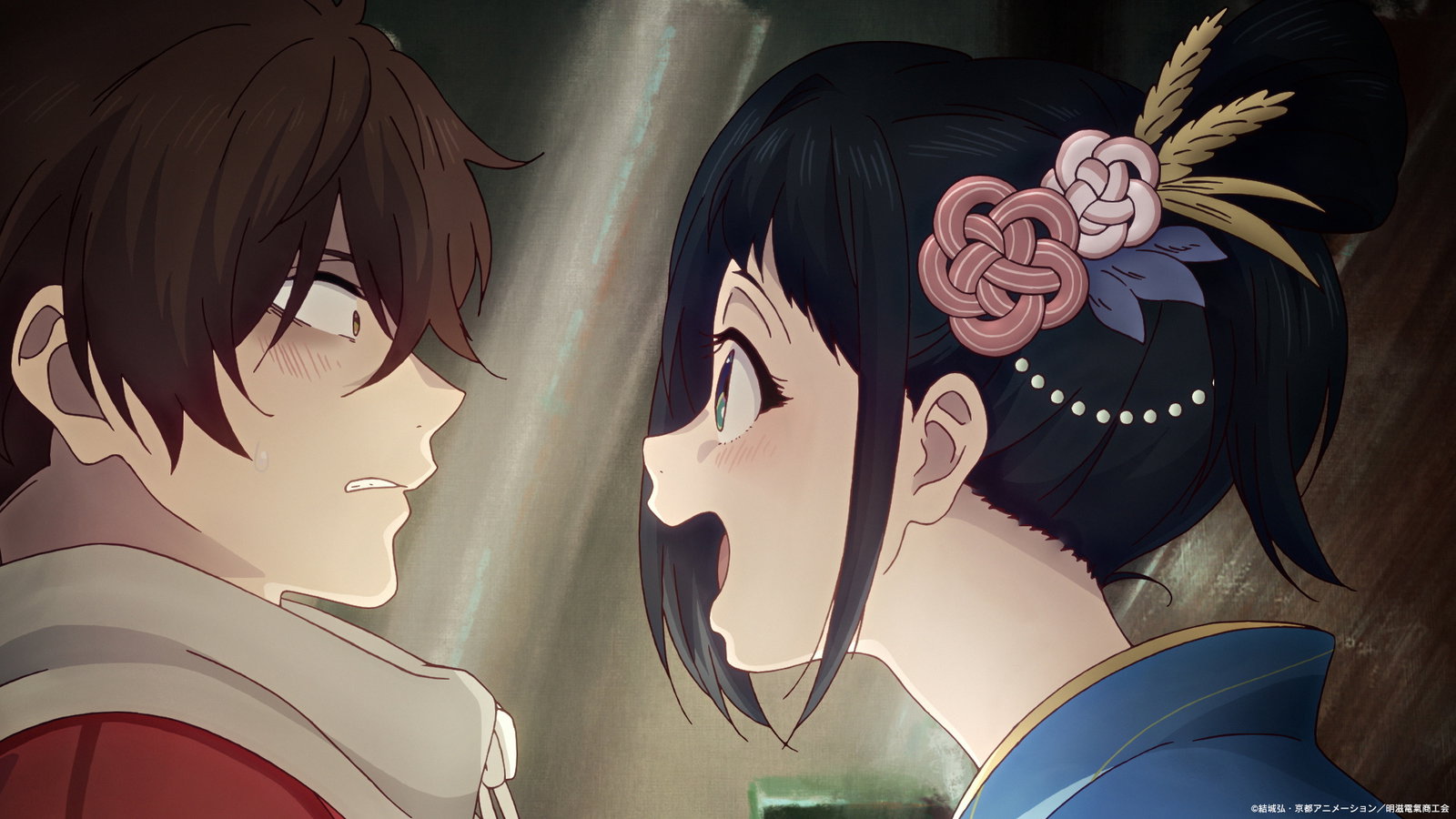
If Kihachi represents skepticism, Inako embodies unwavering faith. She first appears praying at a shrine, hoping simply to speak to her late mother once more. A small electrical device accidentally activates behind her, convincing the innocent girl that a deity has answered her prayers. Mistaking Kihachi for the "Great God Akubi," she bows before him with complete sincerity.
Their encounter is both hilarious and surprisingly revealing. Kihachi dismisses gods, miracles, and blind belief as foolishness. Inako responds with the line that becomes the philosophical backbone of the episode: "It's important to believe in something greater than ourselves. My belief's all I have." Rather than mocking her optimism, the series treats it as a genuine strength.
Credits: Netflix
Credits: Netflix
When Kihachi demonstrates an early recording device by preserving Inako's voice on a wax cylinder, she sees magic where he sees engineering. Where Kihachi explains mechanisms, Inako experiences wonder. The contrast perfectly captures the show's central conflict—not science versus religion, but skepticism versus hope. Progress, it suggests, requires both imagination and understanding. Life, however, refuses to remain peaceful.
Back at his quiet repair shop, Kihachi continues repairing machines while his uncle urges him to find proper work. Yet Inako's brief visit lingers in his thoughts. When asked what he plans to build next, his answer is unexpectedly telling: perhaps... paradise. Meanwhile, another figure enters the story.
Enters the man chasing a dream
Yosuke Mizoe arrives at the Momokawa household under the guise of celebrating Noriko's engagement, only to reveal his true intentions. Exploiting the family's financial troubles, he demands repayment of a debt before proposing marriage to Inako as an alternative. The proposal is accepted despite both sisters' objections, immediately establishing Yosuke as a manipulative force driven by motives that extend far beyond marriage.
Those motives become clearer when Noriko secretly entrusts Inako with Seiroku's long-lost Electrical Catalog and sends her directly to Kihachi. At the same time, Yosuke begins desperately searching the Momokawa household for the mysterious notebook, hinting that it carries a value known only to a select few.
Inako eventually reaches Kihachi's workshop, where exhaustion overtakes her. Upon waking inside one of his experimental projections, she mistakes the illusion for paradise itself and believes she has finally reunited with her mother. Once again, Kihachi dismisses it as nothing more than technology. Yet Inako's response surprises him. Rather than marveling at paradise itself, she praises the machine that made her feel as though she had truly been there, calling electricity "the century's greatest invention."
For Kihachi, those words reopen wounds left by Seiroku's disappearance. Every mention of electricity reminds him of a promise he believes died years ago. But Inako refuses to let him sink into despair. She tells him, without hesitation, that she believes in him. When Kihachi asks why, her answer is wonderfully simple:
"My talent is believing." It is perhaps the most important moment of the episode. Kihachi cannot yet believe in himself, so Inako believes enough for both of them.
Credits: Netflix
Credits: Netflix
Before the two can explore the mystery further, Yosuke finally tracks them down. Inako hands Kihachi the Electrical Catalog just as Yosuke storms into the workshop through clouds of steam, accidentally embracing Kihachi while mistaking him for his intended bride. The comedic misunderstanding ends the premiere on a cliffhanger, but beneath the laughter lies a far greater mystery.
ADVERTISEMENT
Article continues below this ad
Who was Seiroku really? Why is everyone searching for the Electrical Catalog? And more importantly, can faith alone rekindle a dream that even its creator abandoned?
Episode 1 does not simply introduce its characters; it introduces an idea. In a world convinced that steam is humanity's future, perhaps the greatest revolution is not electricity at all. Perhaps it is believing in tomorrow before anyone else does. As the curtain falls on The Electric Boy, one thing becomes abundantly clear: the Age of Electricity will not be built by machines alone—it will be built by those willing to believe in it first.
ADVERTISEMENT
Article continues below this ad
How did you find Episode 1, The Electric Boy of Sparks of Tomorrow? Are you excited for Episode 2? Let us know in the comments below.
ADVERTISEMENT

Edited By: Hriddhi Maitra
ADVERTISEMENT
ADVERTISEMENT
