
INTERVIEW: 'Lost Chapters' Director Lorena Alvarado Explains the Powerful Connection Between Family Memories and Forgotten History
Credit: Several Futures
Credit: Several Futures
What happens when you return home and see it crumbling down right before your eyes? You suffer and pray that things do not escalate. In Lorena Alvarado's Lost Chapters, a woman named Ena finds herself in a similar situation and discovers harsh truths about life. Ena has been living away from home for years, and when she finally decides to return home, she realizes that her family and her homeland, Venezuela, are caught in the grip of fading memories. Her grandmother is losing her memory, while her father is busy searching for rare Venezuelan books.
But everything is turned upside down when Ena encounters a mysterious postcard. She is on a quest to track down a missing author. As this turns from being a literary mystery to a heart-wrenching exploration of family, identity, and the fragility of memories, director Lorena Alvarado reveals in an interview with Netflix Junkie that she has incorporated reality into her fiction by working with her own family members in making this film, thus finding the perfect blend between what is scripted and what is not.
Aayush Sharma: One of the film's most fascinating ideas is how Ena's search for a forgotten Venezuelan writer slowly becomes a search for her own family's past. Was it always your intention for the literary mystery to function as an emotional map of memory, rather than simply a narrative device?
ADVERTISEMENT
Article continues below this ad
Lorena Alvarado: That is a beautiful question to start with. Originally, it was more of a narrative device. It served as an excuse to make Anna leave the house and explore Caracas. I had always wanted to create a journey through the city's iconic literary spaces, and the search for this book became the perfect reason to do so. But very quickly, it became connected to the theme of memory, which I was exploring throughout the film. I think, unconsciously, that was always the heart of the story. It just took me a while to realize how every character and every thread in the film touches on memory in different ways. With my grandmother, it's explored in a very literal sense through memory loss. With the father, it's this quixotic effort to safeguard books in a country that's falling apart. Anna, meanwhile, represents something much more personal. She is someone returning home after many years abroad, trying to piece together this fragmented sense of identity.
Ultimately, the book tied everything together beautifully. This forgotten writer they're searching for added another layer to the story, a broader, historical perspective. For me, it reflects what's happening to the country itself, where there's a kind of collective amnesia about our own history. So, in the end, the search for the book became deeply connected to this larger theme of memory. That was really at the core of it.
Aayush Sharma: The film suggests that losing books, stories, and writers is not very different from losing memories within a family. Do you see cultural memory and personal memory as equally fragile, especially in a country like Venezuela, where so much history has been disrupted?
Lorena: Yes and no. As I was mentioning before, I think we have a kind of collective amnesia in Venezuela about our own history, to the point where we do not always fully understand it ourselves. Maybe that is why the same mistakes keep happening. In that sense, I do think there is a parallel between personal memory loss and broader historical memory loss. At the same time, I also believe there are efforts, both by individuals and institutions, to safeguard memory. For me, making this film was one of those efforts. It was a way of creating a document that can outlast time and be a little less fragile than memory itself. I think so many of the things we do- conducting interviews, taking photographs, writing- are all attempts to preserve what might otherwise be forgotten. There are ways of pushing back against the fragility of memory. As human beings, we've always tried to do that. In many ways, we are all constantly engaged in this battle against forgetting.
Credit: Several Futures
Credit: Several Futures
Aayush Sharma: Your father and grandmother play fictionalized versions of themselves, yet the film never feels like a documentary or a conventional family drama. How did you find the balance between protecting your family's real emotions and allowing fiction to reveal truths that reality sometimes cannot?
Lorena: Another beautiful question. The film originally started as a more classical documentary. But as I developed it, I had so many ideas that leaned toward fiction, ideas involving both the city itself and the interactions within my family. I kept trying to fit those ideas into a documentary framework, but eventually it became incredibly liberating when I realized I could simply embrace the film as a work of fiction. That is when I fully committed to writing a script and crafting scenes without feeling constrained by the need to justify everything within a documentary format or convince people that every moment was real. It allowed me to open the door to my imagination and create fictional moments. Because the people in the film are real, though, it created this really beautiful hybrid space. Many of the moments are completely real, while others were written and carefully staged. The result is a film where it's often very difficult to tell what's real and what's fictional. The line between the two becomes incredibly blurred.
In fact, it is sometimes hard even for me and my family to draw that line. I think that is because they are all playing themselves. Although I wrote the scenes, I never wrote the dialogue. Most of the conversations you hear are genuine and spontaneous; I simply created the situations and prompted the scenes to unfold naturally. So while the structure was written, everything they said came from them in the moment.
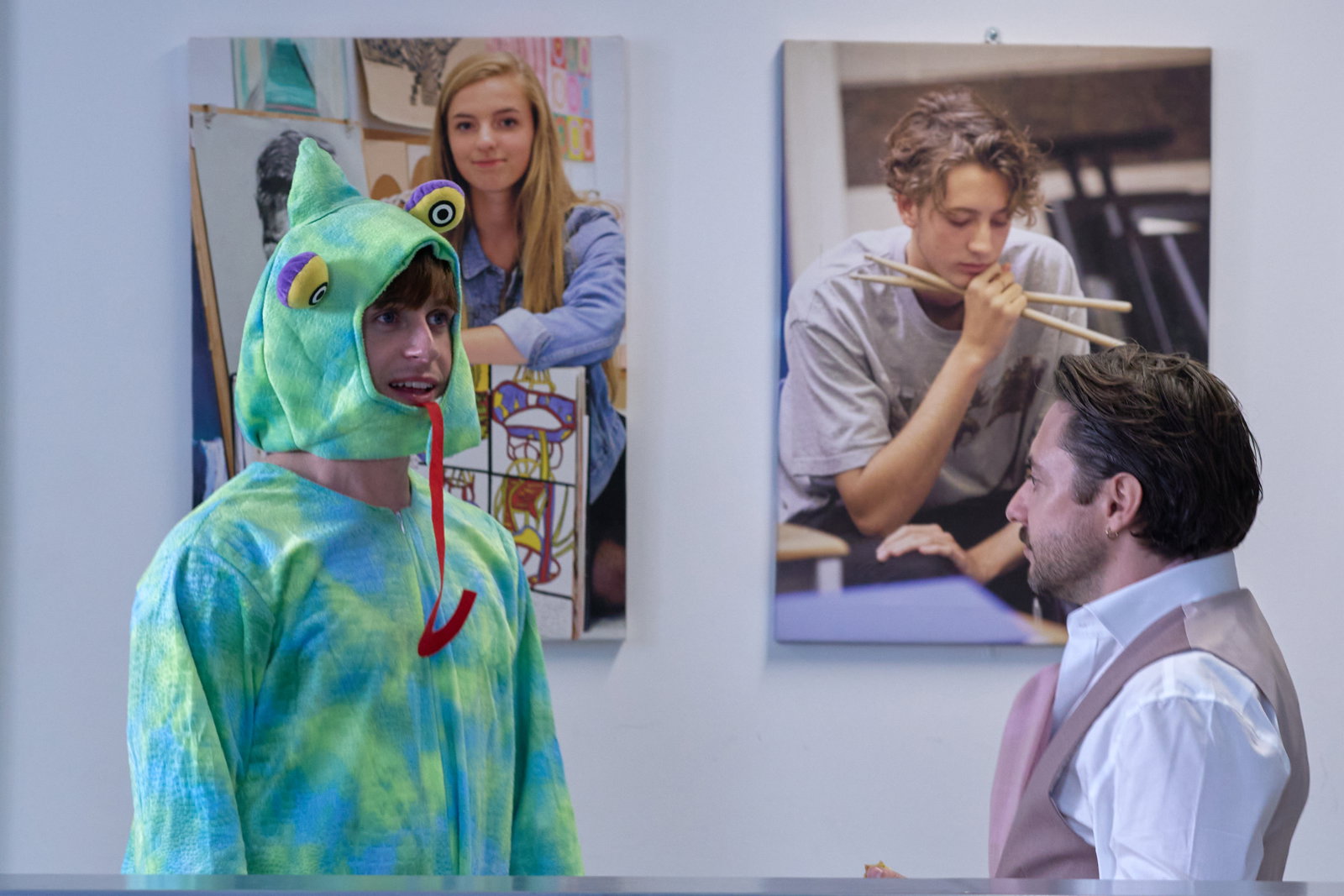
Aayush Sharma: There are moments where Caracas feels completely real, but at the same time, it feels like a place remembered rather than simply observed. Were you consciously trying to blur the line between memory and geography, so that the city itself feels like a character struggling to hold onto its identity?
Lorena: Definitely. One of the most difficult questions I faced at the beginning of this film was whether I wanted to portray Caracas as it really is, in a more documentary sense. Historically, Caracas has been a very chaotic city. It is dangerous, it's noisy, and it's far from calm. But I think this film became my fantasy of Caracas. In a way, I created a new version of the city. That also ties into your previous question. I think it's important to remind people that this isn't the real Caracas; it is my imagination of Caracas. It's my love letter to the city. In that sense, the film creates an entirely new place, much like the cities in Italo Calvino's Invisible Cities. It is a reimagining of a real location that also exists as something fictional. Part of that feeling came from the fact that we shot the film during the pandemic, which gave the city a ghostly atmosphere. Many of the spaces are empty. That is also a reflection of the Venezuelan diaspora, with so many people having left the country. For me, those empty spaces evoke the feeling of memory loss, of gaps, absences, and missing pieces.
If you think about memory loss as having holes in your mind, I wanted to transpose that idea onto the geography of the city. Seeing places that were once vibrant and full of people now sitting empty became, for me, a powerful metaphor for memory itself, its fragility, its absences, and the things that slowly disappear over time.
Aayush Sharma: Your film moves at a very gentle rhythm, asking viewers to observe rather than constantly anticipate the next plot point. In today's cinema landscape, where audiences are often encouraged to seek immediate answers, did you deliberately embrace patience as a storytelling philosophy?Lorena: Yes, absolutely. I very deliberately wanted the film to have a sense of unresolvedness. I wanted to introduce certain plot points without necessarily resolving them. I intended to maintain a slow, meditative rhythm that invites the audience into a calm, contemplative world. That gentle pace was a very conscious creative choice. Even though the film does not rush toward clear answers, I think it still holds people's attention because it's relatively short; it's only about 60 minutes. But I think the film finds a balance between its gentle, unhurried pacing and its concise runtime, allowing the audience to settle into its atmosphere without feeling overwhelmed.
Aayush Sharma: Adela's fading memory is heartbreaking, but the film never treats dementia only as a tragedy. Instead, it almost becomes another way of looking at time. How did her experience shape your understanding of what it means to remember—and perhaps more importantly, what it means to forget?
Lorena: My grandmother has been slowly losing her memory for many years. On one hand, it has been a very sad and tragic experience. But on the other hand, it has also been surprisingly humorous, because she's such a charismatic and funny person. I think there is something about memory loss that can bring people closer to childhood. As your sense of self begins to fade, moments of forgetfulness can sometimes become unexpectedly funny. At least in the early stages of my grandmother's memory loss, that's how my family approached it. We embraced it with a sense of humor, and I think we were still in that place while we were making the film. We were able to find a certain lightness within something that was undeniably difficult.
Today, though, things are very different. She's now reached a point where she's almost completely lost her memory. She no longer recognizes the people around her and can't really hold a conversation. That's the other side of memory loss. It feels like slowly sinking into sand; you go deeper and deeper until you gradually lose parts of yourself. That is why I think memory loss is such a difficult subject to talk about. It's not black and white; it's full of contradictions. It carries immense sadness, but it can also contain moments of genuine warmth and humor. Like many painful experiences, approaching it with a sense of lightness doesn't diminish its seriousness; it simply makes it a little more bearable. Sometimes, being able to laugh at the sad moments is one of the ways we cope with them.
Credit: Several Futures
Credit: Several Futures
Aayush Sharma: There's a beautiful irony in the fact that Ena is searching for someone history almost forgot while, at the same time, she's trying to preserve memories that her grandmother is slowly losing. Was that parallel the emotional heart of the film from the very beginning, or did it reveal itself during the writing process?
Lorena: I think it was a bit of both. The exploration of memory was always my starting point, and I always knew it was the emotional heart of the film. But many of these connections only revealed themselves while we were shooting and later during the editing process. I think they're subtle precisely because they weren't planned. We simply set out with the intention of exploring these themes, and along the way, these beautiful, almost magical, connections emerged on their own. They felt less like deliberate choices and more like happy accidents that naturally tied everything together. I do love the parallel between Anna's journey and her grandmother's experience. On one side, Anna is searching for something, trying to hold on to it, while on the other, her grandmother is slowly losing her memories. I often imagine it very literally: if memory were a physical object, Anna would be trying to gather and preserve its pieces, while her grandmother would be slowly letting those same pieces slip away.
For me, that's one of the most beautiful parallels in the film. It creates a quiet emotional connection between these two characters, even though they're experiencing memory in completely different ways.
ADVERTISEMENT
Article continues below this ad
Aayush Sharma: By the end of the film, it almost feels as though the search for the forgotten writer matters less than the conversations and connections it creates within the family. Would you say Lost Chapters ultimately argues that the act of searching is more important than the possibility of finding?
Lorena: For sure. I think it also connects back to your first question. The search for the book was always, in many ways, an excuse to send Anna out into the city with her father. It created opportunities for conversations, encounters, and meaningful connections with the people they met along the way. So yes, for me, the act of searching, talking, and connecting has always been far more important than reaching the destination itself. Once you arrive at the endpoint, the journey is over. What truly matters is everything that happens along the way. I think that's true not just for the film, but for life as well. Life isn't really about arriving somewhere; it's about the search itself.
ADVERTISEMENT
Article continues below this ad
Have you seen Lost Chapters? Let us know your thoughts.
ADVERTISEMENT

Edited By: Itti Mahajan
More from Netflix Junkie on Hollywood News


ADVERTISEMENT