
‘The Testaments’ Episodes 1–3 Recap: Power, Control, and the Beginning of Gilead’s End
The world of The Testaments steps into view as a continuation of the legacy left behind by The Handmaid's Tale, and it does not arrive quietly. Developed by Bruce Miller from Margaret Atwood’s universe, the story unfolds 15 years later, where Gilead has refined its control into something smoother, almost polite, yet equally suffocating.
While Gilead presents itself as a perfected system of order and devotion, the introduction of new voices begins to expose the cracks beneath its polished surface, hinting that control may not hold forever.
Agnes and the illusion of normalcy
ADVERTISEMENT
Article continues below this ad
The episode of The Testaments opens with Agnes, played by Chase Infiniti, narrating her life in Gilead as if it is the most natural thing in the world. She lives in a controlled household with her father, the Commander, her stepmother Paula, played by Isolde Ardies, and the Marthas. The environment is calm on the surface, yet every detail is structured. Dolls reflect real people, turning her playtime into a rehearsal of domestic hierarchy.
Agnes explains that even simple acts like reading or questioning can lead to severe punishment. Her narration reveals how deeply she has internalized the rules. The dollhouse she plays with mirrors her real life, where control is disguised as care and obedience is treated as a virtue.
Daisy, played by Lucy Halliday, enters the story as a newcomer from outside Gilead. Her presence immediately feels different. While Agnes is conditioned to accept the system, Daisy carries a subtle awareness that something is not right.
The girls are taught about morality, danger, and obedience through carefully constructed lessons. Authority figures present control as protection, insisting that women must remain disciplined to avoid chaos. Aunt Lydia plays a central role in shaping these lessons, reinforcing the idea that obedience is the only path to safety. Punishment is normalized, and fear is embedded in daily life.
The episode ends with a quiet but unsettling shift. Agnes begins to show small signs of internal conflict, while Daisy’s presence hints at something larger happening beneath the surface. The introduction of Daisy is not random; it signals the arrival of change.
The twist lies in the realization that Gilead is not as stable as it appears. The system is watching, but it is also being watched.
Agnes comes of age in Gilead’s terms
In this episode, Agnes reaches a milestone that the system celebrates heavily. Her transition into womanhood is treated as a formal event, marked by ritual and recognition. This moment is not personal; it is institutional. Her stepmother, Paula, played by Isolde Ardies, reinforces the importance of this stage, guiding Agnes through expectations of beauty, behavior, and future marriage. The emphasis is on presentation and obedience, not individuality.
Daisy continues to observe Gilead through a different lens. She notices inconsistencies and begins to question the system more openly, although she must remain cautious. Her interactions suggest that she understands more than she reveals. This awareness becomes a subtle form of resistance, even if it is not yet fully expressed.
A key moment unfolds when Daisy and Agnes are pulled into punishment, turning discipline into a public spectacle rather than a private correction. The situation escalates as Aunt Lydia orchestrates the entire scene with calculated precision, ensuring that every girl is not just watching but actively absorbing the consequences.
The episode ends on a tense note when Agnes begins to feel the pressure of expectation more deeply, while Daisy’s behavior hints at something hidden beneath her surface. Their bond begins to shift, as trust is tested and secrets begin to form. The twist lies in the growing realization that both girls are being shaped for different purposes, yet both may end up challenging the same system.
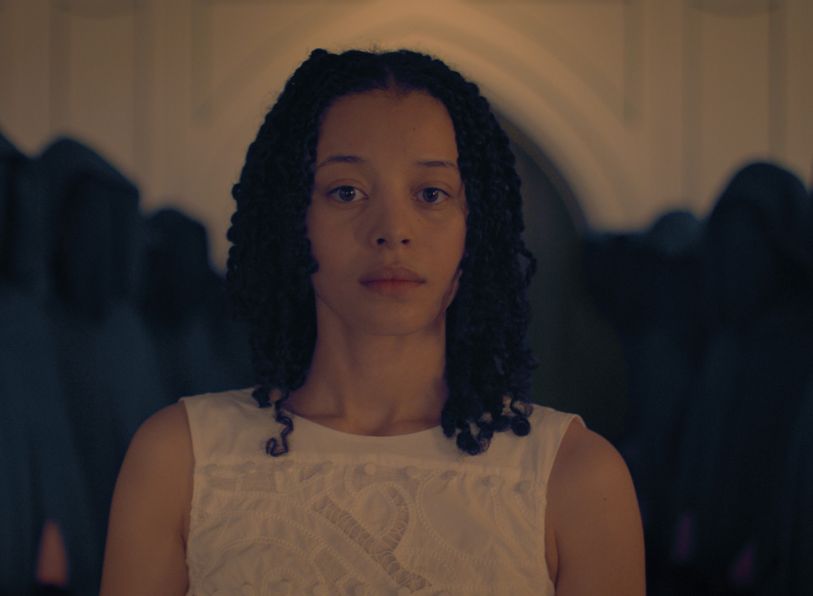
While Agnes is being prepared for a future within Gilead, Daisy’s hidden motives suggest that the system may already be dealing with an unseen threat from within its own walls.
Daisy’s hidden past and the outside world
Daisy narrates parts of her past, revealing that she once lived a very different life. Her memories include family, freedom, and experiences that stand in stark contrast to Gilead’s structure. Her past becomes a key part of her identity. It shapes her understanding of the present and fuels her resistance. This contrast between past and present deepens her role as someone who does not fully belong to the system.
Agnes continues to navigate her life under strict expectations. Her interactions with others, including her friends Becka and Shunammite, played by Mattea Conforti and Rowan Blanchard, show the different ways girls respond to Gilead’s control. Some accept, some resist internally, and some question quietly. Agnes finds herself caught between these responses, unsure of where she stands.
Daisy’s storyline reveals a deeper connection to the resistance movement, suggesting that her presence in Gilead is not accidental but related to Mayday. Her past ties begin to surface, and it becomes clear that she may have a larger role to play. Aunt Lydia continues to observe and control, but even she appears aware that something is shifting. The system is no longer as predictable as it once was.
The episode concludes with a major twist: Daisy’s true purpose begins to take shape, and Agnes starts to question everything she has been taught. Their paths begin to align in unexpected ways, hinting that both may be part of a larger plan against Gilead.
ADVERTISEMENT
Article continues below this ad
The final moments suggest that Gilead is entering a new phase. The system is still powerful, but the next generation is no longer as compliant as before. While secrets surface and identities begin to shift, the foundation of Gilead faces its first real challenge as Daisy’s identity comes to light.
Across the first three episodes of The Testaments, control is not just enforced; it is designed, refined, and internalized. Yet, through characters like Agnes and Daisy, and Aunt Lydia, the cracks begin to show. What emerges is not immediate rebellion but a slow, deliberate shift. The system that once seemed unbreakable now faces a generation that questions, remembers, and resists in ways that may not be loud, but are undeniably powerful.

ADVERTISEMENT
Article continues below this ad
What are your thoughts on the way Agnes and Daisy are being shaped within Gilead, and the subtle shifts in power and control across the episodes? Let us know in the comments below.
ADVERTISEMENT

Edited By: Itti Mahajan
More from Netflix Junkie on Hollywood News







ADVERTISEMENT