
‘The Testaments’ Episode 4 Recap: Agnes Awakens, Daisy Risks It All as Gilead’s Grip Starts Slipping
Credits: Disney
Credits: Disney
In the long shadow of The Handmaid’s Tale, the world of The Testaments does not scream for attention; it waits with unnerving patience. A new generation breathes inside rules they never questioned, until curiosity begins to itch. Episode 4 arrives like a polite invitation, hinting that something far less polite is about to unfold.
While polished rituals try to hold the illusion steady, episode 4 slowly tilts the table, turning polite performances into psychological battlegrounds where every glance carries consequences.
The tea party that turns obedience into a performance sport
ADVERTISEMENT
Article continues below this ad
Agnes does not attend a tea party; she walks into a live audition disguised as civility. The gathering feels less like hospitality and more like a surveillance reel curated for approval. Alongside Becka and the other Plums, she performs submission with the precision of someone aware that one wrong breath could rewrite her future. Every gesture feels studied, as if femininity itself has been reduced to choreography under watchful eyes.
Credits: Disney/Russ Martin
Credits: Disney/Russ Martin
Aunt Lydia, embodied again by Ann Dowd, observes like a critic who has already decided the review will sting. Her gaze cuts through politeness, searching for cracks beneath curated innocence. Mothers like Paula hover in the background, their presence less comforting and more like extensions of the system. The room breathes tension, where approval feels rationed, and failure feels permanent.
What appears as etiquette training quietly reveals itself as a marketplace of futures. Marriage prospects linger invisibly, turning teenage girls into carefully evaluated prospects. The tea, the smiles, the rehearsed laughter, none of it belongs to them. It belongs to a system that measures worth in obedience while pretending it is offering choice.
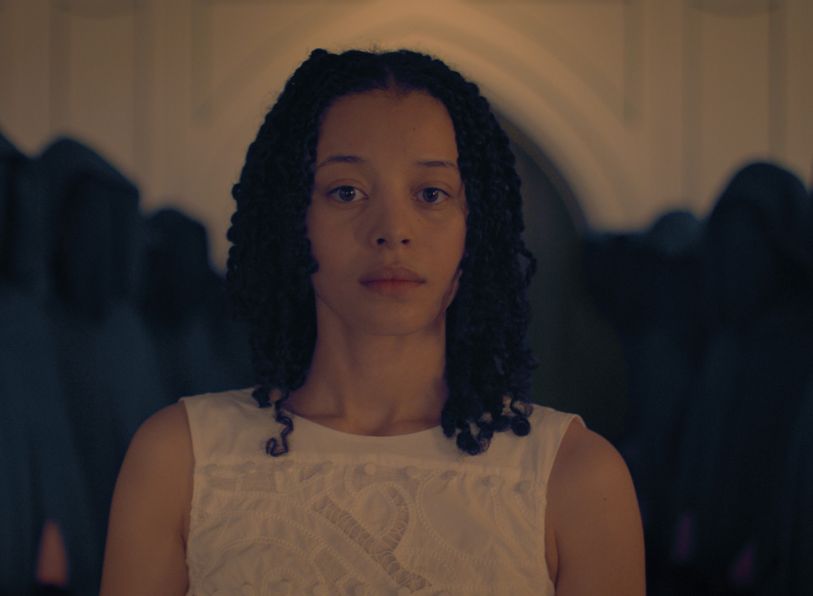
While the tea party polishes control into something almost elegant, the illusion begins to fracture as darker truths creep in, turning quiet rooms into spaces of unspoken terror.
Gilead’s decay beneath Dr. Grove’s shadow
Enter Dr. Grove, a figure who turns authority into something deeply unsettling. Positioned as a trusted professional, he embodies the kind of power that thrives when accountability disappears. His interactions with Agnes reveal a pattern that feels less accidental and more systemic. Under the guise of care, his behavior crosses the line, exposing how protection in Gilead often masks unfair treatment.
Agnes does not process this as rebellion; she processes it as confusion shaped by conditioning. The system has trained her to internalize blame, to question her own discomfort instead of the man causing it. That psychological trap lands harder than the act itself, turning harm into silence. Her reaction feels visceral, not dramatic, as if her body understands the danger before her mind is allowed to.
Credits: Disney/Russ Martin
Credits: Disney/Russ Martin
The horror does not stop with Agnes. Becka, portrayed with quiet fragility by Mattea Conforti, carries a heavier burden as his daughter. Her fear runs deeper, layered with proximity and inevitability. Their friendship evolves in this space, not through shared joy but through shared realization that the system protecting them is the same one enabling harm.
While Agnes and Becka begin to understand that fear is not a flaw but a carefully engineered feature, yet still cling to a fragile sense of hope, another story unfolds where danger is not inherited, it is deliberately chosen and relentlessly sustained.
Daisy walks a tightrope where one slip could cost everything
Daisy moves through Gilead like a perfectly rehearsed illusion, where every smile feels timed and every word carries risk. Disguised as a Pearl Girl, she performs belief with the precision of someone who knows one wrong note could end everything. The danger does not arrive loudly; it lingers in small moments, in glances that last too long, in questions that feel slightly misplaced. While the system demands obedience, Daisy quietly rewrites the script, turning survival into an act of resistance.
Credits: Disney/Russ Martin
Credits: Disney/Russ Martin
ADVERTISEMENT
Article continues below this ad
What makes Daisy’s situation sharper is the constant mental strain of living two lives at once. Inside the rigid structures of Gilead, she gathers intelligence while pretending to absorb its teachings, a balance that feels almost impossible to maintain. Each step inside Aunt Lydia’s world becomes a calculated move, where even trust is treated like a liability. The pressure builds not through action alone, but through the exhausting need to remain invisible while doing something that could change everything.
Beneath the mission lies a deeply personal cost that refuses to stay buried. The truth about her past, including the loss of those who protected her identity, turns every decision into something heavier than strategy. Daisy is not simply risking exposure; she is carrying the weight of a sacrifice that demands she succeed. In a place where loyalty is manufactured, her defiance feels dangerously real, pushing her closer to a line that, once crossed, offers no way back.

ADVERTISEMENT
Article continues below this ad
What are your thoughts on The Testaments episode 4 and the way Gilead’s control begins to quietly unravel? Let us know in the comments.
ADVERTISEMENT

Edited By: Aliza Siddiqui
More from Netflix Junkie on Hollywood News


ADVERTISEMENT