
The Odyssey Translator Doubles Down on Christopher Nolan’s “Emotionally Empty” 'The Odyssey'
Credits: Universal Pictures
Credits: Universal Pictures
Christopher Nolan’s The Odyssey has become a box office juggernaut, smashing records and sailing toward the billion-dollar mark just weeks after release. The mythological epic has earned enthusiastic audience support, an “A” CinemaScore, and hundreds of millions worldwide.
Yet, while moviegoers have embraced Nolan’s vision, the scholar whose translation helped inspire it remains deeply dissatisfied with the finished film.
Emily Wilson critiques the film’s emotional and moral depth
ADVERTISEMENT
Article continues below this ad
Emily Wilson, the University of Pennsylvania classics professor and translator of the 2017 English edition of Homer’s The Odyssey, has expanded her criticism in an op-ed for The Atlantic.
“These lessons are legible in Homer and Virgil, but are elided by Nolan’s visually stunning, emotionally empty film,” Wilson wrote. Her argument is that the movie claims to value compassion and hospitality while its visual storytelling prioritizes machinery, warfare, and spectacle.
Credit: Universal Pictures
Credit: Universal Pictures
In The Atlantic, Wilson focuses particularly on the film’s treatment of the Trojan Horse and the repeated references to Zeus’ law, which reflects the ancient principle of treating strangers with generosity. In her view, the film does not sufficiently explore the human cost of the conflict or the choices that led to it.
“The script tells us loudly that people matter, but the camera shows us that what matters is the mechanical challenge of moving objects through space,” she wrote.
Wilson had already criticized the screenplay in a review for the London Review of Books, where she questioned its psychological, emotional, political, and ethical depth. Her assessment stands in sharp contrast to the film’s commercial performance. The Odyssey has earned approximately $405 million domestically and $922 million worldwide after three weeks.
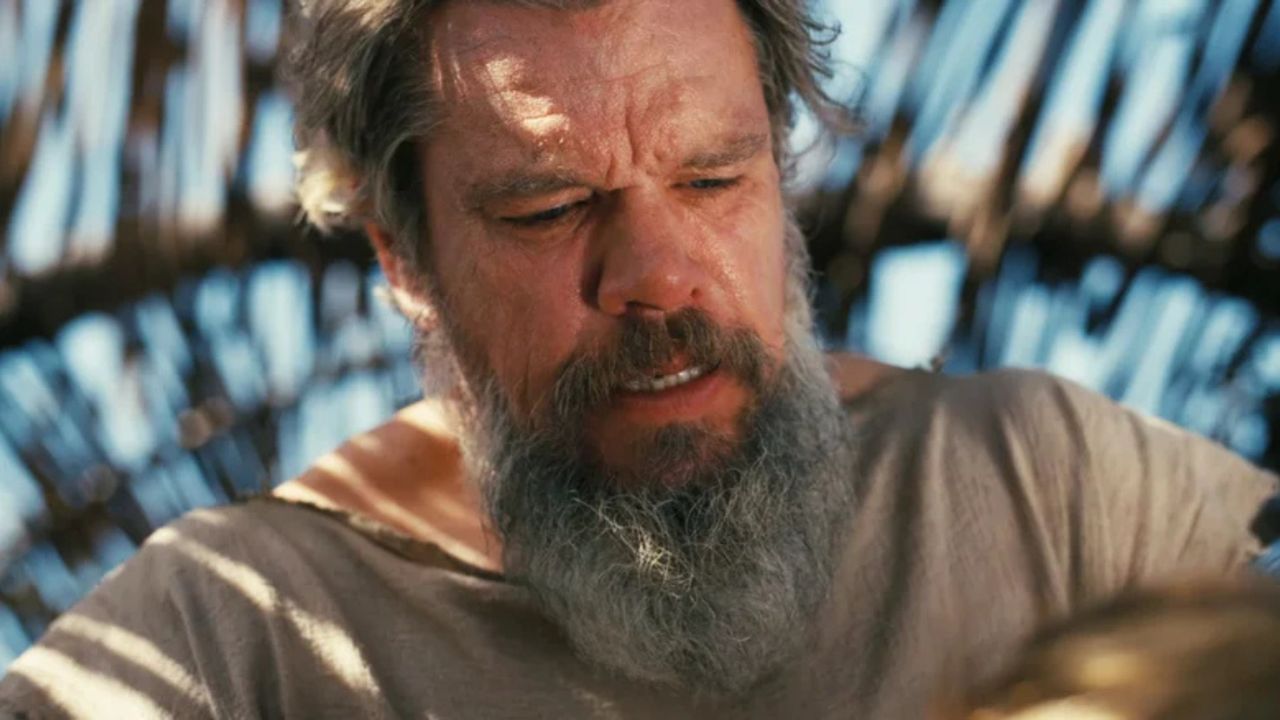
The divide between critical interpretation and cinematic storytelling becomes even clearer when looking at how Nolan reshapes Homer’s original narrative.
How Christopher Nolan’s adaptation reshapes Homer’s epic
Christopher Nolan’s The Odyssey follows the broad outline of Homer’s ancient epic, but it reshapes the story for a modern cinematic audience. The film places greater emphasis on war trauma, personal responsibility, and the psychological burden carried by Odysseus, while the poem presents his journey through a more openly mythological world of gods, monsters, fate, and divine intervention.
Credits: Universal Pictures
Credits: Universal Pictures
ADVERTISEMENT
Article continues below this ad
One of the clearest changes is the reduced presence of the Olympian gods. In Homer’s poem, Athena, Poseidon, Hermes, and other deities directly influence events, helping or obstructing Odysseus as he attempts to return to Ithaca. Nolan largely removes them from the action, turning divine forces into general ideas or psychological impressions.
Nolan also adds a stronger sense of guilt to Odysseus’ character. Rather than presenting him mainly as a clever hero trying to reclaim his home, the film depicts a man forced to confront the consequences of his choices during wartime, especially the Trojan Horse strategy. These changes transform the adaptation from a story primarily about heroic homecoming into a more introspective drama about memory, accountability, and whether returning home can truly undo the past.
ADVERTISEMENT
Article continues below this ad
What do you think about the criticism surrounding The Odyssey and its interpretation of Homer’s work? Let us know in the comments.
ADVERTISEMENT

Edited By: Itti Mahajan
More from Netflix Junkie on Hollywood News



ADVERTISEMENT