
Steven Spielberg Warns Hollywood Will “Run Out of Gas” on Franchise Films
via Imago
Credits: Imago
Steven Spielberg knows what it takes to build cinematic worlds that last, and more importantly, when they begin to lose their magic. From dinosaurs thundering through Jurassic Park to children chasing starlight in E.T., he mastered the rare balance between spectacle and soul, originality and franchise. So when Spielberg speaks about the future of cinema, it appears to be a warning signal from the architect himself.
And with his latest extraterrestrial venture Disclosure Day, he is once again looking beyond the horizon, urging Hollywood to do the same.
Steven Spielberg wants a future beyond familiar worlds
ADVERTISEMENT
Article continues below this ad
At CinemaCon, while promoting Disclosure Day, Steven Spielberg made it clear that even giants like Universal must resist the gravitational pull of endless franchises.
“If all we make is known, branded IP, we’re going to run out of gas,” Spielberg said. “There is nothing more important than giving the audience visual stories, and they can be in any form, but we need to tell more original stories.”
It is striking admission from the very filmmaker who helped define the blockbuster era, yet perhaps that is precisely why it matters. The moment carried weight beyond promotion.
Motion Picture Association CEO Charlie Rivkin presented Spielberg with the “one-time honor, the America 250 award,” a tribute that left him visibly emotional. It marked his first appearance at CinemaCon. But Spielberg was not there just to celebrate; he came with a blueprint. He advocated for longer theatrical windows, praising Universal’s move to extend runs from 17 to 45 days, reinforcing his belief that cinema is an experience meant to linger in the dark a little longer.
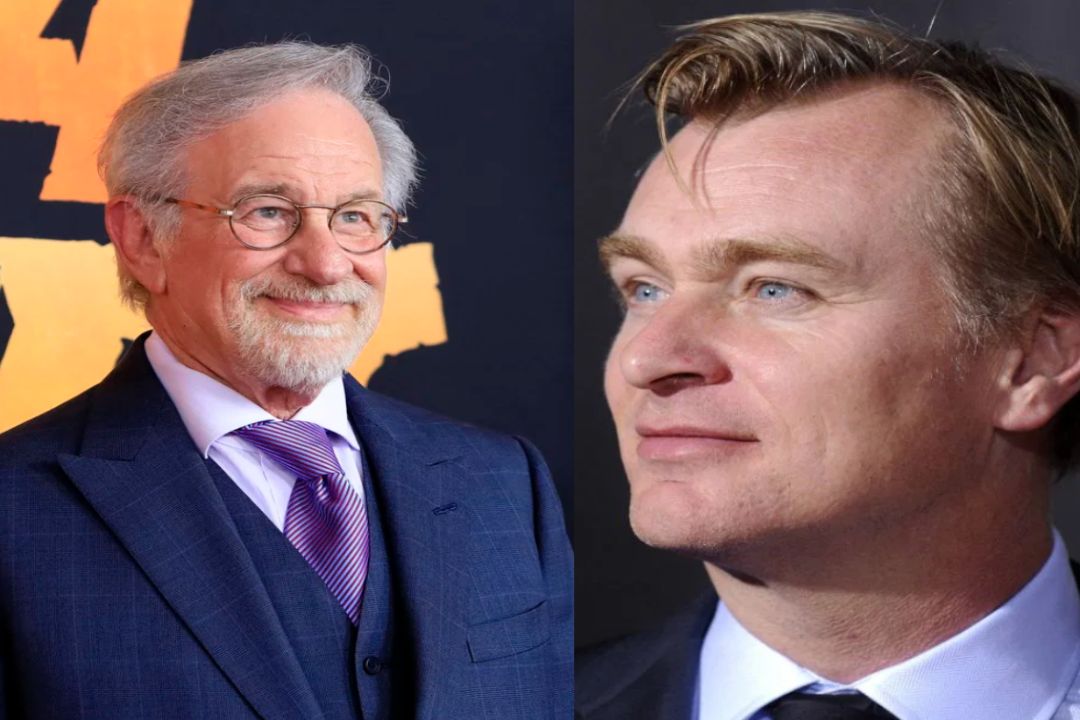
Then comes Disclosure Day, and suddenly, the conversation shifts from theory to mystery. How much of the story is original?
Disclosure Day : Signals from the unknown
The trailer of Disclosure Day unveiled at CinemaCon teased a story worth following. Josh O’Connor’s Daniel Kellner, a cryptosecurity expert turned whistleblower, unearths secrets of extraterrestrial encounters dating back to 1947, echoing the ghost of Roswell. Opposite him, Emily Blunt’s Margaret Fairchild speaks in eerie alien clicks that translate into mathematical language, as if the universe itself is trying to communicate through her.
Steven Spielberg, however, is guarding the final act like a secret buried in the stars.
“[This movie] needs to be experienced,” he said.
“And all you need to get from the beginning to the end is a seat belt.”
ADVERTISEMENT
Article continues below this ad
What lingers, though, are the fragments: children on glowing gurneys, alien fingers curling into memory, a jet piercing through a spectral threshold of light. And that haunting image, a deer bending over a child, its eye revealing something far older, far stranger, feels like Steven Spielberg reaching back to Close Encounters of the Third Kind, as if the past and future of his storytelling are quietly converging. There is even speculation that this could be spiritually tied to that film’s legacy, especially with its 50th anniversary approaching.
If Disclosure Day is indeed a return to Spielberg’s most curious instincts, then perhaps his warning is not just about Hollywood running out of gas, it is about forgetting how to dream in the first place.
ADVERTISEMENT
Article continues below this ad
What do you think? Can original storytelling still compete with franchise giants, or is Spielberg fighting a losing battle? Share your take in the comments.
ADVERTISEMENT

Edited By: Hriddhi Maitra
More from Netflix Junkie on Hollywood News


ADVERTISEMENT