
7 Best Sherlock Holmes Performances That Stand Out for Different Reasons
Credits: Daniel Smith/Warner Bros. Entertainment
Credits: Daniel Smith/Warner Bros. Entertainment
First introduced by Sir Arthur Conan Doyle in 1887's A Study in Scarlet, Sherlock Holmes has become the gold standard for fictional detectives. Across four novels and 56 short stories, Doyle crafted mysteries that blended razor-sharp deduction, forensic observation, and the enduring friendship between Holmes and Dr. Watson. Sherlock Holmes has since inspired countless film and television adaptations, each reimagining the detective for a new generation.
Some actors emphasize his eccentric brilliance, others his emotional restraint or humanity. However, these performances prove that while the character remains timeless, every portrayal uncovers a different facet of the world's greatest consulting detective.
1. Jeremy Brett
Jeremy Brett’s Sherlock Holmes, running from 1984 to 1994, produced by Granada Television under Michael Cox, remains the most rigorous book-purist adaptation of Arthur Conan Doyle’s detective. Built directly from the original stories and Sidney Paget’s Strand Magazine illustrations, the series deliberately rejected the Hollywood image of a polished, pipe-smoking gentleman, instead restoring Holmes as a volatile, razor-minded investigator.
Brett’s performance is defined by psychological duality and physical precision. His Holmes surges into frantic investigative energy during cases, then collapses into eerie stillness when bored, embodying Doyle’s descriptions of emotional extremity and intellectual dependence on stimulation.

The production’s grounded supporting cast, especially Watson, Mrs. Hudson, Lestrade, and Mycroft, reinforces this realism. Together, they create the closest screen realization of Doyle’s literary Holmes.
2. Benedict Cumberbatch
Set in contemporary London, Benedict Cumberbatch’s Sherlock, which ran from 2010 to 2017, reimagines classic cases through smartphones, digital forensics, and rapid data analysis while preserving Holmes as a relentless pattern-seeking intellect. Structured as 13 feature-length episodes, Cumberbatch’s performance is defined by the “high-functioning sociopath” lens, capturing Holmes’s psychological duality. In investigative mode, he becomes a surge of intellectual velocity, delivering rapid deductions with surgical precision and almost ecstatic focus.
When unstimulated, he collapses into volatile boredom, shown through emotional withdrawal, disruptive behavior, and reckless experimentation. Beneath this control, brief flashes of empathy surface, especially in his bond with Watson. Martin Freeman’s Watson grounds the narrative with trauma-shaped humanity, Andrew Scott’s Moriarty mirrors Holmes as chaotic brilliance, while Mycroft, Mrs. Hudson, and Lestrade form a stabilizing human framework around Holmes’s brilliance and isolation.
3. Basil Rathbone
For many moviegoers, Basil Rathbone was Sherlock Holmes. His performances for 20th Century Fox and Universal Pictures between 1939 and 1946 created the template that classic Hollywood never really moved past. With his sharp profile, intense gaze, and clipped delivery, he looked as if he had stepped straight out of Sidney Paget’s Strand Magazine illustrations, turning illustration into living cinema. The films began in Victorian London with The Hound of the Baskervilles and The Adventures of Sherlock Holmes, then shifted into a bold reinvention where Holmes fought wartime espionage in a 1940s modern setting, tracking spies and uncovering Nazi plots.
Rathbone’s Holmes is all motion and authority, a man who enters scenes like a verdict already decided. He lacks the book’s heavier melancholy, instead becoming a polished, action-driven intellectual force. The deerstalker, cape, and pipe became pop culture symbols through him, even when the films dressed him in trench coats and fedoras. His fondness for disguise added playful theatricality, letting him slip into entirely different identities with ease. However, among book purists, Nigel Bruce’s portrayal of Watson remains highly controversial even though it is popular.
4. Robert Downey Jr.
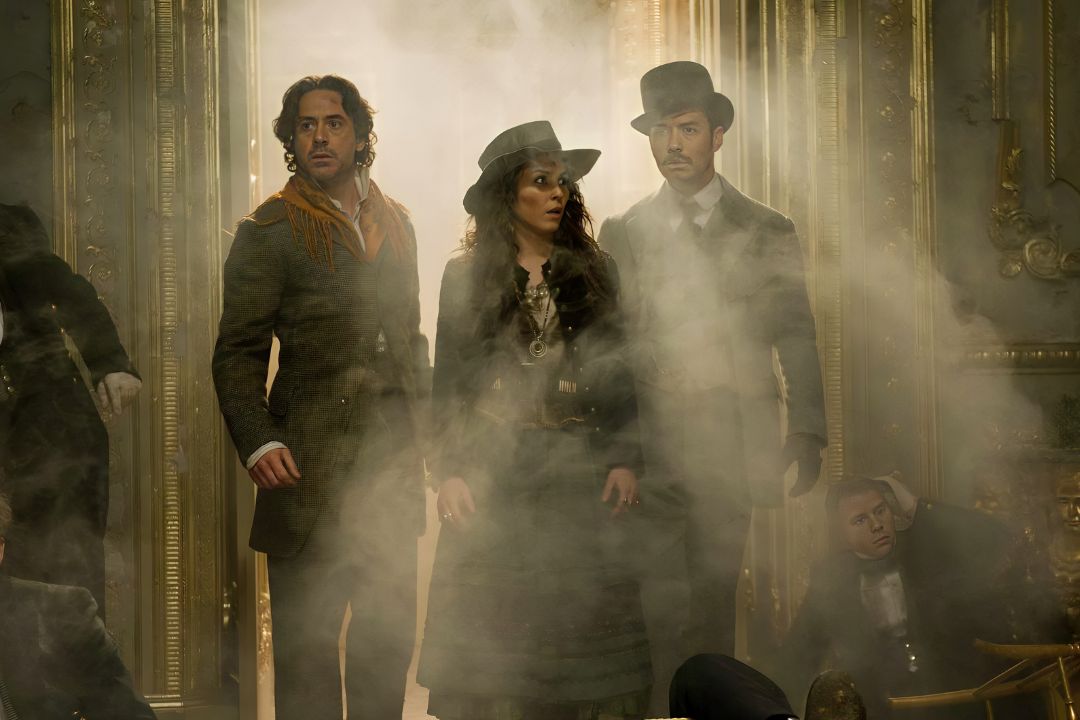
Guy Ritchie’s Sherlock Holmes films turn the detective into a whirlwind of motion, intellect, and street-level chaos, with Robert Downey Jr. delivering a definitive action-heavy interpretation. Set in a reimagined Victorian London soaked in fog, grime, and industrial noise, the world feels less like a drawing-room puzzle and more like a living machine of crime, science, and underground power struggles. Downey Jr. portrays Holmes as a disheveled genius oscillating between self-imposed isolation and explosive cognitive acceleration.
In low phases, he withdraws into chaotic experiments and obsessive planning, while in active cases his mind operates at violent speed, processing outcomes faster than speech can follow. “Holmes-Vision” externalizes this intellect, slowing combat into calculated sequences before snapping back into brutal precision. Rachel McAdams’s Irene Adler stands as a crucial counterbalance, reimagined as a cunning grifter and emotional wildcard who repeatedly outmaneuvers Holmes and exposes his rare vulnerabilities. Rather than a passive love interest, she becomes an intellectual and strategic equal.
5. Jonny Lee Miller
With its gender-reimagined core relationship, Elementary stands apart as a long-running contemporary Sherlock Holmes portrayal that reshapes the detective myth for modern television. Running from 2012 to 2019, the CBS series spans 154 episodes across seven seasons, making Jonny Lee Miller’s Holmes the most extensively developed screen version in history. In modern-day New York City, it unfolds as a procedural yet evolves into a long-form psychological study of recovery, relapse, and reinvention. Miller’s Holmes is defined by twitchy brilliance and emotional exposure rather than detached superiority.
His deductions are rapid and physical, but his intelligence is paired with visible vulnerability, especially in his ongoing battle with addiction and rehabilitation under supervised living. This human fragility distinguishes the portrayal from colder interpretations. Lucy Liu’s Joan Watson fundamentally reshapes the dynamic, replacing traditional sidekick framing with a grounded, authoritative partner who begins as a sober companion and evolves into Holmes’s intellectual equal. Natalie Dormer’s Moriarty, merged with Irene Adler, intensifies the emotional stakes as Holmes’s ultimate intellectual and psychological counterforce, completing a deeply modern, character-driven reinvention of the Holmes universe.
6. Peter Cushing
Peter Cushing’s Sherlock Holmes work spans from 1959 to 1984, marking one of the longest and most stylistically distinct interpretations of the character across both film and television. His defining debut came with Hammer Films’ The Hound of the Baskervilles (1959), a theatrical release that reimagined Holmes within a fully Gothic horror atmosphere. Years later, he returned to the role for the BBC’s Sherlock Holmes television series in 1968, which ran across multiple adaptations and episodes. His final appearance came much later in The Masks of Death (1984), a television film that revisited an older Holmes near the end of his investigative life.
Across these decades, Cushing’s portrayal defined the Gothic Holmes aesthetic. A lifelong admirer of Arthur Conan Doyle, he approached the role with strict book-purist discipline, emphasizing Sidney Paget’s original illustrations. His Holmes is lean, sharp, and intensely physical, moving through fog-heavy Victorian landscapes with predatory precision. The performance fuses detective logic with Hammer Horror atmosphere, creating a Holmes who feels both literary and eerily cinematic in equal measure.
7. Henry Cavill
In Netflix’s Enola Holmes trilogy, Henry Cavill’s Sherlock Holmes is reimagined as a supporting character within a family-centered narrative. Rather than occupying the traditional role of central detective, Sherlock becomes part of a broader Holmes family dynamic led by Enola Holmes, shifting focus away from solitary genius toward relational intelligence. Cavill portrays Sherlock as composed, observant, and affectionate in his own way, emphasizing restraint rather than emotional detachment. His deductive abilities remain intact, rooted in classic Holmesian observation, but they are expressed through mentorship and subtle encouragement rather than command.
The evolving sibling relationship forms the emotional backbone of his arc, with Sherlock gradually acknowledging Enola as an equal intellectual force. Surrounding characters such as Mycroft, Eudoria Holmes, and Dr. Watson reinforce this shift by positioning Sherlock within a network of competing ideologies and emotional influences. The result is a Holmes who functions less as a lone pillar, as in other adaptations, and more as a stabilizing presence within a fractured yet evolving family system.
Across these seven portrayals, Sherlock Holmes evolves through distinct interpretations that highlight different facets of the character. Rathbone represents authority, Brett captures book-accurate volatility, Cumberbatch delivers modern intellectual speed, Downey Jr. brings kinetic action, Miller offers emotional realism, Cushing defines Gothic precision, and Cavill presents gentle mentorship. Each version expands Holmes through a unique cinematic and narrative lens.
Which of these Sherlock Holmes portrayals stands out most to you? Let us know in the comments.

Edited By: Hriddhi Maitra
