
Prime Video's 'The Love Hypothesis' Review: Faithful in Plot, Uneven in Romance

Credits: Philippe Bossé/ Prime Video © Amazon Content Services LLC
Credits: Philippe Bossé/ Prime Video © Amazon Content Services LLC
There are many things that can make a girl happy: a song at exactly the right moment, a dress that makes her feel beautiful, a late-night conversation with a friend, or a book that keeps her awake long after she should be sleeping. And then, of course, there is romance—the kind that makes your heart flutter over fictional people and convinces you, for a few hundred pages, that perhaps love really is as simple as finding your person.
Perhaps that is why romances have always found such a comfortable home on screen. Adaptations let readers watch the characters they fell for and the scenes they replayed in their heads come alive.
Prime Video’s The Love Hypothesis, adapted from Ali Hazelwood’s bestselling novel, arrives with precisely that expectation. It gives us many of the moments we remember—but not always the feeling that made us love them.
The Love Hypothesis is us visually watching the book come to life
If there is one thing The Love Hypothesis does not deserve to be accused of, it is forgetting where it came from. The film is, in many ways, almost startlingly familiar to anyone who has read Ali Hazelwood's novel. It opens exactly where the book does: Olive, struggling with her contact lenses in Adam's lab bathroom, only to run into the man she would rather avoid. Even the awkwardness of their first exchange feels lifted straight from the pages. From there, the adaptation continues to scatter little gifts for readers who know the book by heart.
The fake-dating arrangement arrives with its familiar academic stakes—Adam's grant, Stanford's unwillingness to renew it, and the convenient little fiction of a serious relationship that might save the day. Even the date of their meeting, October 24, makes its way onto the screen. There is the handshake, the coffee-shop date, the elaborate rules of their fake relationship, the student-faculty picnic and Adam's delightfully uncomfortable attempts at looking like someone's boyfriend. The film even remembers the smaller things: his surprise at Olive's alarming amount of sugar, his awkward forehead kiss, the flu shot he is inexplicably terrified of, and the way Olive ends up helping him navigate the softer parts of being human.
And then there are the scenes that feel almost like they have been lifted from the book and placed, unchanged, in front of a camera. Olive's SBD presentation, Adam helping her prepare for it, his history with his mentor, Tom Benton worming his way into Olive's professional life, and even the rather unfortunate business of Adam calling Olive “edible” all make their way into the film.

Credits: Philippe Bossé/ Prime Video © Amazon Content Services LLC
Credits: Philippe Bossé/ Prime Video © Amazon Content Services LLC
The supporting characters are not left behind either. Anh remains the friend who will drag Olive into situations she would happily avoid, while Malcolm gets to be his wonderfully chaotic self. The film understands that these friendships are part of what makes Olive's world feel lived-in, rather than simply placing her in a romance and calling it a day.
For a book-to-screen adaptation, that level of familiarity is comforting. There is a certain pleasure in recognizing a scene before it happens, in hearing a line you remember and thinking, Oh, they kept that. And The Love Hypothesis gives readers plenty of those moments.
But there is a difference between being faithful to the events of a book and being faithful to the feeling of it. The film knows which scenes belong in the story; the more difficult question is whether it always knows why those scenes mattered. Because while almost everything seems to be where it should be, the emotional threads connecting these moments do not always feel quite as tightly woven.
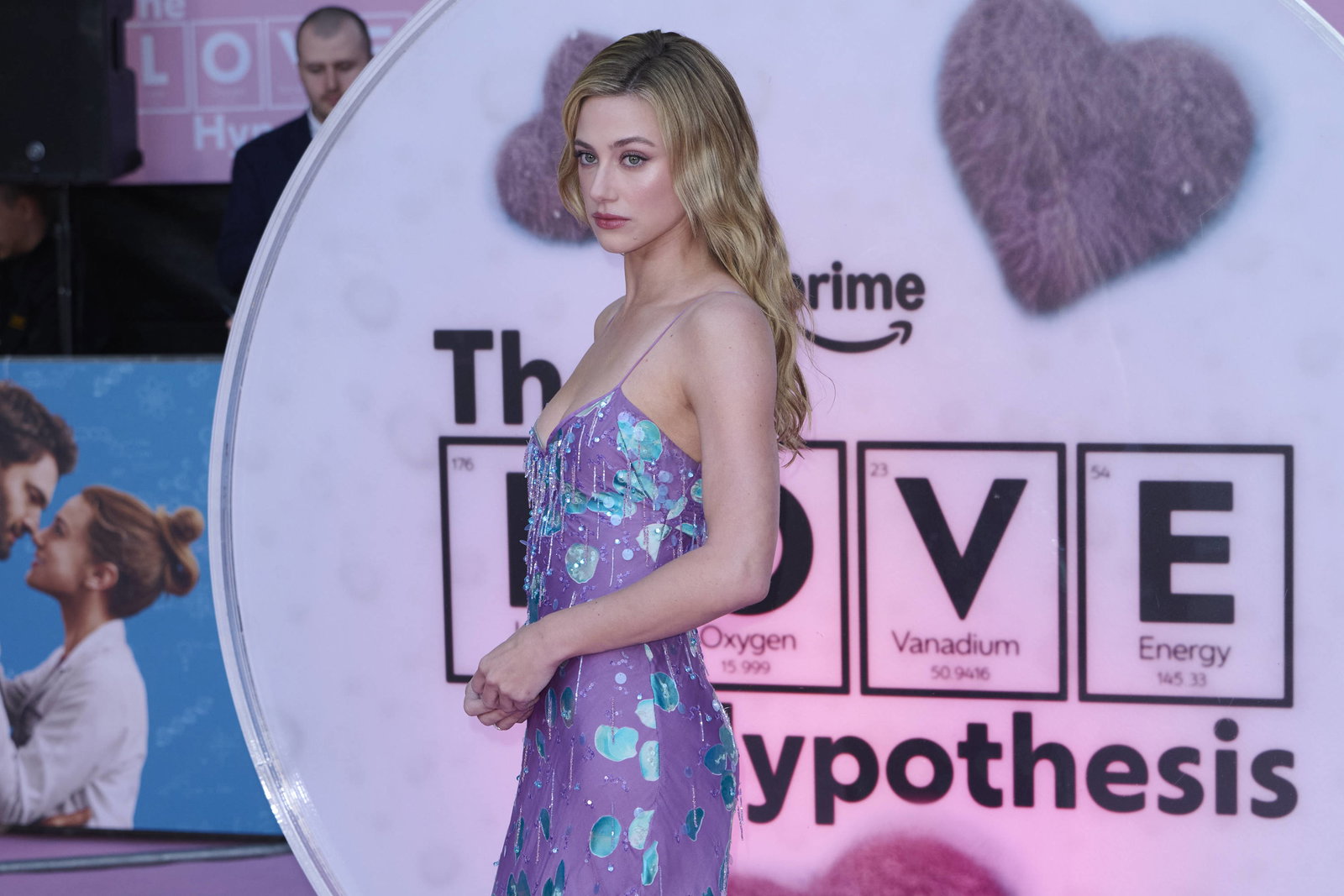
“Wanted to Pay Homage” — Lili Reinhart on Her ’90s Rom-Com Method Dressing for 'The Love Hypothesis'
And that, ultimately, is where the adaptation begins to become more interesting than a simple exercise in spotting differences.
Adam Carlsen is as constipated in love as he was in the book
Adam Carlsen has never exactly been the poster boy for effortless romance. Even in the book, his idea of expressing affection seems to involve staring intensely, saying very little, and looking as though someone has just asked him to solve a particularly difficult equation. The film, to its credit, understands this very well. Adam spends a considerable portion of the movie looking, quite literally, constipated in love.
There is the uncomfortable smile when Anh and Malcolm discover the relationship, followed by an awkward forehead kiss on their first coffee date that is somehow supposed to convince everyone that this is a perfectly normal romance. There is the infamous “you nice, very nice” when he sees Olive dressed up. There are his painfully awkward attempts to comfort people, and the general impression that every emotion has to pass through several academic departments before it reaches his face. And yet, beneath all that awkwardness, the film makes an important departure from the book: this Adam seems to fall in love with Olive as we watch him do it.
That is not quite the same Adam readers meet on the page. In the book, there is the knowledge that Adam has already been carrying these feelings for Olive for two years. His love is not something that begins with the fake relationship; it is something that has been quietly sitting underneath it all along. The film, however, seems more interested in showing us the process of Adam falling for her. We watch him become increasingly attentive, soften around her, help her with her presentation, hold her hand when he is scared of getting a flu shot, and slowly become less Dr. Evil and more boyfriend.

Credits: Philippe Bossé/ Prime Video © Amazon Content Services LLC
Credits: Philippe Bossé/ Prime Video © Amazon Content Services LLC
In isolation, this is not necessarily a bad choice. In fact, there is something lovely about watching a character discover his feelings in real time. But it changes the texture of the romance. The Adam of the book carries the tension of a man who already knows exactly what he wants but cannot—or will not—say it. The Adam of the film is discovering what he wants alongside Olive.
That distinction matters because so much of Adam's appeal comes from what exists beneath his silence. When you remove the knowledge that he has been in love with Olive for years, his awkwardness becomes less the nervousness of a man desperately trying to conceal feelings he has had forever and more the nervousness of a man figuring out what those feelings are.
Still, perhaps that is why the film's Adam works best when he is allowed to be exactly what his face promises: deeply, hopelessly, and spectacularly awkward. He may not always look like a man who has mastered the art of romance, but at least he looks like a man who is trying to learn it.
Book lore accurate, Adam calls Olive edible but the chemistry was not chemistrying
If there is one thing a romance cannot afford to lose in translation, it is chemistry. You can recreate the scenes, reproduce the dialogue, and dress the characters exactly as the reader imagined them, but if the two people at the centre of the story do not make you believe they want each other, something inevitably gets lost. This becomes particularly noticeable around chapter 16.
For readers of the book, this is not just another scene. It is the point at which we finally get a much clearer sense of Adam's perspective and, more importantly, how he sees Olive. The film does recreate the moment—yes, Adam does tell Olive that she is “edible”—but hearing the words is not quite the same as feeling the heat behind them. The scene arrives with all the ingredients it is supposed to have, yet somehow leaves you waiting for the spark. And unfortunately, the problem does not end with that scene.
After Chapter 16, the chemistry between Adam and Olive begins to feel increasingly muted, even as the plot keeps insisting that their relationship is becoming more serious. They argue, reconcile and eventually confess their feelings, but the emotional progression does not always feel as intense as the story wants it to be. Some moments should make you think, Oh, these two are completely gone for each other, and instead you find yourself thinking, Yes, they are definitely supposed to be in love. That distinction is important.

Credits: Philippe Bossé/ Prime Video © Amazon Content Services LLC
Credits: Philippe Bossé/ Prime Video © Amazon Content Services LLC
The film does have tender moments that help establish a relationship that is moving beyond the fake-dating arrangement. But romance is not built only from gestures; it is built from the tension between them. It is in the pauses, the looks that last a second too long, the sense that two people are constantly aware of each other even when they are talking about something completely ordinary. And that is what feels missing.
Perhaps this is also where the film's decision to make Adam's love more gradual works against it. If Adam is falling for Olive as the movie progresses, the romance needs to keep building in intensity alongside him. Instead, some of the later scenes feel strangely less charged than the earlier ones. The story reaches the point where these two should be unable to keep their feelings contained, but the chemistry does not always rise to meet the moment.
It is particularly frustrating because the film gets so many of the beats right. The characters are there. The dialogue is there. The scenes are there. Even the “edible, Olive” moment is there. But romance, unfortunately, cannot survive on a checklist.
You can put the right words in their mouths. You can put them in the right room. You can even put them in the same bed. You still need them to look like they are in love.
If chemistry falters, romance lost its rhythm too
By the time The Love Hypothesis reaches its final stretch, the film begins to feel like it is racing towards an ending it has already decided it needs to reach. And strangely enough, that rush does not make the movie feel fast. It makes it feel slow.
The problem is not that there is too much story. There is, in fact, a lot of it. Tom's involvement in Olive's research escalates, Adam leaves for his flight, Malcolm's conflict with Adam has to be resolved, Olive has to look for another lab after Tom's disgusting offer, Anh has her conversation with Adam, and eventually Adam confronts Tom before the story arrives at its inevitable confession and happy ending. Individually, these moments work. Together, they do not always weave as neatly as they should.
The film seems to move from one plot point to another without giving each emotional development enough room to settle. One moment Olive is dealing with the professional mess surrounding Tom; the next, Adam is distancing himself; then Malcolm returns; then Anh talks to Adam; then Adam decides to confront Tom; and suddenly we are at the confession. There is movement everywhere, but not always enough connective tissue between those movements.
That is what makes the pacing so peculiar. The movie can feel as though it is taking its time while simultaneously making you wonder, Wait, we're already here?

Credits: Philippe Bossé/ Prime Video © Amazon Content Services LLC
Credits: Philippe Bossé/ Prime Video © Amazon Content Services LLC
The final stretch especially needed more breathing room for Adam and Olive themselves. After all the awkwardness, fake dating, and gradual shift in their relationship, their eventual confession should feel like the culmination of everything that came before it. Instead, the plot seems to do much of the work of pushing them towards the ending for them.
And perhaps that is the biggest irony of the adaptation. For a story whose central romance is built around two people pretending to be together until their pretend relationship becomes real, the film sometimes feels too conscious of the destination. It knows they have to fall in love. It knows they have to kiss. It knows there has to be a happy ending. What it occasionally forgets is that the audience needs to feel them getting there.
The result is a movie that is remarkably faithful to the book's individual moments, but less successful at stitching those moments into one continuous emotional journey.
Still, there is something undeniably satisfying about seeing Olive and Adam finally get their happy ending. Perhaps that is the advantage of having read the book: even when the journey feels uneven, you already know why you wanted to arrive.
Arriving on Prime Video on September 23, The Love Hypothesis brings Ali Hazelwood’s much-loved romance from the page to the screen tomorrow.
Are you excited for the film? Which scene are you most excited to watch? Let us know in the comments.

Edited By: Aliza Siddiqui
