
INTERVIEW: ‘Something You Should Know About Me’ Creators Andy Fidoten and EJ Marcus on Romance, Self-Doubt, and Finding Yourself (TRIBECA)
Credits: Obscured Pictures
Credits: Obscured Pictures
The premise of every romantic comedy film mainly focuses on finding love, but Something You Should Know About Me does something different. It not only talks about finding your special one but also about finding yourself. What starts as a simple story about a young man falling in love with his best friend takes a surprising turn when his insecurities surface, leaving him unable to decide what to do and what not to do.
Directed by Andy Fidoten, the film, which had its premiere at this year's TRIBECA Festival, takes place in a convention hosted by the members of the LGBTQIA+ community and primarily focuses on AL (played by EJ Marcus), a young artist who is struggling with self-doubt and the fear of not belonging. As the story progresses, the movie beautifully explores themes such as queer identity and personal growth. Moreover, it also talks about the stories we tell ourselves and the people around us.
Netflix Junkie caught up with director Andy Fidoten and lead actor EJ Marcus to discuss the film's visual language, the realities behind AL's insecurities, and why Something You Should Know About Me is much more than just a romantic movie.
ADVERTISEMENT
Article continues below this ad
Aayush Sharma: One of the most striking visual choices is the contrast in lighting; the hall scenes are bright and socially open, while the moments centered on AL and Jesse feel dimmer and emotionally fragile. Andy, could you talk about the visual grammar behind those lighting transitions? Were you consciously externalizing AL’s fear of emotional rejection through cinematography?
Andy Fidoten: My cinematographer is gonna love this question because we tried to make a really intentional choice. We had two lighting guidelines that were carrying us. One was the camp aesthetic, which was based around Wet Hot American Summer and those very classic, nostalgic, funny films. At the same time, my cinematographer and I looked to a very different visual reference point for the emotional, intimate scenes: Nan Goldin's 1980s photography—very moody New York City, queer romance. We wanted to create a really specific visual grammar to talk about queer intimacy without being overt about it. Obviously, in the movie itself, we wanted the story, and I think it is, to be accessible to anybody who is ever in love, has had a crush, or has had an unrequited crush. But one of the cool things about movies is that you can infuse visual storytelling subtly. That became a cue we wanted to use, so I'm glad it came across so well.
Aayush: EJ, your character AL constantly interprets silence, glances, and casual conversations as emotional threats. Your performance feels deeply internal rather than overtly dramatic. How did you approach portraying a character whose biggest battles are internal and often invisible?
EJ Marcus: That is such a good question. To me, Al instantly felt relatable; not because I actually move through the world the way he does, but because of what you're saying. He felt like someone who, like all of us, has a million things going on inside at all times and isn't always sure what he wants to share with people or how to relate to them in that way. I think even if you're someone who doesn't struggle with that kind of externalized anxiety, everybody has those thoughts inside them: "Is this the right place for this?" "Am I doing this right?" So he just felt incredibly real to me. Thankfully, because of Andy's writing, he felt so vivid and fully formed that I immediately thought, "Okay, I know who this is." In terms of embodying him, we were kind of joking on set that I would get ready for takes by having this weird physical spasm or something. But it really did feel very physical for me. The weight of his emotions felt like a blanket that I would put on before a scene and think, "Okay, now I'm going into it."
Credit: Obscured Pictures
Credit: Obscured Pictures
Aayush: AL’s insecurity around Mason goes beyond simple jealousy. He almost mythologizes Mason as someone more desirable, more socially fluent, and more “worthy” of attention. What were you both trying to say about self-perception within queer spaces, where comparison and validation can sometimes become emotionally consuming?
EJ: I think you put it really well. The idea of inherently comparing yourself to other people and where you are in your own journey feels especially specific to queerness. I mean, I think everyone experiences that to some degree, but there's something about queerness that can make those comparisons feel even more intense. Al comes into the story feeling pretty good about himself because he has Jesse with him. He has the armor of that relationship and feels secure in it. But Mason represents a threat to that in the largest sense. What felt important to me in those moments, especially when Mason is first introduced, was treating him as a threat regardless of what he was actually doing. It wasn't really about Mason's actions. He could have done almost anything in those scenes, and Al would have had the same reaction.
That felt really important because it felt true to me. Especially when you are younger, people can seem incredibly threatening, even when they haven't done anything wrong. It's not really about them at all—it's about your own insecurities, fears, and comparisons. It has everything to do with what's going on inside of you and very little to do with the other person.
Andy: I think Mason really ends up representing the intense, physical manifestation of every insecurity that Al has ever had. That is why it is so fun when we eventually realize that he is actually very different from what Al assumed. He is not this larger-than-life threat at all—he is just another person.
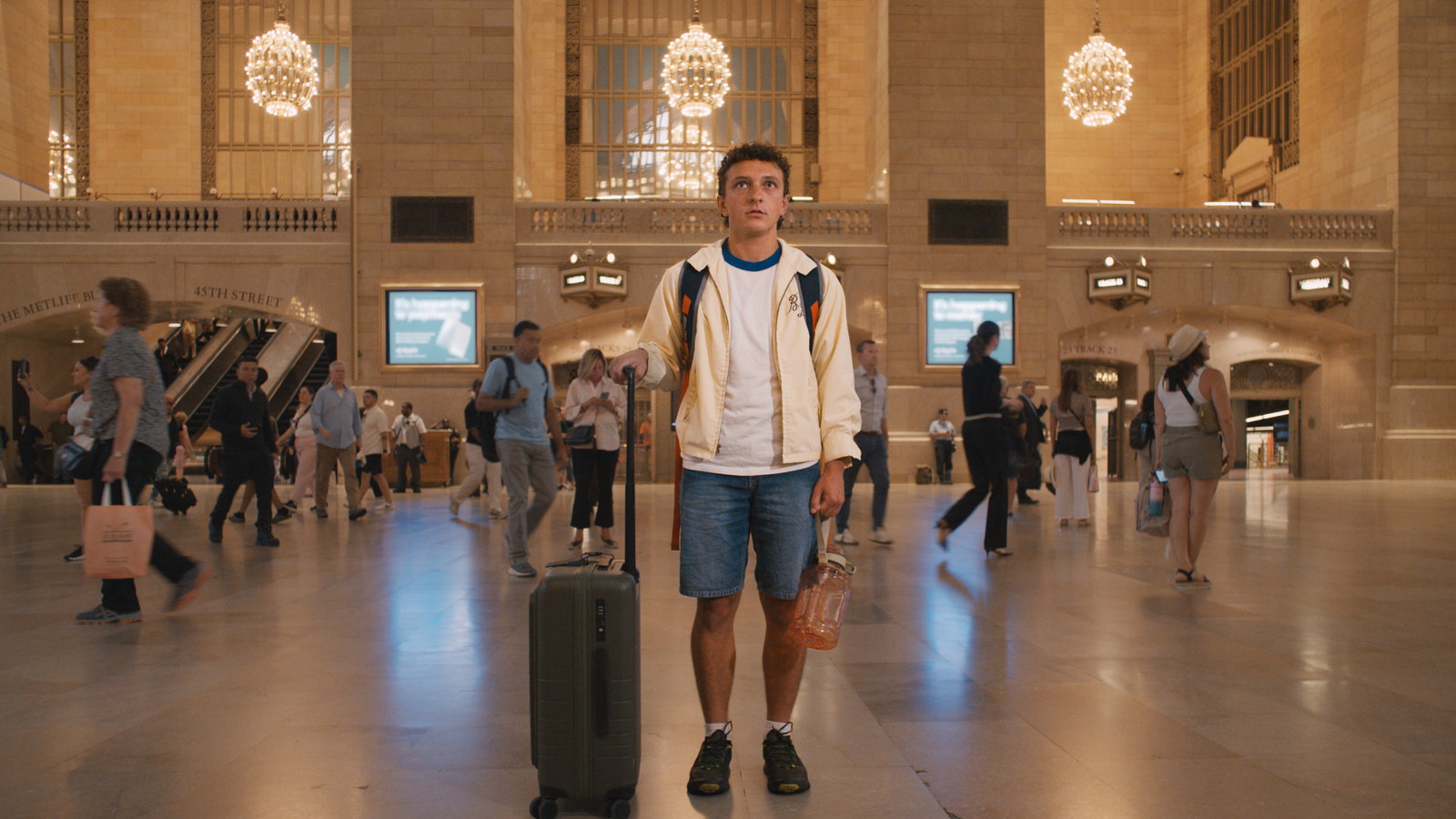
Aayush: Mason could have easily been written as a stereotypical “perfect rival,” but the film gives him emotional humanity and depth. Andy, how careful were you about avoiding the trope of turning desirable queer characters into antagonists simply because they trigger insecurity in others?
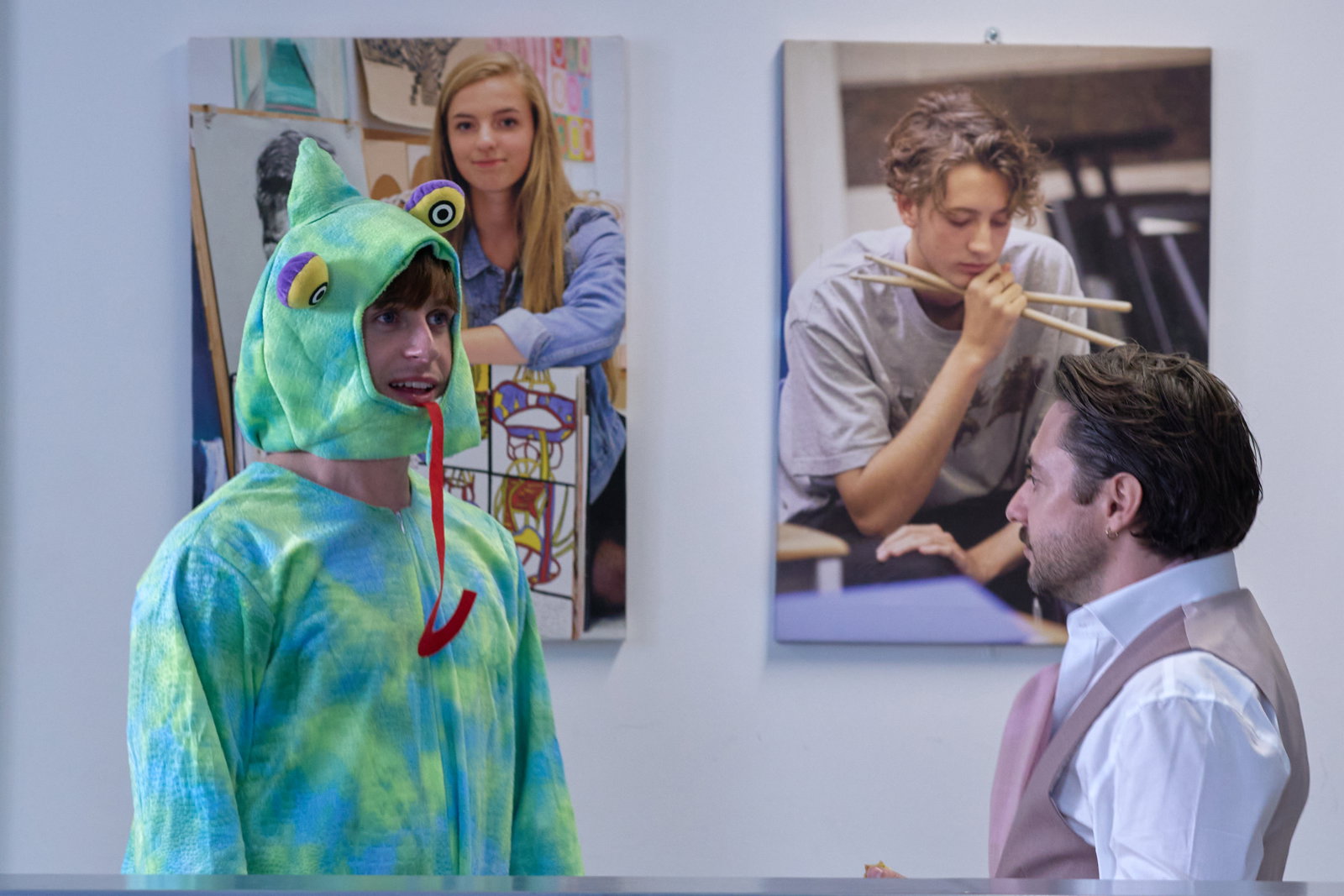
Andy: The thing that was so important about handling the storytelling around Mason was trying to keep us deeply rooted in Al's perspective. I was reflecting on this today—EJ is in every single scene of the movie and was basically on all the time while we were shooting. Part of the function of the cartoons is that they clearly identify where "evil Mason" exists. Evil queer Mason lives in the cartoon world. That's where we see how Al twists Mason around in his head and turns him into this larger representation of all his fears and insecurities. Once you step out of those spaces, though, you cannot help but notice that the guy standing in front of us on screen isn't the same guy who exists in Al's fantasy world. Because we're so attuned to Al's perspective—and hopefully questioning it without judging him—we become aware of the gap between how he sees the world and how the world actually is.
That allows Mason to stay real. Then he becomes even more real when he and Al start breaking down those boundaries and genuinely connect. A lot of that came from staying committed to Al's perspective. I also kept reminding myself that Mason is supposed to be the coolest guy at cartoon camp. That's a very specific type of person. A lot of people who seem incredibly cool—because they are attractive, confident, or a little reserved—can feel intimidating from a distance. But once you get even one degree closer to them, you realize they're wonderful people. They are just comfortable with themselves.
Aayush: The “Something You Should Know About Me” exercise completely reshapes the audience’s understanding of the people in the room. Andy, structurally, it almost functions like a narrative rupture that forces both AL and the viewers to confront their assumptions. How did you build that sequence so it could feel vulnerable without becoming emotionally manipulative?
Andy: For me—and I would actually be really interested to hear how it felt to inhabit all the different characters in that scene—I think we are ultimately dealing with matters of perception. Al represents something very universal. We all have to work through those initial feelings we experience when meeting new people: fear, anxiety, self-judgment, and the instinct to judge others. A lot of us develop self-defensive mechanisms that lead us to create simplified versions or stereotypes of people before we really know them. What is helpful in this story is that Al's struggle is tied to trying to fit in as an artist. Because of that, his projections are specifically connected to his artistic insecurities. But I think the experience itself is something many people can relate to.
That is really the function of the cartoon space. It creates a place where we can see the worst versions of someone's thoughts laid bare. It allows us to recognize that these thoughts are not necessarily who a person is—they're often the product of fear, insecurity, and vulnerability at their most heightened.
EJ: I felt similarly because, as an actor, when I first read that sequence, it was incredibly helpful. Sometimes, as an actor, you want to know what the absolute worst thing a character might be thinking, and you have to invent that for yourself. But here, Al actually has a space where he's being completely honest. It is like he is saying, "This is exactly what's underneath all of my feelings. This is the underbelly of everything I'm thinking. If I could just go crazy for a day and say all of this out loud to these people, I probably would." That was so useful because it helped me understand the extremes of where he is coming from. If that's where his mind goes at its most heightened, then what is he holding back when he is actually interacting with these people? And what happens when Mason completely subverts the expectations of the monster Al has created in his head?
Credit: Obscured Pictures
Credit: Obscured Pictures
It was also funny because it became a learning tool for me. I found myself thinking, "Oh, these are the things Al considers insults?" And I'm like, "That is not even that bad." It is funny because you realize that he's decided these things are terrible, even though they're really just reflections of his own insecurities.
Aayush: Without spoiling too much, the ending feels intentionally open emotionally — less about providing an easy resolution and more about emotional honesty. Andy, what does the ending ultimately mean to you? And EJ, where do you personally believe AL is emotionally headed after the film ends?
EJ: Well, it is a rom-com, so of course, there is an element of romantic resolution in the movie. I do not want to get too specific about how that plays out, but I think there's an important caveat. Both characters are aware that this is something they're experiencing in the moment. It is meaningful, and there is a genuine emotional victory for Al in the romantic sense, but that is not really the true victory of his story. The real victory is that he has gained a little hard-fought confidence in himself and in his artistic journey. He comes to understand that he's headed somewhere with his art, and that belief in himself is ultimately more significant than the romantic outcome.
ADVERTISEMENT
Article continues below this ad
So when I think about the ending, I see it as both a satisfying conclusion to his immediate arc and a reversal in the way he views himself. He has more confidence and a greater ability to trust his own instincts. At the same time, it leaves us with a more open-ended question: now that his life may be changing, and now that it's becoming harder to ignore his broader artistic ambitions, what is he going to do next?
Andy: I think Al is so stuck at the beginning of the movie in so many ways—emotionally, creatively, and professionally. He is constantly getting in his own way, and he's reluctant to embrace change. By the end, though, all I could really hope for him was an openness to possibility. The goal is not necessarily for him to have everything figured out. In fact, it's almost the opposite. It's about him finally reaching a place where he can accept uncertainty and be excited by it. I like the idea that we don't know exactly what's next for him. Neither does he. But for the first time, he's willing to move forward and figure it out.
ADVERTISEMENT
Article continues below this ad
Did you watch Something You Should Know About Me? Let us know your thoughts about the movie.
ADVERTISEMENT

Edited By: Aliza Siddiqui
More from Netflix Junkie on Hollywood News




ADVERTISEMENT