
Interview: Otilia Portillo Padua on Building the Literally Living, Breathing, and Growing “Speculative Documentary” – ‘Daughters of the Forest’
Films are often built around events that unfold. Daughters of the Forest chooses instead to grow, not metaphorically, but in a profoundly tangible sense.
It does not move in straight lines or tidy arcs, but spreads quietly and insistently, like the very mycelial networks it studies. Rooted in the lived realities of two women navigating science, ancestry, and survival, the film resists the urge to explain itself too neatly. Instead, it invites the viewer to sit within overlapping systems of knowledge, where the rhythms of cooking, foraging, and fieldwork coexist with something more elusive, almost otherworldly. The result is a cinematic experience that feels understated when labeled 'immersive', such are the boundaries between human and non-human that it blurs without ever fully dissolving them.
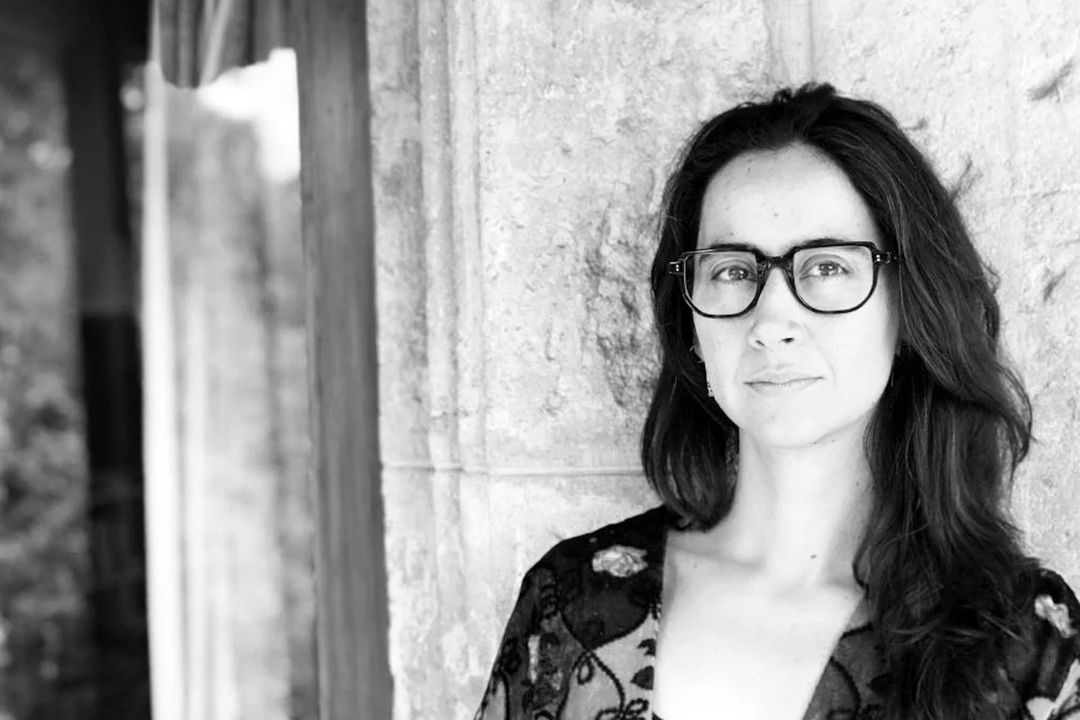
In this conversation, director Otilia Portillo Padua sat down with NetflixJunkie to unpack how that immersive world came to life. She reflects on crafting a hybrid grammar that merges observational documentary with speculative storytelling to shape a narrative that feels intentionally entangled between Indigenous communities and science. The discussion also explores sound, structure, and the challenge of rendering invisible ecosystems perceptible, all without losing their mystery.
ADVERTISEMENT
Article continues below this ad
Your film operates at the intersection of observational documentary and speculative sci-fi—how did you technically construct this hybrid grammar without letting one mode dilute the epistemological integrity of the other?
Otilia Portillo Padua: When I started the project, I explored the idea of creating a “speculative documentary.” I have always been a fan of the possibilities of genre in cinema and in literature. Speculative fiction starts with “what if” scenarios. This genre would give us the liberty to explore non-human perspectives and use the language and tools of cinema to do so. At the same time, I knew the core stories had to be based on the messiness and beauty of human experience, which was not a singular thing, but a collection.
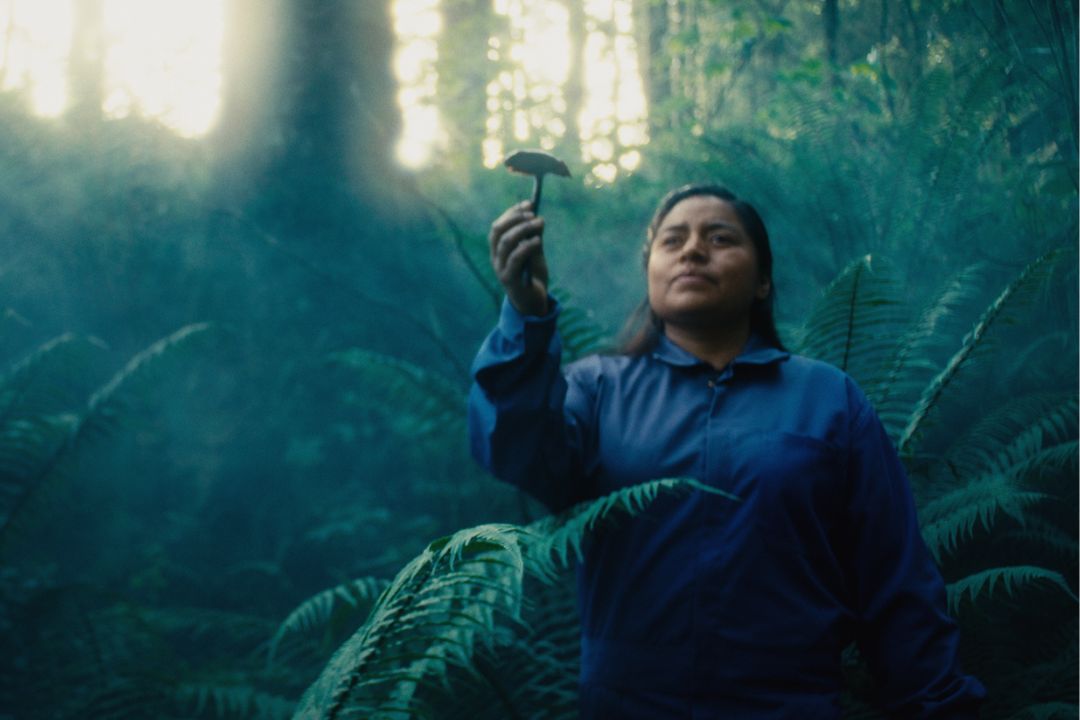
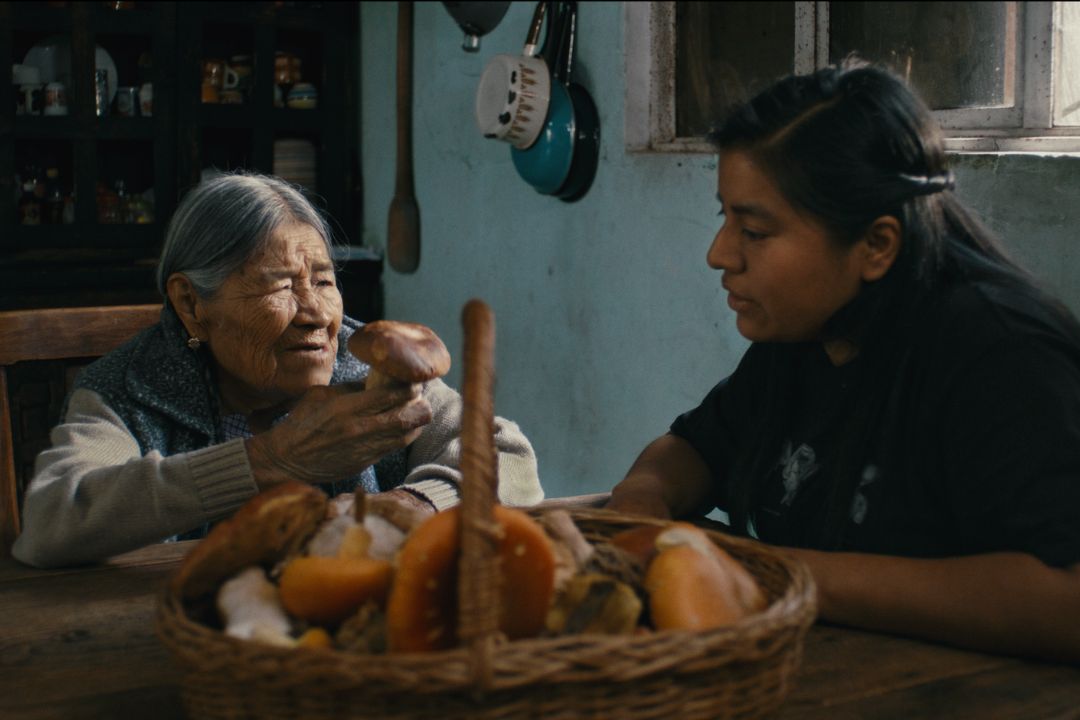
There was so much depth in the worlds of the film’s protagonists, their relationships, the cooking, and their knowledge. This “observational cinema” would complement the more speculative cinematic aspect. They wouldn't be opposing forces, similar to how hard science and mysticism aren’t in the film. We first constructed the human stories, each has a different approach, and dramatic questions, and much later we weaved in the fungal aspects. Both elements would help create an ecosystem. It was very important for us to be able to create a world and allow the audience to journey into it.
You’ve described the film as working through a “mycelial lens”—can you elaborate on how this concept influenced your narrative structure, particularly in terms of non-linear storytelling and distributed subjectivity?
Otilia Portillo Padua: The film has two human stories, but has very different dramatic structures. Lis is a node in a web of relationships; we wanted to show her world and her ecosystem, and some of the forces at play that endanger it, but without focusing on the threat or the conflict. Her story is closer to the four-part narrative structure of kishotenketsu. Juli has a more traditional three-act structure, where a character wants something and goes looking for it. None of the above is that straight though; other things happen on the way, much like life does, and it's all entangled. Then there is the fungal storyline, which operates in a different timeline. There are many topics explored in the film, but that is intentional; it felt messier and closer to life, more fungal, with more open-endedness and possibilities.
The documentary engages deeply with Indigenous knowledge systems alongside institutional science—what methodologies did you adopt to avoid extractive representation while still maintaining cinematic authorship?
Otilia Portillo Padua: There were year-long conversations with all of our local scientific advisors who have worked in several Indigenous communities for many years. We also involved Juli and Lis very early on, in what was going to be the contents of the film. They both gave notes on previous cuts until they were comfortable with what was being portrayed. Trust takes time to build. Simultaneously, we also requested permission from both communities, and they are a critical part of the impact campaign, which is still being designed. Before we premiered, we also organized a community screening, so that everyone involved knew and was onboard with what was going to be represented. All this felt like part of a process that was never in contradiction with pushing the cinematic form of the film.
There’s a strong emphasis on “entanglement” in the film—between human and non-human, science and ancestry—how did you translate such abstract ecological philosophies into visual language and editing rhythms?
Otilia Portillo Padua: The film took almost six years to complete, 18 months of editing. With the photographer, Martin Boege, we discussed using lights in the science labs to create a sense of otherworldliness. We also selected camera optics that would keep the audience close to the elements in the forest, but also wide enough to get context. We wanted to show familiar places under a very different light and perspective. We also speculated what the point of the view of the mycelium is? We wanted the audiences to see familiar things in ways they hadn't seen before. Similar principles were applied as we were editing with Lorenzo Mora, and later with the support of Andrea Chignoli, how do you make this film feel fungal? How do we work on the transitions, the structure, and the rhythm?
Given that fungi operate largely in invisible networks, what specific cinematographic or sound design strategies did you employ to render the imperceptible perceptible without anthropomorphizing it?
Otilia Portillo Padua: All of the VFX on screen is composed of different elements, which we either shot (particles, projections) or licensed. So they are all real elements that exist, but just displayed, lit, or shot differently. We don’t really know if mushrooms “see” or “hear,” so inevitably, there is a bit of anthropomorphizing; however, we focused on creating an overall feeling of the non-human.The sound is also enhanced, in order to create a certain subjectivity for the non-human, where there are lots of different elements, but they are all part of an ecosystem. The musical score by Hannah Peel is also embedded into Javier Umpierrez's sound design; they complement each other.
The protagonists are both scientists and Indigenous women navigating systemic pressures like deforestation and marginalization—how did you balance the political urgency of their reality with the film’s more poetic, speculative tone?
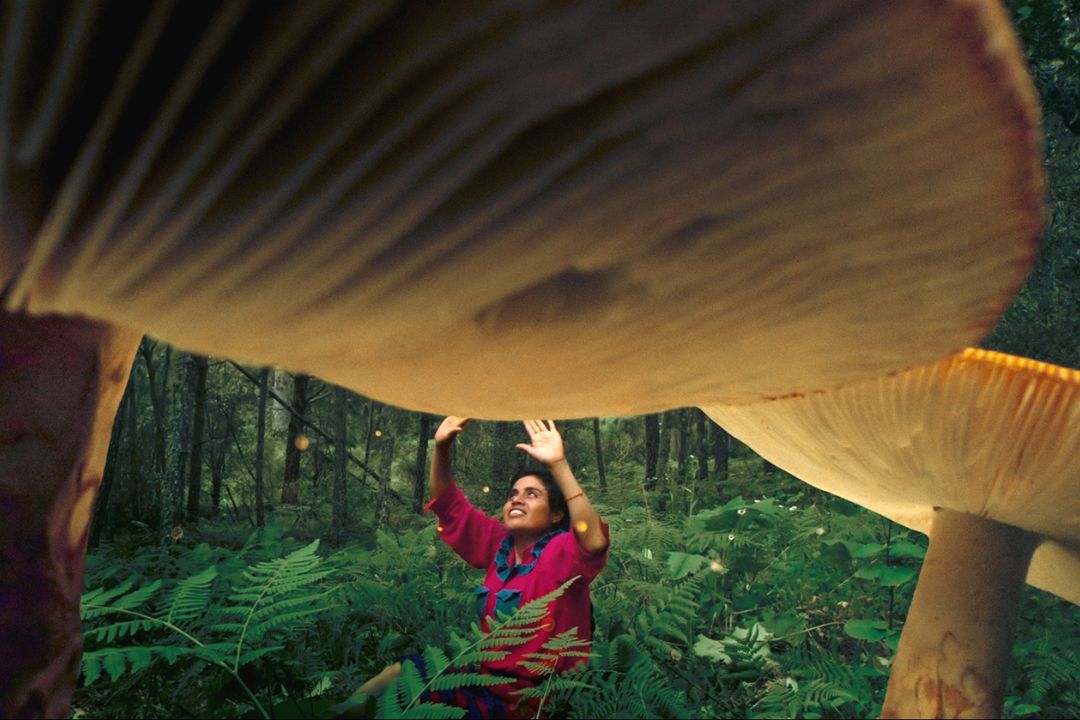
Otilia Portillo Padua: The focus was never the deforestation or the marginalization, but they are important elements of the context that the scientists face. These elements don’t define them or their work. So I used certain tropes of sci-fi, for example, hero shot, but to show actions that are not traditionally seen as heroic, such as companionship, care, and sharing of knowledge. I saw all these traits as characteristics of different sci-fi heroines I wanted to see on screen.
Ursula K. Le Guin’s “carrier bag theory” seems to underpin your storytelling—how did that philosophy concretely reshape your approach to narrative causality and protagonist-centered storytelling?
Otilia Portillo Padua: I wanted to create a carrier bag story, with multiple elements, that was closer to some aspects of life, and less focused on one journey and one outcome. It was woven by distinct forces and human and non-human lives.
Your film resists apocalyptic narratives and instead proposes regenerative futures—how do you see speculative cinema functioning as a tool for ecological imagination rather than dystopian reinforcement?
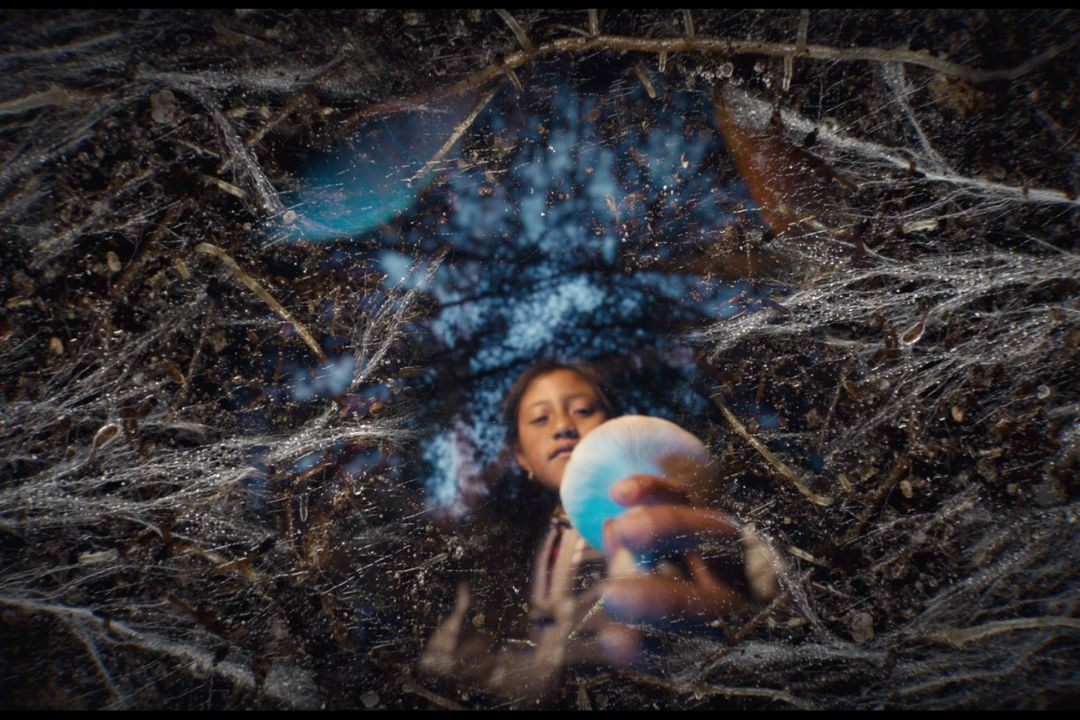
Otilia Portillo Padua: We can’t lose the world to despair and lack of imagination. So many great films focus on the tragedy of humankind and its inherent faults. Other great ones celebrate the achievements of individuals. But what about creating the space to imagine a collective alternative future? What about imagining stories for that? Speculation is a form of resistance; it allows us to reimagine the past and reinvision the future, adopt the other, look beyond the mirror, and learn from other forms of knowledge.
Can you talk about your collaborative process with scientists, foragers, and Indigenous communities—how did this “interdisciplinary alliance” practically influence authorship, decision-making, and even aesthetic choices?
This film is really a product of multiple collaborations; there was never an individual vision behind it. It was process-driven, and there were lots of sessions of experimentation. The aesthetic choices were decided by the creative team.
The film challenges anthropocentrism by positioning fungi as active agents—how did you navigate the philosophical tension between representing non-human agency and maintaining narrative coherence for human audiences?
Otilia Portillo Padua: I had the luck of working with great advisors, one of our story consultants, Sara Dosa, who is marvelous at working with narration. Helped us find the tone of the non-human, where the fungi would talk about themselves, and yet at the same time, they could be talking about people and what people have to face, in terms of loss, endurance, survival, and adaptation.
In blending sensory immersion with scientific inquiry, how did you design the film’s soundscape to function not just as atmosphere but as a form of knowledge transmission?
Otilia Portillo Padua: It took a lot of trial and error to find a voice. At times it might feel like a singular murmuration, but it's actually 4 voices in Zapotec, which is Juli’s mother tongue, and also the language that the holy mushrooms spoke to her in. We want to keep the emotion of a human voice, but give it a non-human aspect, such as plurality. The voice is a chorus, and it is integrated with all the other non-human sounds in the forest. Those voices are also not manipulated, but rather moved around in space, so that sometimes you feel it's one, other times they are actually one, other times they talk at the same time, and other times they are unraveled.
The film emerges from regions facing ecological and socio-political conflict—how conscious were you of positioning the documentary within global climate discourse versus grounding it in localized, lived realities?
Otilia Portillo Padua: The film starts with some as small as a fungus and as big as the mycelium. I wasn't trying to make a film about the bigger conflicts, and that was not the focus. The focus was always on how mushrooms shaped and transformed individual human lives in the face of all these challenges.
ADVERTISEMENT
Article continues below this ad
Finally, Daughters of the Forest reimagines cinema itself as a collaborative, almost ecological system—do you see this film as a prototype for a new kind of filmmaking practice that mirrors the interdependence it depicts?
Otilia Portillo Padua: This is a great question. I would certainly hope so! And not only in cinema, but in the way we relate to one another, and how our actions, even the smallest ones, have a resonance. But there are so many forces constantly pushing back. There are so many financial interests, so little understanding of difference, opposition to risk taking, so much emphasis on the individual, justified by a capitalist interpretation of Darwin, where the strongest, loudest survive. But fungi teach us that it is actually the most adaptive that resists the longest. For so long, we have thought about the singular artist genius, who is justified in all of their pursuits to create art, but I do think that is changing. Lynn Margulis proposed that cooperation between species is a primary driver of evolution and complexity, and not only competition. Film is a form of art that requires a strong collaboration of many disciplines, but so are other forms of work. I feel like we have to learn to work with one another across our differences (that’s also what the holy mushrooms told Juli), the same way we learn how to forage and spread spores, through forms of respect and reciprocity.
ADVERTISEMENT
Article continues below this ad
What are your thoughts on Daughters of the Forest? Let us know in the comments.
ADVERTISEMENT

Edited By: Hriddhi Maitra
ADVERTISEMENT
ADVERTISEMENT
