
EXCLUSIVE: How 'California Scenario' Uses Isamu Noguchi’s Installation to Explore Memory, Silence, and Survival
Memory is not always about what we speak; it lingers in objects, landscapes, and the spaces we live in. And James Takata's California Scenario exists in that fragile in-between, where thought-provoking cinema meets the sculptural immersion.
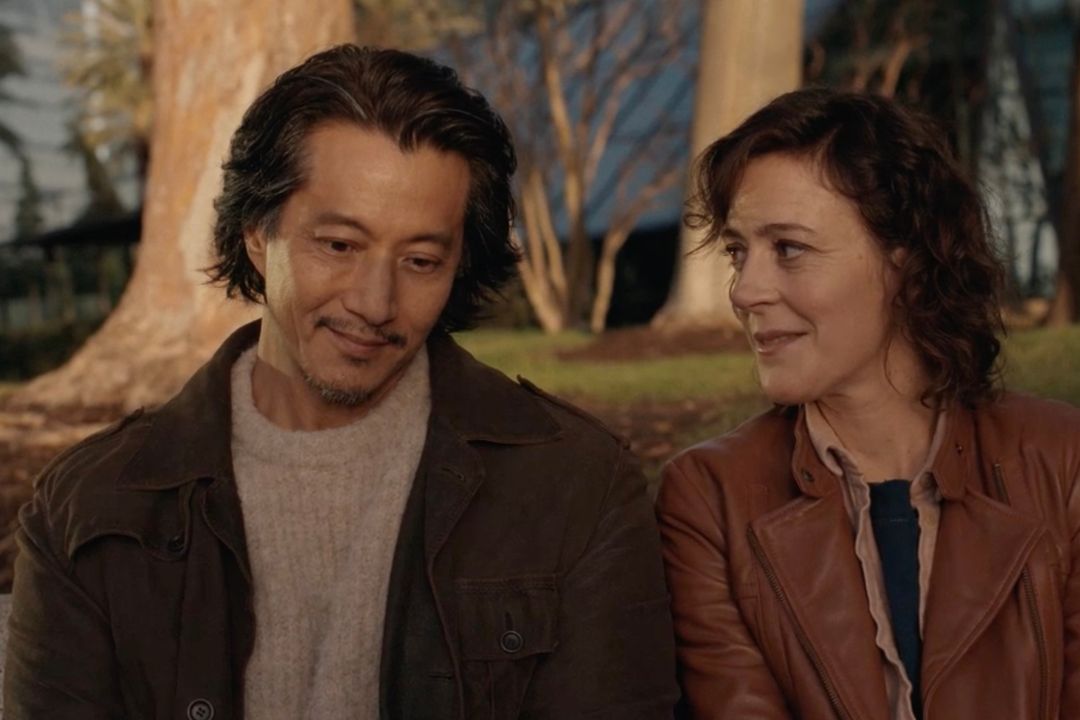
Set within Isamu Noguchi's monumental installation in Costa Mesa, the movie chronicles the journey of two single parents navigating turbulent times. Although their lives are different, one thing connects them, and that is the weight of the intergenerational trauma they have been carrying over the years.
The movie, which had its premiere at this year’s Santa Barbara International Film Festival, does a commendable job in transforming stone, water, and negative spaces into vessels of intergenerational memory, tracing how history quietly shapes the present.
ADVERTISEMENT
Article continues below this ad
Netflix Junkie caught up with filmmaker James Takata and co-writer Dara Resnik to talk about the project, reflection on building a story inside a sculpture, projecting memory onto walls, and shaping a temporal design that moves between past and present, much like Noguchi believed time itself does.
California Scenario exists in a space between narrative cinema and spatial experience. How did you conceptualize the film’s dramatic architecture when the primary “set” is a sculptural environment rather than a traditionally narrative-driven location?
James Takata: I have been inspired by the art of Isamu Noguchi for a long time. And, you know, his art and his story really resonate with me as a fellow Japanese American. And he was also biracial at a time when that was very rare, and my daughters are both biracial. He also voluntarily went to an incarceration camp during World War II, and that is also part of my family's history. So there were a lot of things that, for me, Noguchi has been very resonant.
And so, I have wanted to tell his story for a long time. However, as we have talked about, that is probably a $200 million movie. He has got the most interesting life that just spans the entire world in his art, and so many connections. But for us, when we started talking about a movie that was probably more within our budget, Dara had the great idea to try to shoot it at California Scenario in Costa Mesa, which is right down the road from us here in LA.
The conversation between a mother and a daughter about a Holocaust survivor keeping objects “just in case” suggests a survival logic that outlives the danger itself. How did you ensure the audience senses the weight of history without being directly told its source?
Dara Resnik: My family escaped those areas of Europe just before the Holocaust, but my family all sort of has that particular affinity for keeping things like used paper towels, which I actually think is a pretty universal experience. I have a close friend who is Chinese American, and it's something that we bonded over immediately, our parents’ refusal to throw those away until they are falling apart. But I actually thought that the thing that James came up with, which I just thought was so genius, was when he came up with the idea to project the images of the Japanese incarceration camps on the walls of the installation itself. I thought that was a great, artful way to bring that into the present day without having to steep us in the darkness of that history.
James Takata: To sort of go back to the first question, and, you know, the space is so theatrical. You know, it's a one-and-a-half-acre abstraction of the California landscape. And as you saw, it has these great white walls on two sides of it; there are office buildings on the other two sides. And so, as soon as we saw the space, it was this inspiration of, oh, what can we do with this? Like, how can we maybe project memories, or, you know, onto these walls? And Noguchi also designed sets for Martha Graham, and he designed a lot of his public sculpture as a sort of theater, which becomes sculpture when it is activated by the people in it.
Dara: And so- He talked a lot about wanting people to immerse themselves and immerse their lives inside his art. So, yeah, it was both for us to bring the characters there and, in honor of Noguchi, have them experience their lives there, and also bring some of their history to the set he created, this giant set.
California Scenario is the first film to shoot inside Noguchi’s California Scenario. That place plays an important part in the film. As a filmmaker, do you think working in such places mean different to you than other places like soundstages? And does that change your approach?
James Takata: A 100%. You know, it is such an exciting space, both during the day and at night. And talking to people, obviously, we had scouted it and been there a lot, but talking to some of the people on the crew, they said when they first got there, like, “Well, oh, this is it.” It was sort of underwhelming. But the more time we spent there, the more they started to really appreciate the beauty and appreciate the magic. Speaking of these areas in the installation, there is a desert area, a forest walk, and a water source, and they are all supposed to represent parts of the California landscape, which is why it is called California Scenario.
For us, each of those sorts of functioned as a set, and it was so exciting to be able to explore that space with a camera, with actors, and really be able to shoot in any direction. And, you know, it’s open to the public. We had a conversation before we did it that we were going to let people who wanted to come and see it, or who were working there, just walk through. So rather than locking up the space, our PAs would say, “It’s okay if you come in, just don’t look at the camera.” And so there are a lot of times where there will be people passing in the background, and those are just members of the public.
Dara Resnik: It was really impressive watching James come off of six seasons of This Is Us as their second VP, and he directed an episode there. The way that they shoot that show is incredibly organic. The camera is really immersed with the characters. Watching him apply that to this space, where people are organically moving around, even if they are not in the movie, letting our actors explore the space the way Isamu Noguchi would want real people to explore the space allowed them to find natural places for them to have these really important conversations as characters.
Was the act of holding onto physical objects conceived as a form of memory storage, control, or future-proofing, and how does the film differentiate between those overlapping motivations? How did you avoid over-determining their symbolism on the page?
Dara Resnik: That is a great question. I think it’s all of the above. And I actually think this is a cousin answer to sort of what you’re asking, but one of the things that we love about Isamu Noguchi’s work is that it is timeless. He sort of almost did not believe in time. He believed in the past, the present, and the future all happening simultaneously, which is something that we play with in the installation. I think that those objects are representative of that. The past, this is emblematic that the past happened. It’s here in the present, and I might be able to future-proof my life if I can hang on to it. And it is something that I think many immigrant groups, particularly in America, share.
Now, James, you refer to Noguchi’s non-linear relationship to time. How did that philosophy translate into your temporal design—in terms of scene order, ellipses, and transitions?
James Takata: It comes from the idea and the feeling that, you know, the past is often so part of the present, and the way our characters experience their memories, they see something, it, like, takes them back to that place. I have certainly had that experience. You just sort of go to that place. Something evokes that memory, and it is there. And suddenly, like, you know, you are 10 years old.
Dara Resnik: I thought it was so smart when James came up with the idea to shoot the first half of the movie in 4:3, so that it felt like the characters were a little bit more boxed in when they are in their lives and immersed in those memories inside their homes. And then when they get to the installation, it expands to 2:1. That allows us to feel how they’re getting out of their past and trying to come into the future.
Much of the emotional weight is carried through silence, gesture, and negative space. Can you discuss how you calibrated the balance between dialogue and visual storytelling during the writing and editing process?
James Takata: It was very important for us to maintain those silences. So much is said in those silences, especially in Jacob’s storyline. You know, when he is with his daughter, when he’s with his dad, there is so much that’s unspoken and so much that is communicated by a look or by not saying something. So, we preserved that in the editing, and that was very much intentional in the writing. You know, we like to say, on Jacob’s side, it is a family that does not talk about anything. And on Laura’s side, it is a family that talks about everything, and yet they are not talking about the things. So, you know, they are coming at these; they are trying to grapple with these inherited traumas in different ways, but both are struggling.
ADVERTISEMENT
Article continues below this ad
Dara Resnik: It was, I think, what we tried to do; we did a lot of early cut screenings for our friends and family who know a lot about the background of the movie. We only cut silences out when we were hearing from people that it felt like it was slowing down too much. But if it was something that people felt played well and they were fine sitting in it, we let it play. It was really nice because we both come from TV shows where we don’t normally have the ability to do that.
Ultimately, does the film suggest that awareness itself, rather than resolution, is the first real inheritance that can be passed forward? Was this idea present from the earliest drafts? How did it shape your approach to the ending?
James Takata: That was, you know, it’s funny, the ending, when we screened it for the cast and crew, the cast actually forgot the ending that was in the script. But it was there all along. That was always a part of it. Going back to that memory of the grandfather saying, you know, you get to make your own story.Dara Resnik: Interestingly, the ending has been something that was part of it almost from the very beginning. It was actually one of the first scenes that we wrote. Yeah, after we had written about the first 20 pages, we wrote the end, and then we wrote everything in the middle.
ADVERTISEMENT
Article continues below this ad
Are you excited for California Scenario? Let us know in the comments.
ADVERTISEMENT

Edited By: Itti Mahajan
ADVERTISEMENT
ADVERTISEMENT
