
Christopher Nolan’s Best Female Characters That Left a Lasting Impact
Credits: Syncopy, Legendary Pictures, DC Entertainment, and Warner Bros. Pictures
Credits: Syncopy, Legendary Pictures, DC Entertainment, and Warner Bros. Pictures
Christopher Nolan’s films are often praised for their intricate storytelling and philosophical ambition, yet they continue to draw debate over how female characters are positioned within those narratives. Critics frequently argue that women in his work are framed in relation to male protagonists, sometimes appearing as limited emotional catalysts rather than fully autonomous leads. This has fueled ongoing discussion about whether his filmography underrepresents women’s interiority despite its thematic richness.
However, even within male-driven frameworks, Nolan’s women often function as moral anchors, catalysts of discovery, or intellectual equals. Looking beyond the criticism reveals a richer pattern: women who, though sometimes constrained by narrative structure, still leave a lasting imprint on Nolan’s cinematic universe.
10. Ariadne (Inception)
Christopher Nolan’s Inception is often remembered for its layered architecture of dreams and heist mechanics, but Ariadne stands out as the film’s most essential human compass. Ariadne is the only member of the team who actively probes into Cobb’s fractured psyche. She discovers his dangerous obsession with his late wife, Mal, and realizes he is losing control of his subconscious. By confronting him, she becomes an emotional investigator within the dream architecture itself, forcing Cobb to face guilt he has buried so deeply that it threatens to collapse both the mission and reality, potentially trapping everyone in Limbo.
This makes her one of Nolan’s most crucial narrative stabilizers, not through force, but through insight and moral clarity. What also deepens her significance beyond Inception is her trajectory in Nolan’s broader universe. Played by Elliot Page, the actor later came out as a trans man and now uses he/him pronouns, reshaping how audiences refer to and understand his earlier and current work.

Page has now reunited with Christopher Nolan for The Odyssey, where he plays Sinon, a figure defined by cunning and psychological depth.
9. Ellie Burr (Insomnia)
Played by Hilary Swank, Ellie Burr in Insomnia is a young detective in Nightmute, Alaska, who brings grounded intelligence and subdued intensity to the role. She portrays a deeply observant, idealistic local officer working a small-town murder case, eager yet disciplined in her approach. When veteran LAPD detective Will Dormer arrives to assist the investigation, Ellie immediately admires his reputation and sees him as a figure to learn from.
Ellie acts as the moral center and standard of integrity in a story deeply mired in corruption and compromise. Even though she is starstruck, Ellie is an incredibly thorough detective. By meticulously following the “small things,” such as discovering a mismatched 9mm bullet casing at the scene. She organically pieces together the truth behind Dormer’s lies. As the investigation deepens, her unending persistence places her in direct contrast with Al Pacino’s Will Dormer, ultimately forcing the truth toward light without moral compromise ever.
8. Mal Cobb (Inception)
Even without being real in the physical sense, Mal Cobb exists as a psychologically constructed presence that relentlessly tortures her husband’s mind. Played by Academy Award–winning actress Marion Cotillard, she is a projection inside Dom Cobb’s subconscious, shaped entirely by memory, guilt, and unresolved grief. Within the dream world, Mal appears whenever Cobb performs an extraction or inception, becoming an unpredictable and often hostile force. She sabotages missions, endangers his team, and tries to lure him deeper into Limbo, where she insists they can remain together indefinitely.
Her behavior is not independent but a manifestation of Cobb’s fractured psyche, where love and regret have fused into something destructive and uncontrollable. She embodies the consequences of Cobb’s own act of inception on her in Limbo, where he planted the idea that their reality was false. That idea ultimately led to her suicide, and now she returns as a haunting echo of that trauma. More than an antagonist in Inception, she is Cobb’s unresolved past given form, forcing him to confront guilt, forgive himself, and finally release the memory that is holding him hostage.
7. Katherine “Kat” Barton (Tenet)
While Tenet is built around the nameless Protagonist attempting to prevent a temporal third world war, Kat Barton stands as the narrative driver and emotional backbone of the story. Trapped in an abusive marriage with Andrei Sator, a powerful oligarch who uses blackmail and their son as leverage, she exists in a constant state of coercion and psychological captivity. Her accidental validation of a forged Goya painting becomes the mechanism through which Sator controls her life, turning art authentication into a weapon of domination.
In the grounding Tenet’s abstract, time-inverted espionage in human consequence, she is not just a passive victim but the emotional engine that reshapes the Protagonist’s priorities, transforming the mission from pure prevention into personal rescue. Her fear for her son Max and her growing resolve create the film’s most tangible stakes, culminating in her evolution from trapped wife to decisive survivor who ultimately confronts Sator. Kat is played by Academy Award–nominated actress Elizabeth Debicki, whose towering physical presence and restrained emotional intensity give the character an even feel of being deeply lived-in rather than theoretical.
6. Amelia Brand (Interstellar)
Anne Hathaway is perhaps Christopher Nolan’s go-to actress because of her ability to fuse intellectual precision with emotional transparency, and her portrayal of Amelia Brand is a key reason why. She brings a rare balance of scientific authority and deeply human vulnerability to roles that sit at the intersection of logic and feeling, making complex exposition feel alive rather than mechanical. In Interstellar, Dr. Amelia Brand is a NASA scientist and astronaut on the Endurance mission, responsible for evaluating potential habitable planets beyond the wormhole.
As the daughter of Professor John Brand, she is also tied to the mission’s hidden agenda, unknowingly carrying the burden of “Plan B,” the survival of humanity through frozen embryos. Her role becomes emotionally charged when she reveals that her belief in Edmunds’ planet is not purely scientific but deeply personal, rooted in love. Her belief that love transcends dimensions challenges the crew’s rigid logic and reframes the mission’s meaning. Ultimately, her journey leads her to Edmunds’ planet, where she helps secure humanity’s continuation, turning emotional conviction into survival itself.
5. Sarah Borden (The Prestige)
Sarah Borden in The Prestige is one of Christopher Nolan’s most tragic characters and the ultimate victim of the film’s central twist. Played by Rebecca Hall, she brings emotional precision to a story otherwise driven by obsession, rivalry, and illusion. Sarah is the devoted wife of Alfred Borden, trying to build a stable family life while sensing something deeply fractured beneath her husband’s shifting behavior. Unbeknownst to her, Borden is actually two identical twins living one shared identity to preserve “The Transported Man,” meaning the man she loves alternates between genuine affection and emotional absence.
This creates a constant, destabilizing emotional whiplash in her daily life, where love itself feels unreliable and inconsistent. The tragedy intensifies as Sarah becomes increasingly aware that something is wrong but can never fully access the truth. Each interaction deepens her isolation, until the psychological strain becomes unbearable. In the end, unable to reconcile the contradictions of her marriage, she takes her own life in Borden’s workshop, a devastating moment that exposes the human cost hidden beneath the film’s illusions and rivalries.
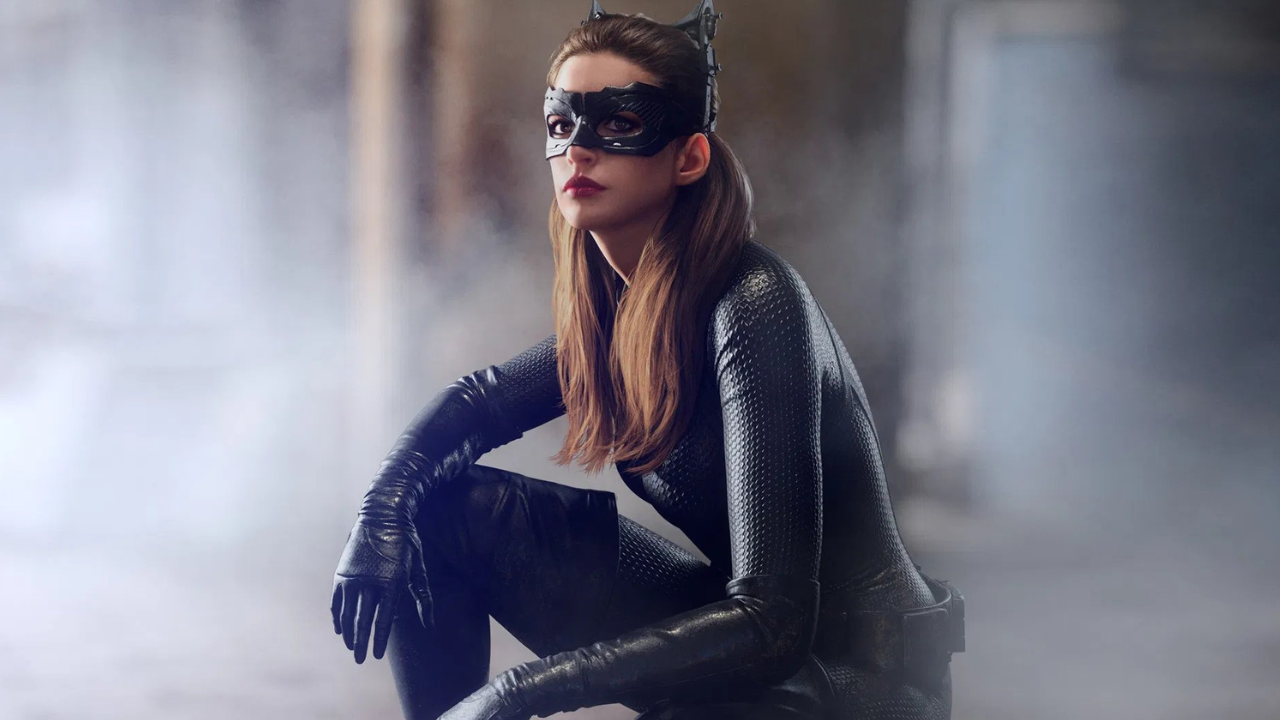
4. Selina Kyle / Catwoman (The Dark Knight Rises)
Anne Hathaway returns as one of Christopher Nolan’s most compelling collaborators, and her portrayal of Selina Kyle in The Dark Knight Rises is often regarded as one of the finest interpretations of Catwoman on screen, redefining the character with wit, restraint, and emotional intelligence. In The Dark Knight Rises, Selina Kyle is a highly skilled cat burglar operating in Gotham’s elite underworld, motivated by survival and the promise of a “clean slate” that could erase her criminal past. She begins the story navigating between criminals and power brokers, eventually stealing Bruce Wayne’s fingerprints as part of a dangerous bargain tied to a hidden identity-erasing program.
Her choices initially position her as an opportunistic survivor, leading her to betray Batman and inadvertently contribute to his capture by Bane. However, as Gotham descends into chaos under Bane’s revolution, Selina’s perspective shifts. Witnessing the true cost of the uprising, she turns against the destruction she helped enable. She allies with Batman, helping him defeat Bane and stop the nuclear catastrophe. Through Hathaway’s performance, Selina becomes a morally fluid yet ultimately redemptive force, embodying both survival instinct and the possibility of change.
3. Katherine "Kitty" Oppenheimer (Oppenheimer)
Set in the 1940s within Christopher Nolan’s historical epic Oppenheimer, Kitty Oppenheimer stands as a force of woman power that upends the traditional “supportive wife” archetype. Played by Emily Blunt, she emerges not as a background figure to J. Robert Oppenheimer, but as a fiercely intelligent, emotionally volatile presence who sees the political machinery around them with unsettling clarity. Unlike her husband, who is consumed by passive guilt and a willingness to absorb punishment from his political enemies, Kitty is a pragmatist driven by urgency and survival.
As postwar investigations tighten, she becomes his most uncompromising defender, urging him to resist the Machiavellian schemes of Lewis Strauss and the gray-board committee intent on dismantling his legacy. During the security hearings, Kitty reaches a dramatic peak, confronting the interrogation process with razor-edged intelligence. While Robert allows himself to be dismantled, she anticipates traps, exposes intent, and challenges the system on its own terms. Her refusal to shake Edward Teller’s hand after his betrayal further cements her as a moral barometer of loyalty and truth in a world defined by suspicion and compromise.
2. Natalie (Memento)
Natalie in Memento is a sharp, cynical bartender working in a gritty town where she is deeply entangled with local drug traffickers. Her path crosses with Leonard Shelby (Guy Pearce), a man with anterograde amnesia who cannot form new memories and relies on tattoos and Polaroid photos to track down his wife’s killer. Initially, Natalie appears as a sympathetic ally, offering him shelter, helping him decode his scattered notes, and using her connections to access DMV records for his investigation. Played by acclaimed Canadian actress Carrie-Anne Moss, fresh off her iconic breakout role as Trinity in The Matrix, Natalie becomes one of Christopher Nolan’s most chilling character studies.
She is the ultimate deconstruction of the classic noir femme fatale, not relying on seduction but on calculated exploitation of Leonard’s fractured memory. In one pivotal sequence, she removes all pens from the house, taunts him into a violent outburst, and later walks back inside in tears, blaming her injuries on Dodd. Knowing his short-term memory lasts only a few minutes, she walks out, waits in her car while he searches in confusion, then returns to weaponize his compassion. This transforms Leonard into an unwitting instrument of her survival.
1. Murphy Cooper (Interstellar)
The emotional anchor, the intellectual savior, and the definitive heartbeat of the entire film, Murph in Interstellar is the brilliant, fiercely determined daughter of NASA pilot Joseph Cooper. When her father leaves Earth on a desperate mission through a wormhole to secure humanity’s survival, young Murph is left behind, devastated and angry, her sense of abandonment shaping the course of her entire life. Across three stages, played by Mackenzie Foy, Jessica Chastain, and Ellen Burstyn, Murph evolves from a grieving child into a world-class physicist under Professor John Brand.
Her life becomes singularly focused on solving the gravitational equation that could allow humanity to escape a dying Earth, turning personal loss into scientific obsession. Her childhood encounters with a “ghost” eventually reveal the film’s central truth: the messages were her father communicating through a five-dimensional Tesseract. Using quantum data transmitted via a wristwatch, Murph decodes the solution and triggers humanity’s salvation. In doing so, she becomes the bridge between love and physics, emotion and equation, ultimately saving the species while anchoring the film’s most devastating human truth.
In Christopher Nolan’s films, women may not always lead the narrative spotlight, but they consistently shape its emotional core and turning points. They act as conscience, catalyst, and consequence, transforming complex ideas into human stakes. Across his work, these characters prove that emotional impact can be as decisive as spectacle or science.
Which of these Christopher Nolan’s female characters stands out most to you? Let us know in the comments.

Edited By: Hriddhi Maitra
