
‘56 Days’ Review: Prime Video’s Erotic Thriller Turns a Whirlwind Romance Into a Brutal Puzzle of Truth and Lies
Whenever a thriller opens with a body and then rewinds to tell you how it got there, the challenge is never the mystery itself, it is whether the journey justifies the destination. With 56 Days, Prime Video’s erotic psychological thriller, the answer is a confident yes. Adapted from Catherine Ryan Howard’s bestselling novel, 56 Days takes a deceptively simple premise, a whirlwind romance formed during lockdown and strips it down layer by layer until intimacy itself begins to feel dangerous.
Produced by Amazon MGM Studios and Atomic Monster, with James Wan attached as executive producer, the series favors psychological unease over shock value, leaning into silence, suspicion, and slow-burn dread.
A romance that feels fated until it does not
ADVERTISEMENT
Article continues below this ad
The series, 56 Days, opens not with romance, but with decay. A decomposed skeletal structure lies in a bathtub, the remnants of a body discovered only when a fire alarm draws attention to the apartment. The police arrive. Questions follow. And from that chilling image, the narrative rewinds to Day 1, charting the 56 days that led to this moment. Usual structure? Perhaps. But the execution keeps you guessing, blurring the line between victim and perpetrator.
Oliver Kennedy (Avan Jogia) and Ciara Wyse (Dove Cameron) meet by chance at a grocery store and fall fast. Their connection is immediate and physical, charged with that dangerous kind of chemistry that makes caution feel unnecessary. The early episodes allow the audience to sit in that rush, shared glances, private jokes, intimate confessions.
Across its eight episodes, 56 Days escalates with quiet precision. The opening chapters lean heavily into romantic acceleration. By the third and fourth episodes, the tone begins to shift. Ciara’s move into Oliver’s luxurious apartment introduces paranoia, control, and a growing fixation on access and power, while the investigation starts uncovering cracks in the apartment’s existence itself.
In the final episodes, romance gives way entirely to consequence. The investigation dominates, personal demons surface, and the series reconstructs the relationship not as a love story, but as a chain of decisions that could only end one way.

But from the outset, the structure undercuts the romance. We already know where this is heading: a body in a bathtub. That knowledge transforms even their most tender moments into potential warning signs.
Direction that reflects emotional disintegration
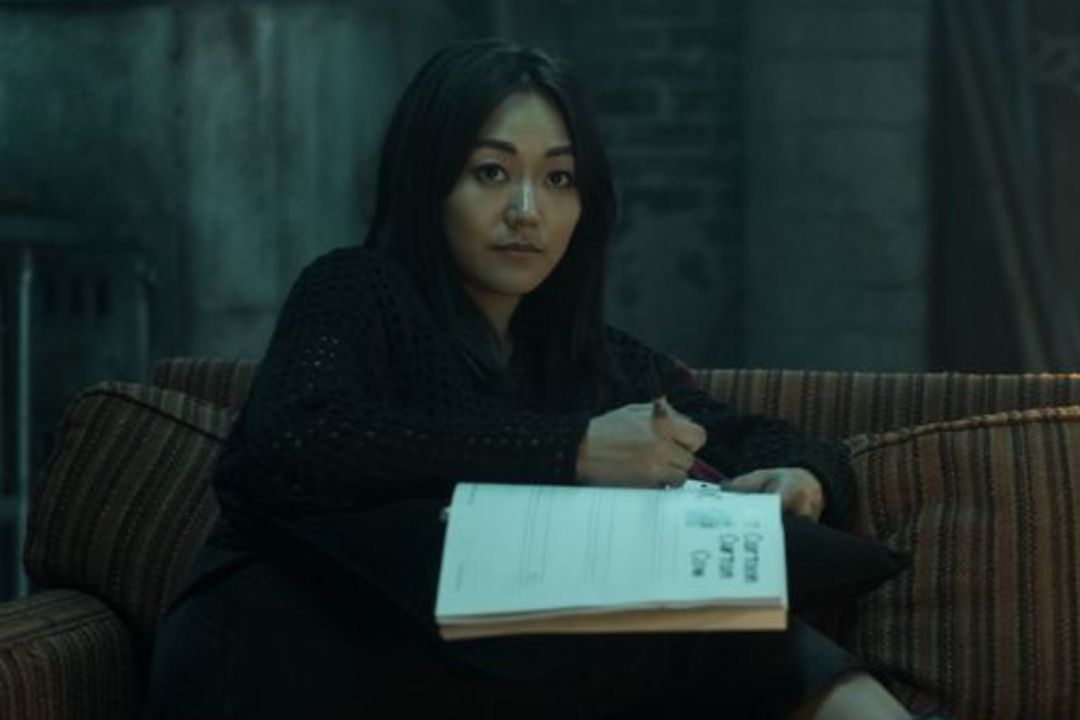
The nonlinear storytelling, directed by Alethea Jones and Shana Stein and developed by Lisa Zwerling and Karyn Usher becomes the series’ greatest weapon. The present-day investigation, led by Lee Reardon (Karla Souza) and Karl Connolly (Dorian Missick), unfolds methodically. Their quiet exchanges dissect the relationship without melodrama. Meanwhile, the past timeline steadily exposes fractures, omissions, evasions, subtle manipulations.
No one is fully honest, but no one feels cartoonishly deceitful either. The show thrives in that gray area.
Visually, 56 Days is restrained but deliberate. Interiors feel intimate yet claustrophobic, especially as the couple grows closer. The apartment gradually shifts from romantic sanctuary to psychological pressure chamber, it is a crime scene after all. Long takes and static framing create a sense of observation, as though the audience is examining evidence alongside the detectives.
Architectural lines and reflective surfaces emphasize fragmentation. Characters are often framed separately within the same shot, reinforcing emotional distance even during moments of physical closeness. The opening crime scene is handled with chilling composure. The decomposed skeletal remains in the bathtub are unsettling not because of excess gore, but because of stillness. The horror is quiet, procedural, clinical. It lingers.
The intercutting between the investigation and the past romance keeps tension taut. Each new discovery reframes earlier scenes, subtly shifting audience perception. It is a structural gamble that pays off, allowing suspense to build organically without relying on cheap twists.
Career-defining turns from Dove Cameron and Avan Jogia
Dove Cameron delivers her most layered performance to date. Known widely for Liv and Maddie and the Descendants franchise, she moves far beyond those polished roles here. Her Ciara is magnetic, naive, soft-spoken yet sharp, vulnerable yet calculating. Avan Jogia's Oliver is introspective and guarded, often internalizing conflict rather than broadcasting it. Jogia allows small behavioral shifts, pauses, hesitations, flickers of doubt to signal unraveling.
Their chemistry is undeniably potent. The relationship feels real enough that its toxicity becomes unsettling. The series’ emotional high point is underscored by Cameron’s haunting rendition of Do I Wanna Know? in episode 8, which plays like a melancholic echo of everything that went wrong.
What ultimately gives 56 Days its sharpest edge is how it reframes revenge not as an act, but as a slow psychological corrosion. Ciara does not enter Oliver’s life seeking love, she enters it seeking restitution for her brother. At her heart she is seeking justice for a life disrupted, for a truth that money and accountability never fully addressed.
As Ciara grows closer to the man she believes is directly responsible for her brother’s death, vengeance begins to fracture under the weight of genuine affection. Love does not arrive cleanly or heroically, it arrives tangled, compromised, and dangerous. In attempting to extract power, security, and financial recompense from Oliver, Ciara finds herself absorbing his moral ambiguity, mirroring his capacity for secrecy and manipulation.
The series suggests that revenge rarely preserves the self; it reshapes it. By the time Ciara’s motivations begin to shift, it is no longer clear whether she is abandoning her original plan or simply evolving into something colder and more complex. As viewers gradually discover, the pursuit of justice does not purify her, it distorts her, leaving love and culpability so entwined that disentangling them becomes impossible.
ADVERTISEMENT
Article continues below this ad
At times, 56 Days stretches certain mystery beats slightly longer than necessary. A few investigative exchanges feel designed to delay rather than deepen. Yet these moments never fully derail the experience. The emotional authenticity between the leads keeps the narrative grounded even when the pacing wavers.
56 Days is not simply about a murder. It is about intimacy accelerated beyond reason, about how attraction can mask incompatibility, and how secrets can quietly calcify within a relationship. Backed by Atomic Monster’s psychological sensibility and anchored by two surprisingly nuanced performances, the series delivers a slow-burn thriller that is seductive, unsettling, and difficult to look away from.

ADVERTISEMENT
Article continues below this ad
What are your expectations from 56 Days? Would it be an ideal adaptation of the book? Let us know your thoughts.
ADVERTISEMENT

Edited By: Aliza Siddiqui
More from Netflix Junkie on Hollywood News





ADVERTISEMENT