
‘56 Days’ Ending Explained: The Death That Wasn’t a Tragedy and the Lives It Freed

Credits: Jan Thijs/Prime
Credits: Jan Thijs/Prime
From its opening moments, 56 Days poses a deceptively simple question: whose body are we looking at? Is it one of the lovers who dared to blur morality with intimacy? Is it collateral damage from a past crime clawing its way into the present?
The series invites viewers to suspect passion, betrayal, even fate itself. But by the end, the truth lands somewhere far more unsettling. The final reveal does not just solve a mystery, it reorders the moral universe of the show, forcing us to rethink who the victim truly was, and who had been quietly orchestrating suffering from the shadows.
What happens in the final chapters of 56 Days does not merely close a case. It changes the trajectory of every life still standing.
ADVERTISEMENT
Article continues below this ad
The body belongs to the quietest character
The corpse that frames the entire series does not belong to either of the lovers, nor to an obvious antagonist. It belongs to Dan Troxler, Oliver’s therapist, a character so understated in the first half of the season that he almost disappears into the background. And that is precisely the point. Oliver is introduced as profoundly isolated. His family is absent when he needs them most, his emotional world reduced to silence and guilt. Dan Troxler becomes his sole refuge, the listener, the professional, the man sworn to heal rather than harm.
In a genre that conditions viewers to distrust criminals and lovers alike, the therapist remains almost invisible, cloaked in the assumed sanctity of his profession.
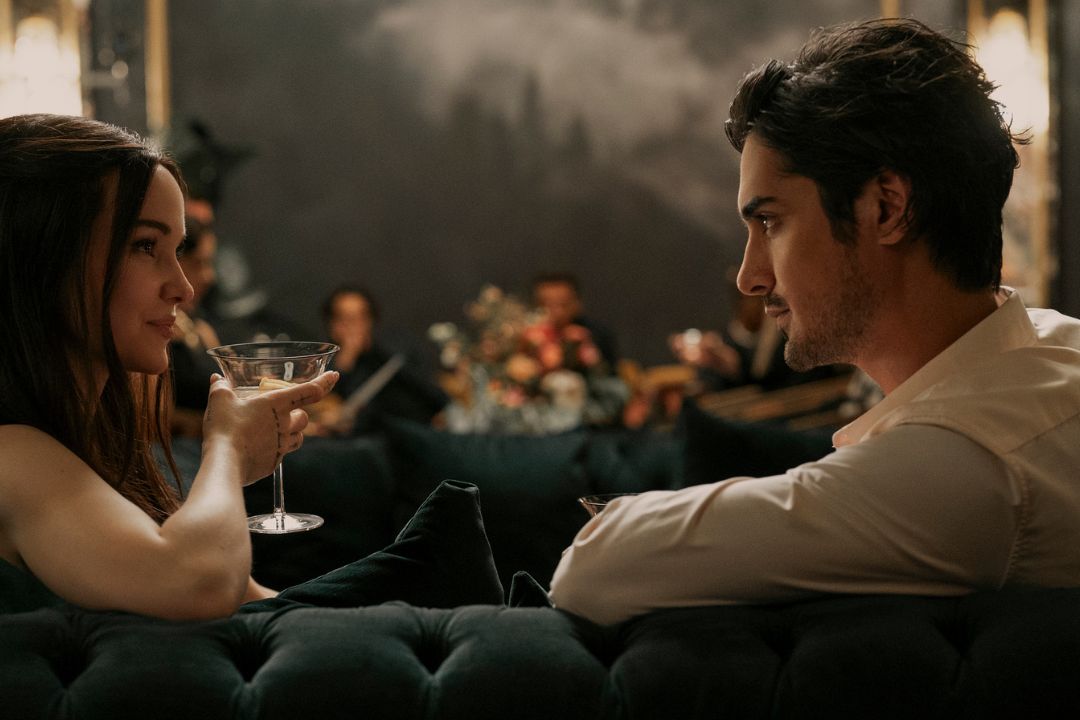
Credits: Philippe Bosse/Prime
Credits: Philippe Bosse/Prime
The final episodes dismantle that illusion piece by piece. As Dan’s past is traced back to Oliver’s high school years, his obsession comes into focus. His ambition to become a clinical psychotherapist, to understand, to control, to shape metastasizes into something corrosive. He is revealed to have a fake PhD, cancelled therapy licenses and a history of lies and deceptions.
In a brutal inversion of crime-thriller logic, the murderer is not the moral monster, and the dead man is not the innocent. Dan’s death is not framed as a tragedy but as a consequence. His end is not an accident of the plot, it is the inevitable collapse of a man who weaponized vulnerability and mistook proximity to pain for moral authority.

This was the man comforting and controlling Oliver all along, who in the last moments of his life, blackmailed his client, Oliver.
Oliver’s undelivered confession in 56 Days, and the sin that never stopped echoing.
Long before Dan Troxler’s interference, Oliver was already imprisoned, not by bars, but by guilt. The origin of that guilt lies in the Narrow River murder, the death of their friend Paul when Oliver and Chase were young, in 2009. Oliver committed the crime. Chase took the fall. Influence, privilege, and silence did the rest.
Years later, that truth festers. It corrodes Oliver’s capacity for peace, intimacy, and self-forgiveness. In one of the show’s most devastating revelations, Oliver writes a letter to Chase in prison, a full confession, unguarded and overdue. The letter never reaches him. Dan intercepts it.
Rather than passing along the truth, Dan does something far crueler. He emotionally manipulates Chase, the brother of Ciara, feeding him fragments of despair, destabilizing what little psychological ground he has left. The result is irreversible. Chase dies by suicide, believing the world has already decided who he is.
This is the moment where the show draws its sharpest ethical line. Oliver committed a crime. But Dan ensured that guilt would never transform into healing. He froze Oliver in punishment, convinced him that suffering was penance, and turned therapy into a closed circuit of shame. When Ciara, later revealed as Megan, uncovers this truth, the series reframes blame itself.
Forgiveness, flight, and the quiet aftermath of survival
The deception at the heart of 56 Days begins the moment Oliver and Megan posing as Ciara meet. Their encounter feels accidental, almost cinematic, but it is anything but that. Megan has rehearsed this meeting long before it happens. Her interest in NASA, astronomy, and cosmic order is a calculated lure, designed to mirror Oliver’s own fascination with systems, distance, and control. She knows what will draw him in. She knows how to speak his language.
Seduction, too, is strategic. Megan understands that Oliver’s emotional fragility is both his armor and his weakness. She softens him deliberately, presenting herself as curiosity incarnate while quietly studying his fractures. The lie about her roof repairs, the gradual move into his apartment, the seamless merging of lives, all of it is staged.
We even see her rehearsing in the mirror, practicing vulnerability, perfecting Ciara as a performance meant to survive scrutiny.Yet Oliver is lying as well. About his past. About Narrow River. About the weight he carries and the violence he has already committed. The series refuses to offer easy absolution. Viewers are allowed into Oliver’s pain, but empathy does not erase culpability.
In exploiting Oliver’s vulnerabilities, she begins to recognize his humanity. By the end, it is Ciara/Megan who articulates the show’s moral reckoning. Yes, Oliver killed Paul. Yes, her brother, mother, older sister Shyla paid the ultimate price. But what she sees, finally, clearly is a man who has been punishing himself every day since, incapable of moving forward because the very person meant to help him ensured he never would.
What destroyed Oliver’s chance at redemption was not guilt alone, but intervention masquerading as care. And somewhere between two liars pretending to be honest, the truth becomes impossible to untangle. Together, they leave Boston in a private jet, severing themselves from the geography of their trauma. Oliver gives Megan the choice of destination, and the series withholds it from us, understanding that healing does not need coordinates.
ADVERTISEMENT
Article continues below this ad
The final image is not of confession or judgment, but of continuation. On a beach far from the past, they are seen with a baby boy, named Chase. Not as erasure, but as remembrance. Not as forgiveness rewritten, but as grief acknowledged without being obeyed.
As for who ultimately bears the blame for Dan Troxler’s death, the series demands a watch to tidy that answer clearly. And that, perhaps, is the point. 56 Days ends not by telling us who to condemn, but by asking whether survival itself can be an act of defiance.

Where Can You Stream 'How to Train You Dragon' Live-Action Movie? Apple TV, Netflix or Amazon Prime?
ADVERTISEMENT
Article continues below this ad
What did you make of the ending of 56 Days? Share your thoughts.
ADVERTISEMENT

Edited By: Aliza Siddiqui
ADVERTISEMENT
ADVERTISEMENT
